
10 Feb Freelancing vs Job in Digital Marketing: What Should You Choose in 2026?
If you’re learning digital marketing or planning to enter this field in 2026, one question will eventually stop you in your tracks:
Should I choose freelancing or a full-time job in digital marketing?
There’s no one-size-fits-all answer—but there is a right answer for you.
Digital marketing is unique because it allows both paths to coexist. Some professionals thrive in stable jobs, while others build flexible, high-income freelancing careers. The real challenge is understanding which path aligns with your goals, lifestyle, and mindset.
Let’s break this down clearly and honestly.
Understanding a Digital Marketing Job
A digital marketing job typically means working with a company, startup, or agency in a structured role. You may handle SEO, social media, paid ads, content, analytics, or a mix of responsibilities depending on the organisation.
In 2026, companies value marketers who understand data, platforms, and AI tools—but jobs still offer structure and security.
Benefits of a Digital Marketing Job
A job provides predictable income, fixed working hours, and a stable environment. For beginners, it’s often the fastest way to gain real-world experience, understand processes, and learn teamwork.
You also get access to:
- Mentors and senior guidance
- Paid tools and platforms
- Consistent projects
- Professional credibility
For students or working professionals switching careers, a job can feel like a safer starting point.
Limitations of a Job
The downside is limited freedom. Your income grows slowly, your time is fixed, and creative decisions are often restricted. Growth depends on promotions—not performance alone.
If flexibility, independence, or location freedom matters deeply to you, a job may feel restrictive over time.
Understanding Freelancing in Digital Marketing
Freelancing means offering your digital marketing skills directly to clients—business owners, startups, creators, or agencies—on a project or retainer basis.
In 2026, freelancing is no longer “unstable side work.” It’s a legitimate career path with global demand.
Benefits of Freelancing
Freelancing offers freedom and scalability. You decide:
- Whom you work with
- How much you charge
- When you work
- Where you work from
Your income is linked to skills and results, not years of experience. Skilled freelancers often earn more than salaried marketers in less time.
It’s also ideal for:
- Housewives
- Students
- Career switchers
- Professionals wanting side income
Challenges of Freelancing
Freelancing requires self-discipline. There’s no fixed salary at the start, no manager pushing deadlines, and no guaranteed clients.
You must handle:
- Client acquisition
- Pricing
- Communication
- Consistency
Without proper guidance and skills, freelancing can feel overwhelming initially.
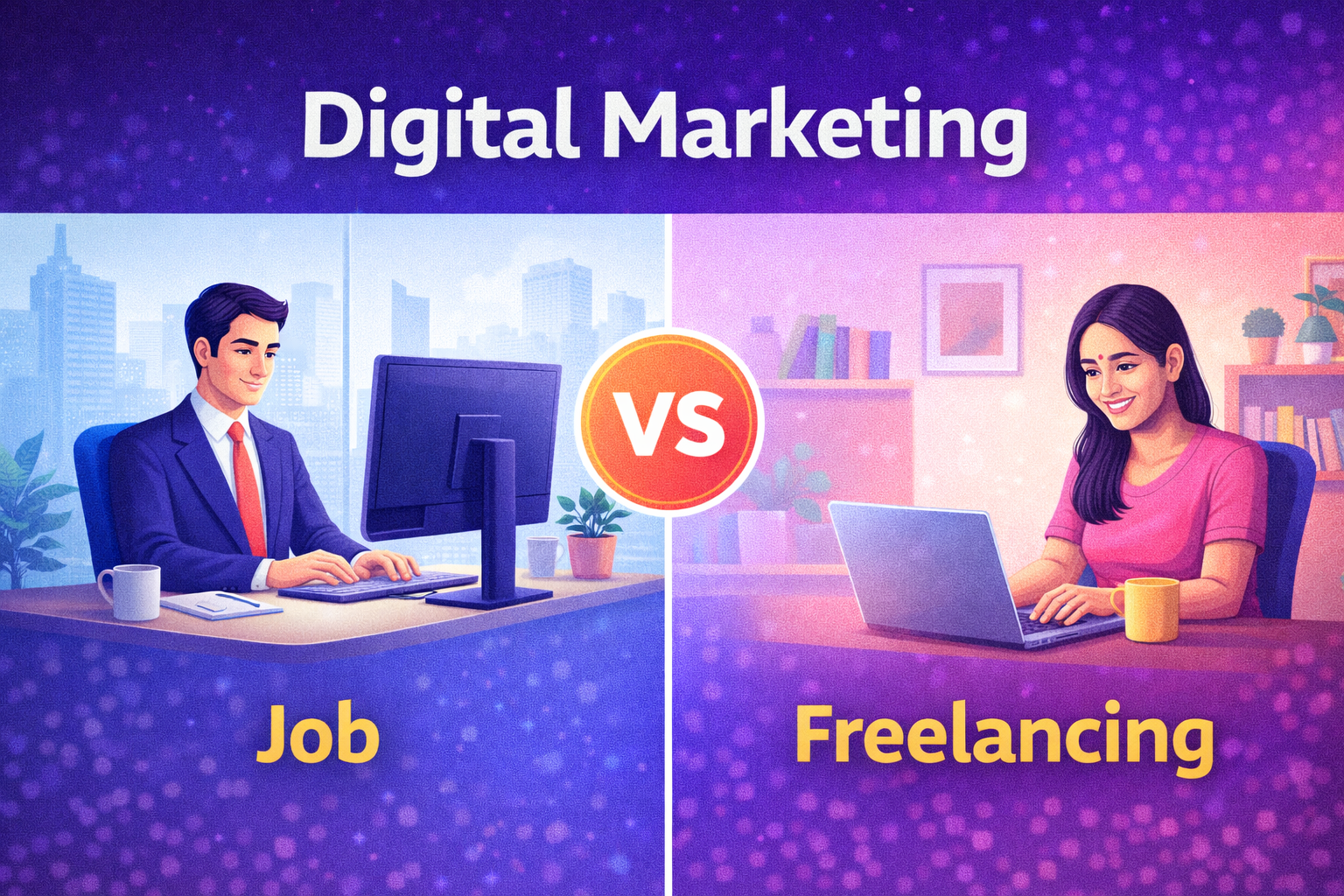
Freelancing vs Job: Key Differences That Matter
The real difference isn’t money—it’s mindset.
A job suits people who prefer structure, steady income, and guided growth. Freelancing suits people who value independence, learning through experimentation, and income flexibility.
In a job, growth is linear.
In freelancing, growth is exponential—but unpredictable at first.
Which Option Is Better for Beginners?
For beginners, learning comes first—not choosing sides.
Many successful digital marketers in 2026 follow a hybrid path:
- Start with a job to gain experience
- Freelance part-time alongside
- Eventually transition fully into freelancing or consulting
This approach reduces risk while building confidence and income streams.
How AI Has Changed Both Paths in 2026
AI has blurred the line between jobs and freelancing.
AI tools now help with:
- Content creation
- SEO research
- Ad optimisation
- Analytics
This means freelancers can deliver high-quality work faster, and job roles now demand strategic thinking over manual execution.
Regardless of the path you choose, AI literacy is no longer optional.
Income Potential: Freelancing vs Job
Jobs offer stability but capped growth.
Freelancing offers uncapped income but requires effort and patience.
In 2026:
- Entry-level jobs pay for time
- Freelancing pays for value
Those who master skills, communication, and results often outgrow job salaries within a few years.
The Question You Should Ask Yourself
Instead of asking “Which pays more?”, ask:
- Do I want flexibility or stability right now?
- Can I handle uncertainty initially?
- Do I enjoy client interaction?
- Am I willing to continuously upskill?
Your honest answers will guide the right choice.
Final Thoughts
There is no “better” option between freelancing and a job in digital marketing.
There is only a better-fit option.
Digital marketing in 2026 allows you to start anywhere and evolve everywhere. You can switch paths, combine both, or create your own model.
What matters most is learning the skill properly.
🎯 Want to Learn Digital Marketing That Works for Both Jobs & Freelancing?
If you want:
- Job-ready skills
- Freelancing confidence
- AI-powered strategies
- Real-world practical learning
👉 Join a future-ready Digital Marketing Course designed for beginners, professionals, and freelancers.
Learn once. Choose your path later—with clarity.
Pingback:Common Digital Marketing Confusion Beginners Face (And the Clarity They Actually Need) - Digital-poonam
Posted at 13:59h, 14 February[…] Confusion #4: “Freelancing or Job?” […]