

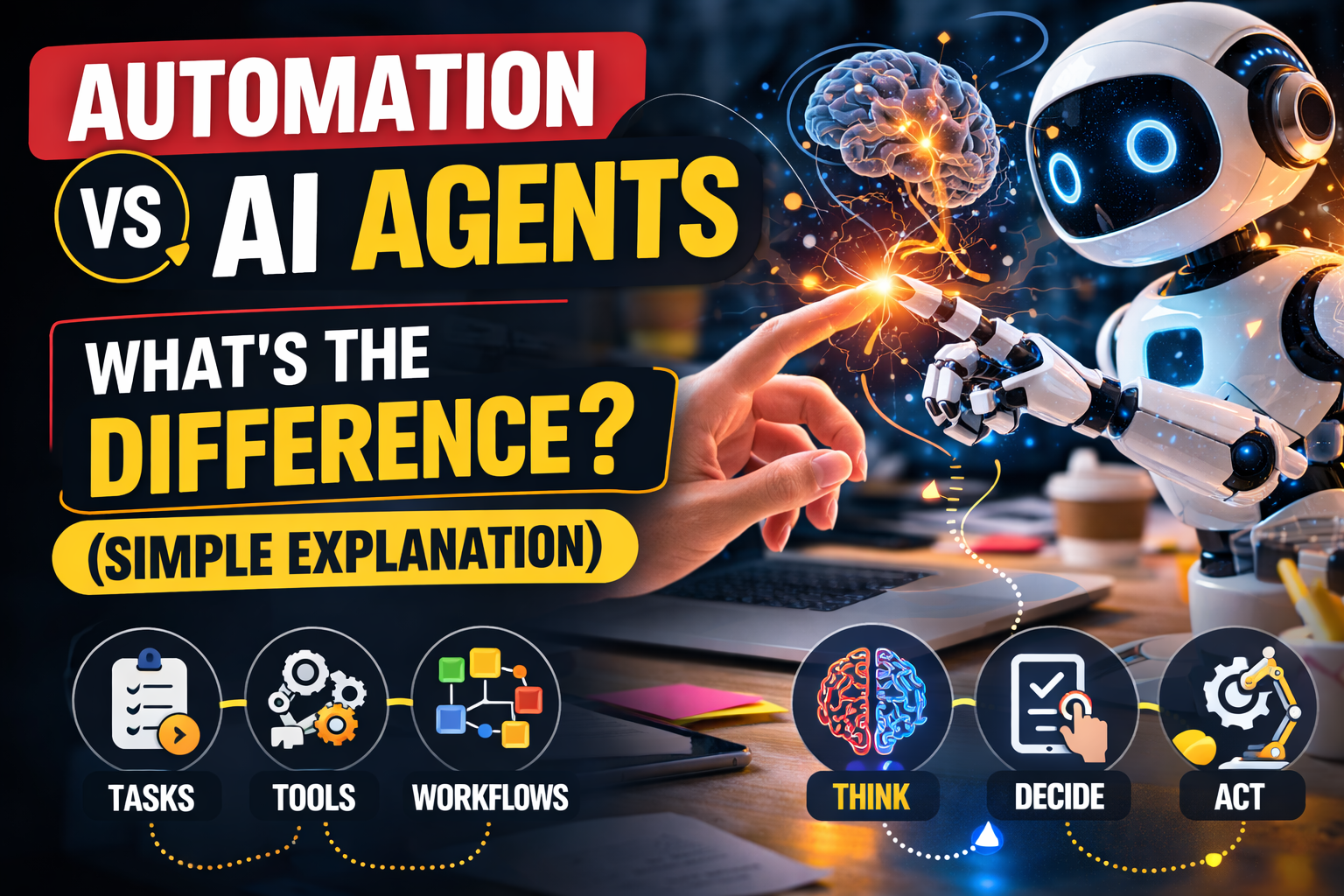
14 Mar Automation vs AI Agents: What’s the Difference? (Simple Explanation)
Imagine you own a small chai stall.
Every morning, you wake up at 5am. Boil milk. Add tea leaves. Strain. Cut onions for samosas. Fry. Serve customers. Take money. Wash utensils. By 11pm, you collapse.
One day, you decide you need help. You have two options.
Option 1: You buy a machine that automatically boils milk at exactly 5am every day. It does the same thing, the same way, forever. If milk spills, it keeps boiling. If you run out of milk, it keeps trying. If you want ginger tea tomorrow instead of regular, too bad—it only does what it was built to do.
That’s automation.
Option 2: You hire a helper. You say, “Run the chai stall. Make sure customers are happy, supplies don’t run out, and we make profit.” The helper figures out when to boil milk, when to buy more supplies, what to make based on what customers want. If something unexpected happens, they handle it. They learn and improve over time.
That’s an AI Agent.
Both help you. Both reduce your work. But they’re fundamentally different. And in 2026, understanding that difference matters more than ever.
Let me explain in plain language—no jargon, no technical nonsense.
The Simple Definition
Let’s start with the simplest way to understand this:
Automation is a machine following fixed rules. If this happens, do that. Every time, exactly the same way.
AI Agent is a digital worker that thinks, decides, and adapts. You give it a goal, it figures out how to achieve it.
Still fuzzy? Let me give you more examples.
Everyday Examples (No Tech Talk)
Example 1: Managing Your Emails
Automation: You set up a rule: “If email subject contains ‘invoice,’ move it to the Invoices folder.” Every invoice email goes there. Even if it’s urgent. Even if it’s from your biggest client. The rule never changes. It works the same way forever.
AI Agent: You say, “Manage my inbox. Flag important emails, draft replies to routine ones, and remind me if something urgent needs attention.” The agent learns what “important” means to you. It notices patterns. If a client starts emailing more often, it flags them as important even without a rule. It adapts.
Example 2: Posting on Social Media
Automation: You schedule 30 posts in Buffer. Every day at 10am, one post goes live. Same time, every day. If a big news breaks, your scheduled post still goes out—even if it’s now irrelevant or insensitive. The machine doesn’t know. It just follows orders.
AI Agent: You say, “Grow our Instagram account.” The agent creates content, decides when to post based on when your audience is active, engages with followers, and adjusts strategy based on what’s working. If something trending happens, it might pause scheduled posts and join the conversation instead. It thinks.
Example 3: Ordering Supplies for Your Business
Automation: You set up: “When inventory of sugar drops below 10kg, order 20kg.” Every time, exactly that. If sugar prices triple, it still orders. If you’re closing for holidays and don’t need sugar, it still orders. The rule is the rule.
AI Agent: You say, “Make sure we never run out of supplies, but don’t waste money.” The agent tracks usage, notices patterns (more sugar on weekends), checks prices, and orders at optimal times. If you’re closing for holidays, it adjusts. If prices are high, it might wait. It optimizes.
See the pattern?
Automation follows instructions. AI Agents understand goals.
The 5 Key Differences (In Plain Language)
Let me break down exactly how they’re different.
1. Rules vs Goals
Automation: You give it rules. “If X happens, do Y.” It’s like giving someone a recipe and saying “follow this exactly.”
AI Agent: You give it a goal. “Make something delicious.” It figures out the recipe, adjusts based on ingredients available, and learns from feedback.
2. Fixed vs Flexible
Automation: Does the same thing every time. Change nothing. Adapt to nothing.
AI Agent: Adapts to new situations. If something unexpected happens, it figures out what to do.
3. No Learning vs Learning
Automation: Never gets better. The 1000th time is exactly like the first time.
AI Agent: Learns from experience. Gets better over time. Notices patterns you might miss.
4. Simple vs Complex
Automation: Good for simple, repetitive tasks. Like a machine that puts caps on bottles all day.
AI Agent: Good for complex tasks that need thinking. Like managing a project with many moving parts.
5. Predictable vs Creative
Automation: You know exactly what will happen. Every time.
AI Agent: Might surprise you. Might find solutions you never thought of. Sometimes that’s good. Sometimes you need to supervise.
When to Use Automation
Automation isn’t bad. It’s perfect for certain things.
Use automation when:
- The task is exactly the same every time
- Nothing unexpected ever happens
- You don’t need decisions, just execution
- Speed matters more than thinking
- You want predictability
Examples where automation shines:
- Sending a welcome email when someone signs up
- Backing up your files every night at 2am
- Posting the same daily report at 9am
- Adding “New Delhi” to every form submission from a Delhi IP address
- Sending an invoice on the 1st of every month
Automation is like a light switch. Flip it, light comes on. Every time. No thinking needed.
When to Use AI Agents
AI Agents are for situations where thinking and adapting matter.
Use AI Agents when:
- The task changes based on circumstances
- You need decisions made
- Learning and improvement matter
- There’s no single “right way” to do it
- You want optimization, not just execution
Examples where AI Agents shine:
- Managing customer service (each customer is different)
- Creating marketing content (what works changes constantly)
- Planning travel (flights, hotels, preferences all vary)
- Researching topics (information changes, sources matter)
- Managing projects (unexpected things always happen)
AI Agents are more like hiring a smart person. They need guidance, but they handle the thinking.
Real Business Example: Digital Marketing
Since you’re interested in digital marketing, let me show how this applies to your field.
Task: Running Facebook Ads
Automation approach: You set rules. “If cost per click goes above ₹20, pause the ad.” “If someone clicks but doesn’t buy in 24 hours, send them an email.” These rules run automatically. They work the same way forever. They don’t notice that ₹20 is fine for some products but expensive for others. They don’t notice that Tuesday audiences behave differently than Sunday audiences.
AI Agent approach: You give the agent a goal. “Generate maximum sales with a budget of ₹1 lakh this month.” The agent creates ads, tests different audiences, adjusts bids based on performance, pauses what’s not working, doubles down on what works. It notices that women over 35 convert better on weekends and adjusts. It sees that video ads work better for one product, image ads for another. It optimizes continuously.
See the difference? Automation follows rules. AI Agents pursue goals.
Task: Content Creation
Automation: You schedule blog posts to publish every Tuesday at 10am. Same time, every week. Even if the post isn’t ready. Even if something more important happened. The schedule is the schedule.
AI Agent: You say, “Build our blog audience.” The agent researches topics your audience cares about, writes drafts, suggests headlines likely to get clicks, schedules posts when readers are most active, promotes old posts that are still relevant, and tracks what’s working.
The Gray Area: Where They Blend
Here’s where it gets interesting. In 2026, the line is blurring.
Smart automation now includes some agent-like features. And agents use automation to execute tasks.
Think of it like this:
Automation is the hands. It does the physical work.
AI Agent is the brain. It decides what the hands should do.
A good system uses both. The agent plans and decides. Automation executes the routine parts.
Example:
You want to send personalized emails to 10,000 customers.
The AI Agent figures out: who should get what message? What offer fits each customer? What tone works for different segments?
Then automation handles: actually sending 10,000 emails, at the right time, to the right addresses, tracking opens and clicks.
The agent strategizes. Automation executes. Together, they’re unstoppable.
Why This Matters for Your Career
You might be thinking: “Okay, interesting. But why should I care?”
Here’s why: the skills needed in digital marketing are shifting.
Basic automation is becoming table stakes. Everyone can set up an email autoresponder. Everyone can schedule social posts. That’s expected.
The real value—the thing that gets you hired and promoted—is knowing how to work with AI Agents.
Companies need people who can:
- Set goals for agents (know what to ask for)
- Guide agents (give feedback, correct mistakes)
- Combine agents with automation (build systems that work)
- Supervise results (know when agents are doing well or badly)
Think of it like managing a team. The manager doesn’t do all the work. They guide the team, set direction, check results. The team executes.
AI Agents are your new team. Learning to manage them is the skill of the future.
Common Confusions (Cleared Up)
Let me address some questions people usually have.
“Isn’t ChatGPT an AI Agent?”
Not really. ChatGPT is smart, but it’s reactive. It waits for you to ask. It doesn’t remember after you close the chat. It can’t take action on its own. It’s more like a very knowledgeable friend you have to keep calling.
An AI Agent would remember your preferences, work on tasks over time, and come to you when needed—not wait for you to come to it.
“Can’t I just use more automation?”
You can. But automation has limits. It can’t handle surprises. It can’t learn. It can’t make judgment calls. For simple, predictable tasks, automation is fine. For anything complex, you need an agent.
“Are AI Agents expensive?”
They’re becoming cheaper fast. Many are included in tools you already use. Basic agents are free. Advanced ones cost money but save more time than they cost.
“Do I need to be technical to use them?”
No. The best agents are designed for normal humans. You talk to them like you’d talk to an assistant. No coding required.
“Will agents replace automation?”
No. They serve different purposes. You’ll still use both. Automation for routine execution. Agents for thinking and adapting.
How to Start Using Both (Without Overwhelm)
If you’re new to all this, here’s a simple path:
Step 1: Master basic automation first.
Learn to schedule posts. Set up email sequences. Create simple rules. Understand what automation can and can’t do. This foundation matters.
Step 2: Identify one task for an agent.
Pick something repetitive but complex. Something that currently takes hours of your thinking time. Research. Content planning. Customer responses.
Step 3: Try a simple agent tool.
Many exist now. Start with something basic. Give it one task. See how it does. Adjust your instructions. Learn how it thinks.
Step 4: Combine them.
Let the agent plan, let automation execute. Build systems where they work together. You’ll get more done with less effort.
Step 5: Keep learning.
This field changes fast. New agents appear constantly. Stay curious. Experiment. The person who learns fastest wins.
What This Means for Your Future
Ten years ago, digital marketers spent hours on manual work. Posting manually. Pulling reports manually. Answering emails one by one.
Today, automation handles much of that.
Five years from now, AI Agents will handle even more—including work that currently needs thinking.
The marketers who thrive won’t be the ones who resist this change. They’ll be the ones who embrace it. Who learn to work with agents. Who use them as force multipliers.
Your job won’t disappear. But it will change. You’ll spend less time doing and more time directing. Less time executing and more time strategizing. Less time on boring tasks and more time on interesting ones.
That sounds like a good trade to me.
Conclusion: Two Tools, One Goal
Automation and AI Agents aren’t enemies. They’re different tools for different jobs.
Automation is your reliable worker. Does exactly what you say, every time, never complains.
AI Agent is your smart manager. Understands goals, figures out how to achieve them, adapts when things change.
Together, they make you unstoppable.
The key is knowing which to use when. Use automation for the predictable. Use agents for the complex. Combine them for magic.
And keep learning. Because this technology isn’t slowing down. Every month brings new capabilities. Every year changes what’s possible.
The future belongs to those who understand these tools and use them well. That future is arriving fast. Make sure you’re ready.
Frequently Asked Questions (FAQs)
1. Can an AI Agent replace automation completely?
No. They serve different purposes. Automation is still better for simple, repetitive tasks that need to happen exactly the same way every time. Agents are better for complex, thinking tasks. You’ll likely use both.
2. How do I know if I need automation or an agent?
Ask yourself: does this task ever change? Does it need decisions? Does it require learning from results? If yes, you probably want an agent. If it’s the same every time with no surprises, automation is fine.
3. Are AI Agents difficult to set up?
Not anymore. The best ones are designed for normal people. You talk to them like you’d talk to an assistant. Some advanced setups might need technical help, but basic agents are user-friendly.
4. Will learning about AI Agents help my career?
Absolutely. Companies are desperate for people who understand these tools. The person who can set up and manage AI Agents is more valuable than the person who can only do manual work. This is one of the fastest-growing skills in marketing.
5. What’s the biggest mistake people make with AI Agents?
Trusting them too much too soon. Agents make mistakes. They misunderstand. They need supervision. Start small, check their work, give feedback. As they learn and you understand their limits, you can trust them with more. But always supervise.
No Comments