
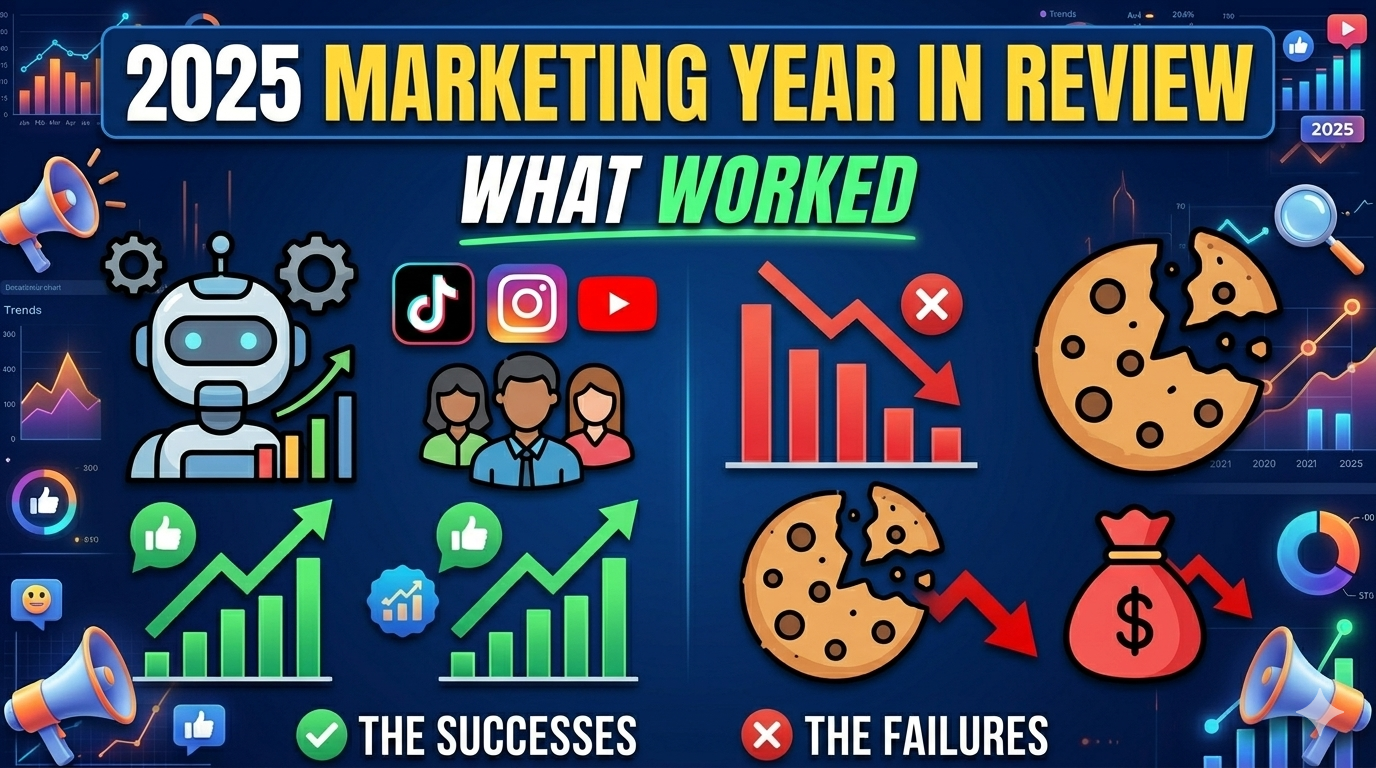
15 Mar 2025 Marketing Year in Review: What Actually Worked (And What Didn’t)
March 2026. We’re three months into the new year. The predictions for 2026 are everywhere. But before we get lost in what’s coming, let’s take one last look back at the year that shaped us.
2025 was weird. Not in a chaotic, “everything changed overnight” way. In a quieter way. The kind of weird where you look around and realize the ground shifted, but so slowly you barely noticed until now.
AI stopped being the shiny new toy and became the boring infrastructure. Platforms stopped trying to be everything and started doubling down on what they’re good at. Users got smarter about spotting BS. And the marketers who won? They weren’t the loudest or the trendiest. They were the most human.
Let’s break down what actually worked in 2025—real results from real businesses—and what quietly died.
The Big Theme of 2025: The AI Hangover
Remember 2023 and 2024? Every week brought a new AI tool that promised to replace half your team. Every LinkedIn post was “how I used ChatGPT to 10x my productivity.” Every brand rushed to slap “AI-powered” on their website.
2025 was the hangover.
People got tired of generic AI content. They got suspicious of “AI-powered” everything. They started asking: “Is this real or did a robot write it?”
The marketers who won in 2025 didn’t abandon AI. They just stopped leading with it. They used it behind the scenes—for research, for drafts, for data crunching—but what they put out into the world felt unmistakably human.
Authenticity became the new premium. Not the performed, “let me be vulnerable for likes” kind. The real kind. The kind you can’t fake.
What Worked in 2025
1. YouTube Long-Form (The Comeback Kid)
For years, everyone chased short-form. Reels. Shorts. TikToks. 15-second attention grabs. And yes, those still worked in 2025. But the surprise winner? Long-form YouTube.
Creators who stuck with 20-40 minute videos saw growth they hadn’t seen since 2020. Why? Because people got tired of the chaos. They wanted depth. They wanted to actually learn something, not just be entertained for 15 seconds before the next dopamine hit.
Channels that did deep dives—on topics, on tutorials, on honest reviews—built communities that actually stuck around. Not just viewers. Fans.
The lesson: Short-form gets views. Long-form builds trust. In 2025, trust was harder to come by and more valuable than ever.
2. Email Newsletters (Yes, Still)
Every year someone declares email dead. Every year email proves them wrong.
2025 was a breakout year for independent newsletters. Substack, Beehiiv, ConvertKit—all grew. But not because of fancy tactics. Because people craved direct connection.
Social media feeds became exhausting. Algorithms decided what you saw. Drama and outrage got promoted. Peaceful, useful content got buried.
Email was the escape hatch. Something in your inbox, from someone you chose, that felt like a conversation instead of a broadcast.
The newsletters that won weren’t the ones with the best subject lines or the fanciest designs. They were the ones that felt like a friend writing to a friend.
3. Niche Communities (Smaller = Stronger)
In 2025, trying to be everything to everyone became a death sentence. The winners were the ones who served a specific group so well that no one else could compete.
Facebook groups for very specific interests. Discord servers for particular professions. WhatsApp communities for local neighborhoods. Paid communities where people actually paid because the value was real.
These weren’t huge. A few thousand members, sometimes just a few hundred. But the engagement? Through the roof. The loyalty? Unshakeable. The business opportunities? Endless.
Because when you serve a niche deeply, they don’t just buy from you. They trust you. They recommend you. They defend you.
4. LinkedIn Text-Only Posts (The Bare Minimum Won)
Here’s something that surprised everyone: in a year of AI-generated everything, plain text posts on LinkedIn outperformed fancy carousels and polished videos.
No images. No links. Just words. Written by a human. With an opinion.
People were starving for real takes. Not the safe, corporate “here are 5 tips” posts. The ones with edge. With personality. With vulnerability. The ones that said something actual humans would say.
Accounts that posted consistently—not daily, just consistently—with real thoughts, not AI-generated fluff, grew faster than they had in years.
5. Google Business Profile (Local SEO Paid Off)
For local businesses, 2025 was the year of Google Business Profile. Not complicated SEO strategies. Not backlinks. Just a complete, active, reviewed profile.
Businesses that posted regularly on GBP—photos, offers, updates—outranked competitors with fancier websites. Businesses that actively asked for and responded to reviews dominated local search.
The algorithm finally rewarded the basics done well.
6. Podcasts (The Slow Burn)
Podcasting didn’t explode in 2025. It just kept growing, quietly, steadily. More listeners. More time spent. More trust built.
What changed? Discovery got better. Spotify and Apple started recommending shows to the right people, not just the popular ones. Small podcasts found their audience without needing a million downloads.
And podcast ads—real ones, read by hosts, not prerecorded spots—performed better than any other ad format. Because podcast hosts have something social media influencers lost: genuine trust.
7. Reddit (The Underrated Goldmine)
While everyone fought for attention on Instagram and TikTok, smart marketers were quietly winning on Reddit.
Not by spamming links. By actually being useful. Answering questions. Sharing expertise. Being a real person in a real community.
When you help someone on Reddit, they don’t just click your link. They remember your username. They trust you. They become customers who already like you before they ever visit your website.
What Didn’t Work in 2025
Let’s be honest about the failures too.
1. Generic AI Content (Finally Died)
For a while, you could publish ChatGPT-generated blog posts and rank. Those days are over.
Google got better at detecting AI content. But more importantly, readers got better at detecting it. Generic, bland, nothing-new content got ignored. Bounce rates went up. Time-on-page went down. Rankings followed.
The sites that survived? The ones that used AI for drafts but added real human expertise, real examples, real personality.
2. TikTok Shop (Fizzled)
Remember when everyone said TikTok Shop would kill Amazon? Yeah, about that.
It worked for some. Mostly dropshippers and impulse-buy products. But for real brands building real businesses? Disappointing.
People came to TikTok for entertainment, not shopping. The friction of buying felt wrong in a feed built for scrolling. Conversion rates never matched the hype.
3. Instagram Reels (Oversaturated)
Reels still worked in 2025. But the bar got impossibly high.
Every brand was making Reels. Every creator was chasing trends. The feed became a wall of people dancing, pointing at text, and using the same audio.
To stand out, you needed either insane production value or genuine originality. The middle ground—just making a Reel because you “should”—got zero views.
4. Twitter/X (Faded Further)
Love it or hate it, Twitter/X became less relevant for most marketers in 2025. The chaos, the changes, the exodus of users—it all added up.
Some niches still thrived (tech, crypto, politics). But for the average business trying to reach average customers? The return on effort kept dropping.
5. Metaverse Marketing (Quietly Disappeared)
Remember when every brand was rushing to build something in the metaverse? In 2025, most of those projects were quietly shut down.
People still don’t want to hang out in virtual spaces wearing headsets. The technology isn’t there. The audience isn’t there. The ROI definitely isn’t there.
A few gaming platforms (Roblox, Fortnite) still have brand presence. But the broader “metaverse” marketing category? Dead.
The Surprises of 2025
1. Print Made a Comeback (Seriously)
Small brands started doing print magazines. Not as a replacement for digital. As a complement.
A physical thing you could hold. Something that arrived in the mail and felt special. No notifications. No algorithms. Just content, on paper, that you chose to receive.
It worked because it was the opposite of everything digital. And in a world of infinite digital noise, physical silence stood out.
2. WhatsApp Became a Marketing Channel
In India and other markets, WhatsApp Business exploded. Not for broadcasting spam—for real conversations.
Customers could message a business like they’d message a friend. Get answers fast. Place orders. Ask questions. The businesses that treated WhatsApp as a relationship channel, not a broadcast channel, won.
3. “Boring” Industries Outperformed Hype Industries
Manufacturing companies. Industrial suppliers. B2B service providers. The “boring” businesses quietly had their best marketing year ever.
While everyone fought for attention in crowded B2C spaces, these companies built SEO authority, created helpful content, and became the go-to resources in their niches. No glamour. Just results.
The Stats That Tell the Story
Let me share some numbers that caught my attention this year:
- YouTube watch time for videos over 20 minutes increased 37% compared to 2024
- Email open rates held steady at 21% while social media engagement dropped across most platforms
- Google Business Profile posts with photos got 42% more clicks than those without
- Reddit referral traffic to niche B2B sites increased 63%
- AI-detected content saw 58% lower time-on-page than human-written content
- WhatsApp Business active users crossed 200 million in India alone
- Podcast ad spend grew 22% while social media ad spend grew only 4%
What We Learned (The Takeaways)
Looking back at 2025, a few clear lessons emerge:
1. Humans beat AI where it counts.
AI can generate. It can’t connect. The brands that felt human—real personality, real opinions, real care—won. The ones that felt like content factories lost.
2. Depth beats volume.
Posting every day didn’t matter. Posting something worth reading did. One great piece performed better than 20 mediocre ones. Long-form came back because people wanted more than surface-level takes.
3. Direct connection is the new luxury.
Email, WhatsApp, podcasts, communities—channels where you reach people directly, without algorithms in between—became more valuable. People are tired of feeds deciding what they see.
4. Niche is the new mass.
Serving everyone meant serving no one. The businesses that picked a specific audience and served them deeply built loyalty that broad competitors couldn’t touch.
5. The basics still work.
Good writing. Real help. Consistent presence. Listening to customers. The fundamentals never went out of style. They just got drowned out by noise. In 2025, the noise got tuned out and the fundamentals shone through.
What This Means for 2026
We’re already in March 2026. The year is moving fast. But the lessons from 2025 are still relevant:
Double down on human connection. Create things that couldn’t exist without you. Build channels you own, not ones you rent. Serve a specific group so well that no one else can compete.
The tools will keep changing. The platforms will keep shifting. But people will always want the same thing: to feel seen, understood, and helped by someone real.
Be that someone. That worked in 2025. It’ll work in 2026. It’ll work forever.
Frequently Asked Questions (FAQs)
1. What was the biggest marketing trend of 2025?
The biggest trend wasn’t a platform or tactic—it was the return to human authenticity. After years of AI hype and generic content, audiences started rewarding brands that felt genuinely human. Real opinions, real voices, real connection outperformed polished, generic content across every channel.
2. Did AI kill any marketing jobs in 2025?
AI didn’t kill jobs—it killed boring tasks. Content writers who only produced generic blog posts struggled. But writers who brought real expertise, original thinking, and authentic voice thrived. The pattern held across roles: AI replaced execution, not thinking. Marketers who thought strategically and used AI as a tool did better than ever.
3. Which social media platform grew the most in 2025?
No single platform exploded in 2025. Growth was more about depth than breadth. YouTube (especially long-form) and LinkedIn (especially text posts) saw strong engagement gains. WhatsApp Business grew significantly as a marketing channel, especially in markets like India.
4. Is short-form video dead?
Not dead, but oversaturated. Reels and Shorts still work, but the bar is higher than ever. You need either exceptional production value or genuine originality to stand out. The days of grabbing views with low-effort trend-following are over.
5. What’s the one thing marketers should carry from 2025 into 2026?
Build channels you own. Email lists, WhatsApp communities, podcasts, your own website—anything where you reach people directly without an algorithm deciding who sees you. Social media is rented land. The landlords keep changing the rules. Own your audience, and you’ll never have to panic when the next platform shift happens.
No Comments