
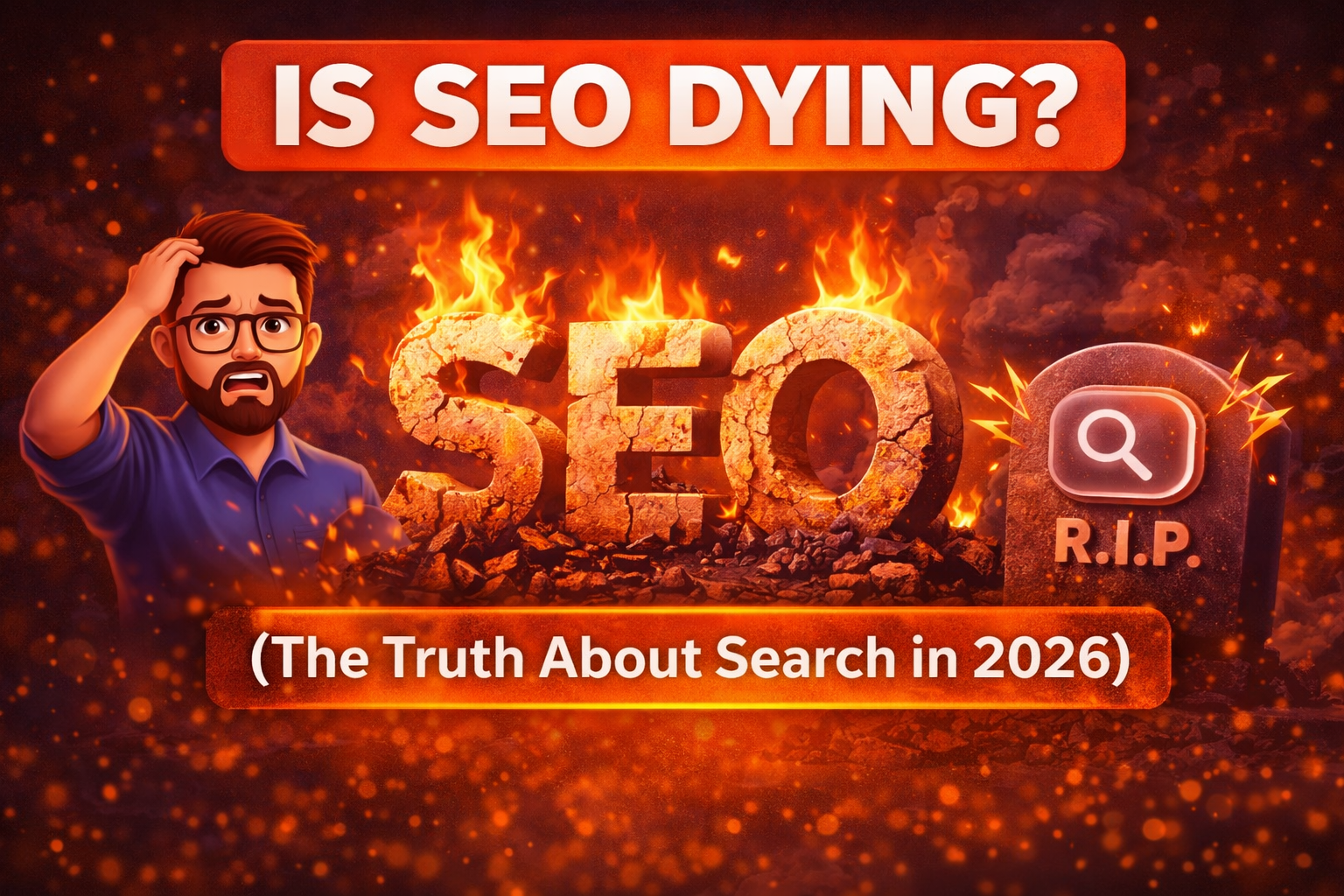
20 Mar Is SEO Dying? (The Truth About Search in 2026)
Every year, someone declares SEO dead.
2012: “Google’s algorithm update killed SEO!” 2016: “Voice search will destroy traditional SEO!” 2020: “Zero-click searches are the end!” 2023: “AI is coming for Google!” 2025: “ChatGPT replaced search!”
And every year, SEO practitioners keep working, keep ranking, keep getting traffic. The obituaries keep getting written. The patient keeps breathing.
So what’s actually happening in 2026? Is SEO finally dying? Or is it just… changing?
Let’s look at the truth. Not the hype. Not the fear. Just what’s actually happening in search right now.
The Short Answer: No, SEO Is Not Dying
Let’s get this out of the way early.
SEO is not dying. It’s evolving. Like it always has. Like it always will.
In 2026, organic search still drives more website traffic than any other channel. Google still processes billions of searches daily. Businesses still compete for those searches. The ones who understand modern SEO win. The ones who cling to 2015 tactics lose.
But here’s the nuance: what worked in 2015 is dead. What worked in 2020 is fading. What works in 2026 looks different.
So if your definition of SEO is “stuff keywords, build spam links, rank fast”—yes, that SEO is dead. It died years ago. Good riddance.
If your definition of SEO is “help people find answers to their questions, be the most useful result, build genuine authority”—that SEO is more alive than ever.
Let’s dig into what’s actually changing.
What’s Actually Happening to Search in 2026
Before we talk about SEO’s future, understand the present. Search is not what it was five years ago.
AI Overviews are real now. Google’s AI-generated answers sit at the top of many search results. For informational queries, users often get their answer without clicking. “Zero-click searches” are common.
Search is everywhere, not just Google. People search on TikTok (for recommendations), on YouTube (for tutorials), on Amazon (for products), on Reddit (for honest opinions), on ChatGPT (for answers). SEO now means optimizing for all of these.
E-E-A-T matters more than ever. Google’s algorithm prioritizes Experience, Expertise, Authoritativeness, and Trustworthiness. Content from real experts outperforms generic content.
User experience is ranking factor. Core Web Vitals, mobile usability, page speed—they all matter. A technically good website ranks better.
Content quality wins. Thin content dies. Deep, useful, well-researched content thrives. AI can generate text, but it can’t generate genuine expertise.
So yes, SEO has changed. But it hasn’t died. Let’s talk about what works now.
What Works in SEO in 2026
Let me tell you what actually moves the needle today.
1. Genuine Expertise
Google can tell if you know what you’re talking about. Not just keywords. Not just word count. Real knowledge. Experience. Authority. Content written by people who actually understand the topic—not just research it—ranks higher.
Action: Write about what you actually know. Show your credentials. Share real experiences. Use case studies. Be the expert, not just a writer.
2. Helpful Content, Not Keyword-Stuffed Content
The “helpful content update” from a few years ago is now fully integrated. Content designed to help users—not manipulate rankings—wins. Content designed to rank loses.
Action: Before you write, ask: “Is this actually helping someone? Or am I just trying to rank?” If it’s the latter, don’t write it.
3. Topical Authority (Not Just Individual Posts)
Google doesn’t just look at one page anymore. It looks at your entire site. Does your site cover a topic comprehensively? Do you have 50 posts on digital marketing or just one? The site with depth wins.
Action: Build content clusters. Pillar page + supporting posts. Cover topics completely, not just one-off.
4. Real Links (Not Bought Ones)
Paid links still work temporarily. But they get caught. Natural links from real sites—earned through great content, not bought—are the only sustainable strategy.
Action: Create link-worthy content. Original research. Data studies. Ultimate guides. Tools. Resources people actually want to link to.
5. Search Everywhere Optimization
Optimize for Google? Yes. But also for YouTube, Amazon, TikTok, Reddit, ChatGPT. People search in many places. Be found in all.
Action: Repurpose content. Blog becomes video becomes social post becomes Reddit answer. Same knowledge, multiple platforms.
6. Optimize for AI Overviews
Google’s AI answers pull from top-ranking pages. You don’t need to stop people from clicking. You need to be the source the AI trusts.
Action: Answer questions clearly. Use structured data. Write clearly. Be the authority. When AI pulls answers, it should pull yours.
7. Brand Searches
People searching for your brand name is the ultimate SEO signal. It tells Google you’re real. You’re trusted. You’re important.
Action: Build a brand people search for. Off-SEO marketing—social, PR, word-of-mouth—feeds SEO. The two are connected.
8. User Experience (Technical SEO)
Fast loading. Mobile friendly. Easy to navigate. These are not optional. They’re ranking factors.
Action: Test your site. Fix page speed. Make mobile perfect. Simplify navigation. Users (and Google) reward good experience.
What No Longer Works in SEO
Let’s bury the tactics that are truly dead.
1. Keyword Stuffing
Repeating “best digital marketing course” 50 times in a post doesn’t work. It hurts. Google sees it as spam. Users hate it. Stop.
2. Low-Quality Link Building
Buying 500 links from Fiverr? Dead. PBNs? Caught and penalized. Link schemes? Risk your entire site.
3. Thin Content
300-word blog posts with no value? Dead. Pages that answer nothing? Gone. Content without depth doesn’t rank.
4. Clickbait Titles
Promising something and not delivering? Google’s algorithms detect high bounce rates. If users leave fast, you drop.
5. Ignoring Mobile
In 2026, mobile-first indexing is standard. If your site isn’t perfect on mobile, you don’t rank.
6. AI-Generated Content (Without Human Touch)
Pure AI content—no editing, no expertise, no personality—is being detected and demoted. Google wants human experience behind content.
7. Chasing Every Algorithm Update
Reacting to every update with panic changes? Bad strategy. Build fundamentals. Updates will come. Solid sites survive.
What About AI? Is ChatGPT Killing Search?
This is the fear everyone talks about. Let’s address it directly.
People are using ChatGPT for answers. Yes. Some searches that used to go to Google now go to AI. That’s real.
But here’s what’s also real: people still need trustworthy sources. AI can generate answers, but it can’t guarantee accuracy. It makes mistakes. It invents facts. It doesn’t have lived experience.
When someone needs an authoritative answer—medical advice, legal guidance, product recommendations—they often check multiple sources. They Google after ChatGPT. They verify. They cross-reference.
SEO now means optimizing for AI too. How? By being the source AI trusts. When ChatGPT cites sources, it pulls from authoritative sites. Be that site. Be the source. Be the authority.
AI is not killing search. It’s changing how people search. SEO is adapting. Again.
What “SEO” Means in 2026
If the old definition of SEO was “optimizing for search engines,” the new definition is “optimizing for how people find information.”
That includes:
- Google (still the biggest)
- YouTube (the second largest search engine)
- Amazon (where people search for products)
- TikTok (where younger generations search)
- Reddit (where people seek honest opinions)
- ChatGPT and AI tools (where people ask questions)
- Voice search (on phones, speakers, cars)
- Social platforms (each with their own search)
SEO is no longer one thing. It’s the discipline of being findable wherever people look. The tactics vary by platform. The principle is the same: be helpful, be authoritative, be there.
Why SEO Practitioners Are Still in Demand
If SEO were dying, jobs would be disappearing. They’re not.
In 2026, skilled SEO professionals are more valuable than ever. Why?
Because organic traffic is still the highest-quality traffic. Paid traffic costs money. Organic traffic is free (once you rank). Businesses will always want free, high-intent visitors.
Because competition is fierce. Everyone knows SEO matters. The businesses that do it well win. The ones that don’t, lose. That creates demand for expertise.
Because search is complex. Google’s algorithm has hundreds of factors. AI overviews, user experience, topical authority, E-E-A-T—it’s a lot. Businesses need specialists who understand it.
The SEO that’s dying is the SEO of 2010. Shady tactics. Keyword stuffing. Link schemes. That’s gone. Good riddance.
The SEO that’s thriving is strategic. It’s integrated with content, PR, UX, and brand building. It’s about being genuinely useful, not gaming algorithms.
What Successful SEO Looks Like Today
Let me paint you a picture of modern SEO done right.
A small business owner starts a blog about their industry. They don’t write generic posts. They share real experiences. Case studies from actual clients. Data from their own business. Solutions to problems they’ve actually solved.
They answer questions in their niche. On their blog, on Quora, on Reddit. Not to spam links. To genuinely help. People notice. They become known as an expert.
Other sites link to their content naturally because it’s useful. Their site loads fast. It works perfectly on mobile. Google sees the authority. The rankings come.
When Google’s AI pulls answers for queries in their niche, it pulls from their content. When people ask ChatGPT about their industry, it cites their site. They’re the authority now.
They also create YouTube videos explaining concepts. Those videos rank in Google and YouTube search. They create TikTok content. It gets found by younger audiences. They’re everywhere their audience searches.
This is modern SEO. It’s not about algorithms. It’s about being so genuinely helpful that platforms can’t ignore you.
The Future: SEO in 2027 and Beyond
Predicting is dangerous. But here’s what seems likely:
AI integration deepens. Search engines will use more AI. AI tools will get better. SEO will involve optimizing for both.
Authority matters more. With AI-generated content everywhere, platforms will prioritize genuine expertise. Real experience becomes premium.
Brand becomes SEO. The line between SEO and brand marketing blurs. People searching for your brand name is the strongest signal. Build the brand, build the SEO.
Search diversifies. Google’s share will shrink (slowly). Other platforms will grow. SEO becomes multi-platform discipline.
User experience is non-negotiable. Technical SEO becomes standard. No one ranks without great UX.
Content depth wins. Thin content disappears. Comprehensive, authoritative content rules.
SEO isn’t dying. It’s becoming more integrated, more strategic, more demanding. The bar is higher. So is the reward.
Conclusion: SEO Is Changing. It’s Not Dying.
If you’ve been doing SEO since 2010, yes, the job looks completely different. The tactics you learned are obsolete. The tools have changed. The goals have expanded.
But if you’re starting today, SEO is more exciting than ever. It’s not just about Google anymore. It’s about being found everywhere. It’s about genuinely helping people. It’s about building authority that AI recognizes.
The core hasn’t changed: understand what people need, provide the best answer, make it easy to find.
That worked in 2000. It works in 2026. It’ll work in 2030.
SEO isn’t dying. It’s growing up.
Frequently Asked Questions (FAQs)
1. Is Google still important for SEO in 2026?
Yes. Google still dominates search, especially for commercial and informational queries. But it’s not the only game. A modern SEO strategy includes YouTube, Amazon, Reddit, TikTok, and AI platforms. Don’t abandon Google—just don’t put all your eggs in one basket.
2. Will AI replace SEO professionals?
No. AI will replace SEO tasks—keyword research, content generation, technical audits. But strategy? Understanding audience? Building authority? Creating genuine expertise? That’s human. SEO professionals who use AI as a tool will thrive. Those who only do execution work will struggle.
3. How do I optimize for AI overviews?
Be the best answer. Create clear, authoritative content that directly answers questions. Use structured data. Write simply. Build your authority in your niche. When Google’s AI pulls answers, it pulls from trusted sources. Be a trusted source.
4. Is link building still important?
Yes, but not the old way. Spammy links don’t work. Natural links from authoritative sites—earned through great content, original research, genuine relationships—still matter. Focus on being link-worthy, not link-building.
5. Should I still invest in SEO or switch to paid ads?
Both. SEO is a long-term investment that pays over years. Paid ads give immediate results. The smart strategy is both: SEO for sustainable traffic, paid ads for immediate visibility and testing. Don’t abandon either. Balance them.
No Comments