
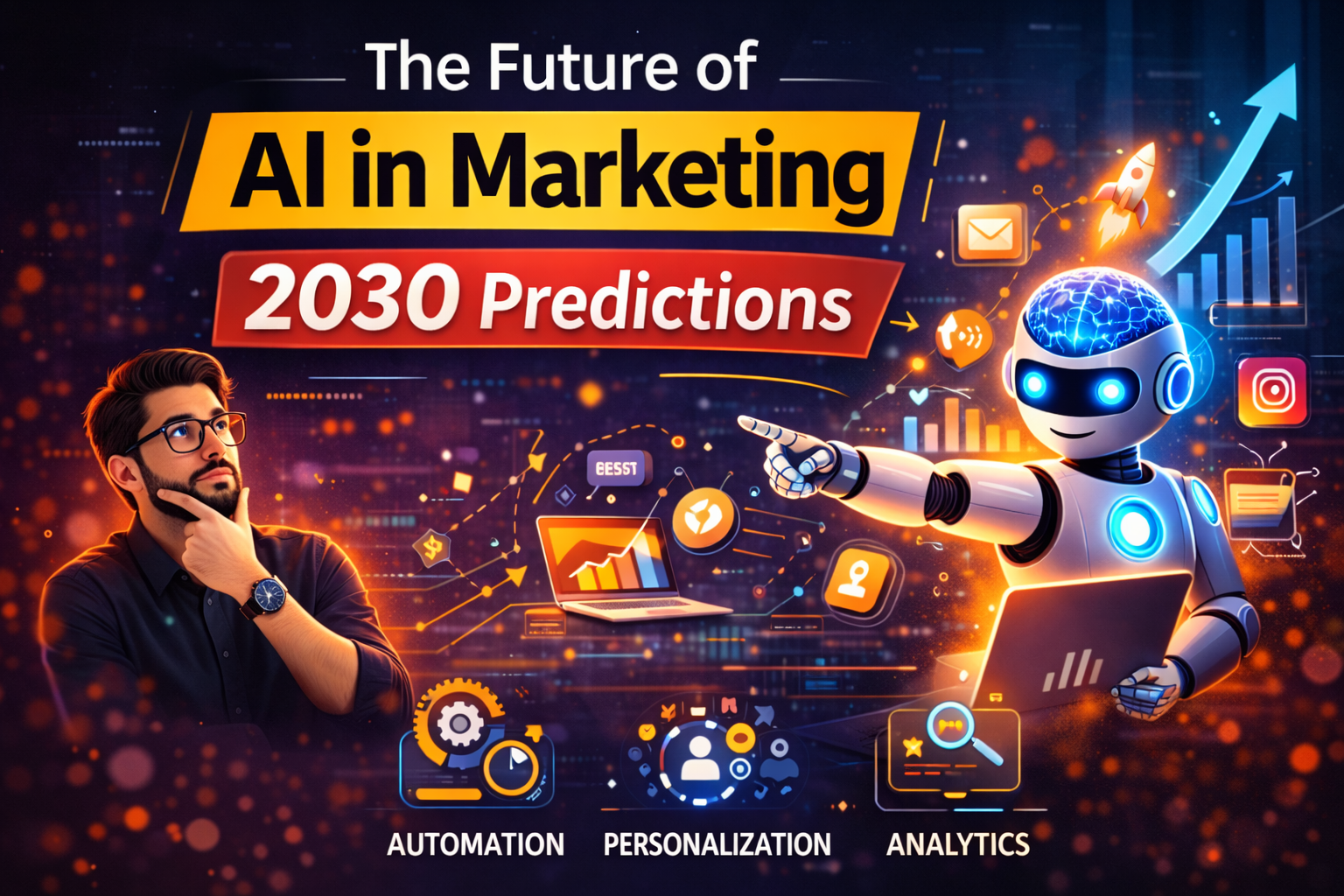
21 Mar The Future of AI in Marketing: 2030 Predictions
Let’s play a game.
Imagine it’s 2030. You wake up. Your AI agent has already reviewed your calendar, prioritized your emails, drafted responses to three client queries, and scheduled your social media for the week. It flags one urgent issue: a campaign is underperforming. By the time you finish your chai, it’s already tested three new ad variations and found one that’s converting 40% better.
You approve. You move to strategic work. The execution happens without you.
This isn’t science fiction. This is where we’re heading. And 2030 is closer than you think.
We’re in 2026. Four years to 2030. In tech terms, that’s an eternity. The AI tools we use today will look ancient. The platforms we rely on may be irrelevant. The skills we need will be completely different.
So what’s coming? Let me walk you through what marketing will look like in 2030—based on where we are now, the trends already visible, and the trajectory of AI development.
Some of this will excite you. Some might scare you. All of it will help you prepare.
Prediction 1: AI Agents Will Do the Work, Humans Will Do the Thinking
This is the biggest shift. And it’s already starting.
Today, you use AI tools. You open ChatGPT, type a prompt, get a response. You open Canva, use Magic Design, get a graphic. You open an ad platform, set up a campaign, let it optimize.
By 2030, you won’t “use” tools. You’ll manage agents.
An agent isn’t a tool you open. It’s a digital worker you assign. You give it a goal. It figures out the steps. It uses the tools. It executes. It reports back. You supervise, strategize, and make high-level decisions.
What this means: Your job shifts from doing to directing. The marketer of 2030 doesn’t write ads—they tell an agent the goal, the audience, the brand voice, and the agent writes, tests, and optimizes. The human provides strategy, judgment, and creativity that AI can’t replicate.
Who thrives: Strategic thinkers. People who understand business goals, audience psychology, and brand identity. People who can manage digital teams as well as human ones.
Who struggles: Execution-focused roles. If your main value is writing captions, scheduling posts, or pulling reports, agents will do it faster and cheaper.
Prediction 2: Personalized Experiences at Scale (Hyper-Personalization)
Today’s personalization is basic. “Hi [Name]” in an email. A recommendation based on what you bought. That’s level 1.
By 2030, personalization will be so deep it will feel like magic.
Imagine: You visit a website. The AI knows your industry, your role, your company size, your past interactions, your preferences. It doesn’t show you a generic homepage. It shows you a page built for you. The images, the copy, the offers, the case studies—all tailored to what would convince you specifically.
An email you receive isn’t one of five variants in an A/B test. It’s generated uniquely for you, referencing your specific interests, your last interaction, even your current mood based on how you’ve engaged recently.
What this means: Generic marketing dies. Everything becomes personalized. The brands that win will be those that can use data to create individual experiences without feeling creepy.
The challenge: Privacy. People will demand transparency. They’ll trade data for value, but only if they trust you. The line between “helpful” and “creepy” will define winners and losers.
Prediction 3: Content Creation Is Instant—Humanity Is the Differentiator
By 2030, generating content will be instant. Need a blog post? 2 seconds. A video script? 5 seconds. A full ad campaign with visuals, copy, and targeting? 30 seconds.
AI will produce unlimited content. And that creates a new problem: sameness.
If every brand can generate endless content, how do you stand out? The answer: humanity.
The brands that win will be those with a real voice. Real opinions. Real experiences. Real flaws. Content that couldn’t have been generated by AI because it’s too specific, too personal, too human.
What this means: Content quantity becomes meaningless. Quality means uniqueness. The ability to express genuine human perspective becomes the only sustainable advantage.
Who thrives: Storytellers. People with unique experiences. Brands with genuine personalities. The weird, the specific, the real.
Who struggles: Brands that play it safe. Generic content. Corporate voice. The middle ground disappears.
Prediction 4: Search Is Everywhere and Nowhere
Today, we say “Google it.” By 2030, that phrase will sound ancient.
Search will be embedded everywhere. You’ll ask your phone, your car, your glasses. You’ll ask in voice, in text, by pointing your camera at something. Answers will come from multiple sources—AI models, specialized search engines, peer networks, brand content.
But here’s the twist: there may be no “search results page” as we know it. Instead, you’ll get one answer. The AI will synthesize information from multiple sources and give you what you need. No blue links. No scrolling through ten options. Just an answer.
What this means: Being “the answer” matters more than ranking #1. If AI synthesizes answers, you want to be the source AI trusts. Authority becomes everything.
Strategy: Build genuine expertise. Be cited by authoritative sources. Create content so good that AI models pull from you. Traditional SEO tactics fade; authority building dominates.
Prediction 5: Video and Voice Dominate
Text isn’t dying. But video and voice are growing faster.
By 2030, voice search will be default for many queries. “Hey AI, find me a plumber.” “What’s the best laptop under ₹80,000?” “Read me today’s marketing news.”
Video will be everywhere. AI-generated video will be indistinguishable from real footage. Brands will create personalized video messages at scale. A thank-you video for every customer. A product demo tailored to each prospect.
What this means: Marketers need to think beyond text. Voice optimization becomes essential. Video skills become baseline, not special. AI video tools will do the heavy lifting, but humans still need to guide the story.
Prediction 6: Real-Time, Always-On Campaigns
Today, we plan campaigns. We set budgets. We launch. We monitor. We adjust. It’s a cycle.
By 2030, campaigns will be always-on, self-optimizing, and real-time. AI agents will monitor performance 24/7. They’ll test creative, shift budgets, target new audiences—all without human intervention.
You won’t “launch a campaign.” You’ll set a goal and let agents pursue it continuously. They’ll respond to trends, news, competitor moves, audience behavior—in seconds, not days.
What this means: Marketers become strategists, not campaign managers. You set objectives, define constraints, monitor performance. The execution is autonomous. Your value is knowing what to optimize for, not how to optimize.
Prediction 7: First-Party Data Is the New Oil
Third-party cookies are already gone. By 2030, all tracking that users don’t explicitly consent to will be obsolete.
The winners will be brands that own direct relationships. Email lists. WhatsApp communities. App users. Loyalty program members. Customers who chose to connect with you.
What this means: Building first-party data is priority #1. If you don’t own your audience, you rent it. And rent keeps rising.
Strategy: Start now. Build email lists. Create communities. Develop loyalty programs. Give people reasons to connect directly. The brands with deep first-party data will have massive advantage.
Prediction 8: AI Ethics and Transparency Become Competitive Advantages
By 2030, AI will be everywhere. And people will be wary.
Consumers will demand transparency. Is this AI-generated? How is my data used? Who makes decisions about what I see? Brands that are honest will win. Brands that hide AI use will be punished.
What this means: Ethics isn’t just compliance. It’s differentiation. Brands that are transparent about AI use, that protect privacy, that let users control their experience—these will earn trust.
Who thrives: Brands that lead with transparency. That say “this ad was generated with AI, but reviewed by a human.” That let users opt in, not opt out. That treat data as a trust exchange, not a resource to extract.
Prediction 9: Marketing and Technology Merge Completely
Today, we have marketing teams and tech teams. They work together, but they’re separate.
By 2030, that separation disappears. Every marketer will be technical. Not necessarily coding, but understanding AI agents, data flows, automation, and platforms deeply.
And every technologist will understand marketing. Not just building tools, but business goals, customer psychology, brand building.
What this means: The “marketing technologist” isn’t a niche role anymore. It’s every marketer. The CMO and CTO may be the same person. Hybrid skills become baseline.
Prediction 10: Small Businesses Will Compete with Giants (For Real)
Here’s the most exciting prediction.
AI levels the playing field. A solo entrepreneur in 2030 with AI agents can do what a 50-person marketing team does today. Content, ads, personalization, analytics—all handled by digital workers.
The advantages of scale—big teams, big budgets—will shrink. Creativity, speed, and genuine connection will matter more.
What this means: The next decade will see a wave of solo and small-team businesses competing with corporations. AI is the great equalizer. The barrier to entry drops. The winners are those with the best ideas, not the biggest budgets.
What Won’t Change (The Human Constants)
With all this change, let’s not forget what stays constant.
People still want to feel understood. AI can personalize, but genuine understanding comes from humans who care.
Trust is still earned, not bought. No algorithm can substitute for consistent honesty over time.
Stories still move people. AI can generate plot, but human experience is what makes stories resonate.
Relationships still matter. Community, connection, belonging—these are human needs that marketing serves.
The tools will change completely. The fundamentals won’t.
How to Prepare for 2030 (Starting Now)
Feeling overwhelmed? Here’s what you can do today to be ready for 2030.
Learn to manage AI, not just use it. Start with tools. Graduate to agents. Learn how to give goals, supervise, provide feedback. This skill will define marketing careers.
Build your strategic thinking. AI handles execution. Your value is knowing what to execute. Understand business, psychology, strategy. These are AI-proof skills.
Develop your voice. Generic content dies. Your unique perspective is your only sustainable advantage. Write, create, share. Let your humanity show.
Own your audience. Build first-party data. Email lists. Communities. Channels you control. Don’t rent attention—own relationships.
Stay curious. The pace of change is accelerating. The people who thrive are the ones who keep learning, keep experimenting, keep adapting.
Focus on fundamentals. Strategy, psychology, storytelling, trust, relationships—these never change. Master them, and you’ll navigate any technological shift.
Conclusion: The Best Time to Be a Marketer
2030 feels far away. But the foundations are being laid now.
AI agents. Hyper-personalization. Search everywhere. Autonomous campaigns. These aren’t distant futures. They’re trends already visible, already accelerating.
The marketers who thrive in 2030 are those who embrace change. Who learn new skills before they’re required. Who see AI as a partner, not a threat. Who understand that the human elements—strategy, creativity, empathy, trust—become more valuable, not less.
This is actually the best time to be a marketer. The field is transforming. New opportunities are emerging. The old gatekeepers—big budgets, big teams, big agencies—are losing their grip.
2030 belongs to the curious. The adaptable. The human.
That can be you. Start preparing today.
Frequently Asked Questions (FAQs)
1. Will AI replace marketing jobs by 2030?
It will replace marketing tasks—especially execution and repetitive work. But marketing strategy, creativity, relationship building, and ethical judgment remain human. The jobs that disappear are the ones that only do execution. The jobs that grow are the ones that combine strategy with AI management. Marketers who adapt will thrive.
2. What skills should I learn now to prepare for 2030?
Focus on: AI agent management (how to give goals, supervise, refine), strategic thinking (business goals, audience psychology), data literacy (understanding metrics, not just reporting), storytelling (unique human perspective), and first-party data building (owning audience relationships). Technical execution skills are fading. Strategic thinking skills are growing.
3. Will small businesses really compete with big brands?
Yes. AI reduces the advantage of scale. A solo marketer with AI agents can execute what used to require a team. The differentiator becomes creativity, speed, and genuine connection—areas where small businesses often excel. The next decade will see more small business success than ever.
4. What happens to Google by 2030?
Google won’t disappear, but its role changes. People will still search, but in more places—AI assistants, social platforms, specialized tools. Google will be one of many places people find answers, not the only place. SEO becomes “search everywhere optimization.”
5. Is it too late to start a marketing career in 2026 if AI is taking over?
It’s actually the perfect time. The field is resetting. Old skills are fading, new skills are emerging. People starting now can learn the skills that will matter in 2030 without unlearning old habits. Focus on strategy, AI management, and human connection—these will be in high demand. The future belongs to those who start now.
No Comments