
05 Apr Local SEO: How to Rank in the “Map Pack” in 2026
You know the feeling.
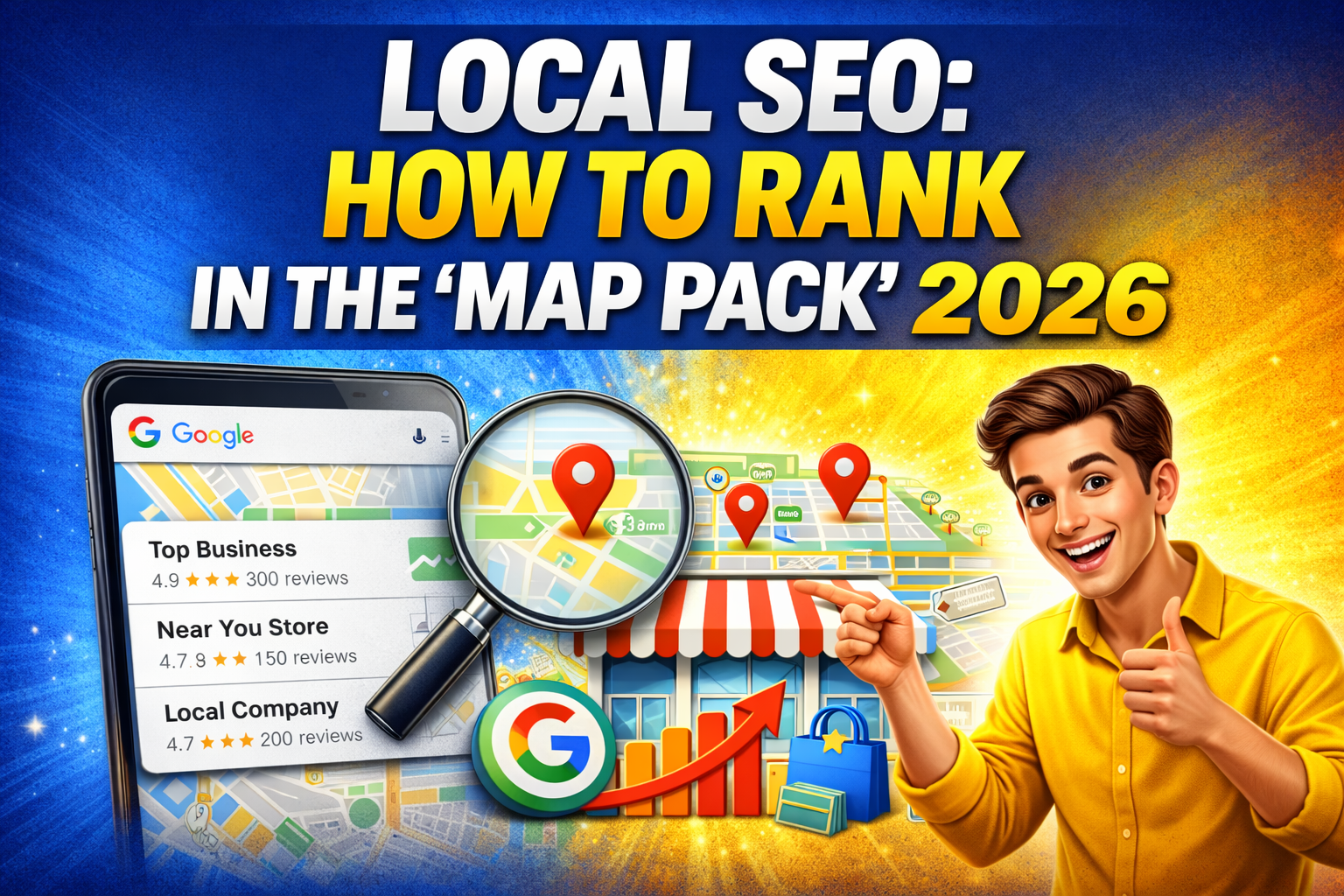
You search Google for “best pizza near me” or “plumber in [your city].” And there they are—three businesses sitting at the top of the page, with a map, phone numbers, reviews, and directions. The “Map Pack.” The holy grail of local search.
If you’re a local business, ranking in those top three spots is like winning a lottery every single day. People click the map pack before they scroll down. They call those businesses before they look at the rest. They visit those locations before they consider your competitors.
And if you’re not in the map pack? You’re invisible. Buried under the fold. Waiting for scraps of attention while your competitors get the calls.
In 2026, local SEO has evolved. Google’s algorithm is smarter. The map pack is more competitive. But the fundamentals remain: Google wants to show the most relevant, trusted, and local results. Give it what it wants, and you rank.
Let me show you exactly how to get your business into those top three spots—step by step, no fluff, no outdated tactics.
What Is the Map Pack? (Quick Explanation)
The map pack is the set of three local business listings that appear at the top of Google search results when someone searches for a local service or product.
Example: Search “coffee shop near me.” Google shows a map with three coffee shops pinned. Below each pin: business name, rating, review count, address, phone number, hours, and a “directions” button.
Above the map pack? Sometimes ads. Below the map pack? Organic search results. The map pack is prime real estate. It gets the most clicks. It drives the most calls. It brings the most foot traffic.
In 2026, the map pack is powered by Google’s local algorithm, which considers three main factors: Relevance, Distance, and Prominence.
- Relevance: How well your business matches the search query.
- Distance: How close your business is to the searcher.
- Prominence: How well-known and trusted your business is (reviews, citations, links, etc.).
Your job is to optimize for all three. Let’s start with the most important: your Google Business Profile.
The Foundation: Optimize Your Google Business Profile
Your Google Business Profile (GBP) is the single most important factor for map pack ranking. Without a complete, optimized profile, you cannot rank. Period.
Here’s exactly what to do.
Claim and verify your profile. If you haven’t claimed your GBP, do it now. Go to business.google.com. Follow the verification process (postcard, phone, or email). Unclaimed profiles don’t rank.
Complete every single field. Don’t leave anything empty. Business name (use your real business name, not keywords), address (exact, consistent with everywhere else), phone number (local number preferred), website (your website URL), category (primary and secondary categories), hours (including special hours for holidays), services (list every service you offer), attributes (women-led, LGBTQ+ friendly, wheelchair accessible, outdoor seating, etc.), and description (500-750 words, naturally including keywords).
Google’s algorithm rewards completeness. A fully filled profile outranks a partial one every time.
Choose the right primary category. This is critical. Your primary category tells Google what your business is. Choose the most accurate, specific category. Not “restaurant” if you’re a “pizza restaurant.” Not “beauty salon” if you’re a “nail salon.” Specificity helps Google match you to relevant searches.
Add secondary categories. You can add up to 9 more categories. Choose relevant ones. A bakery might add “cake shop,” “coffee shop,” “dessert shop,” “wedding cake shop.” Cover all the ways people search for you.
Write a compelling business description. Use your description to naturally include keywords, services, and what makes you unique. Don’t stuff keywords. Write for humans first, Google second. Include your primary services, your location, what makes you different, and a call to action.
Optimize Your Business Name (The Right Way)
Here’s where beginners get into trouble.
Some marketers add keywords to their business name to rank better. “Best Pizza Delhi – John’s Pizzeria.” Google prohibits this. It’s against guidelines. You can be suspended.
Use your real business name. If your business is “John’s Pizzeria,” that’s what goes in the name field. Not “John’s Pizzeria Best Pizza in Delhi.” Not “John’s Pizzeria – Pizza Delivery.” Just your real name.
However, if your business name naturally includes location or service keywords, that’s fine. “Delhi Plumbing Services” is fine if that’s your real registered name.
Don’t game the system. Play by the rules.
Get and Manage Reviews (The Trust Signal)
Reviews are the most powerful prominence signal. Google trusts businesses with many recent, positive, and authentic reviews.
How to get more reviews:
Ask every happy customer. At the right moment—after a successful service, after a compliment, after a purchase. Make it easy. Provide a direct link to your review page. Use QR codes on receipts, counters, and packaging. Train your staff to ask naturally. “If you loved our service, would you mind leaving us a Google review? It really helps our small business.”
Send follow-up emails or texts with the review link. Not spammy—one polite request after service.
What matters for ranking:
- Recency: Recent reviews (last 3 months) count more than old ones
- Quantity: More reviews = more trust
- Quality: 4+ star average is ideal. 3.5-4 is okay. Below 3.5 needs work.
- Diversity: Reviews mentioning different services and keywords help
- Responses: Businesses that respond to reviews signal engagement
Respond to every review. Thank 5-star reviewers. Address 4-star feedback politely. Respond to negative reviews professionally—apologize, offer to make it right offline, show you care. Google notices responsiveness. Customers notice too.
Never fake reviews. Google detects fake reviews. They’ll be removed. Your profile may be suspended. Real reviews only.
Collect Local Citations (Consistency Is Key)
Citations are mentions of your business name, address, and phone number (NAP) on other websites. Directories, review sites, social platforms, industry listings.
Why citations matter: Google uses them to verify your business exists, is legitimate, and is located where you say it is. Consistent NAP across many sites builds trust.
Where to get citations:
- Major directories: Google Business Profile (obviously), Bing Places, Apple Maps, Yelp, Justdial, Sulekha, Indiamart
- Industry-specific directories: Healthcare, legal, real estate, hospitality—whatever applies to you
- Local directories: Chamber of Commerce, local business associations, city-specific directories
- Data aggregators: InfoGroup, Localeze, Foursquare (these feed data to many other sites)
The golden rule: Your NAP must be EXACTLY the same everywhere. Same spelling. Same abbreviation. Same phone number format. “123 Main St” is different from “123 Main Street.” “555-123-4567” is different from “(555) 123-4567.” Consistency signals trust. Inconsistency confuses Google and hurts ranking.
Audit your existing citations. Use tools like Moz Local, BrightLocal, or manually search your business. Fix inconsistencies. Remove duplicates.
Build Local Backlinks (Authority Signals)
Backlinks from other websites to your website help Google understand your authority. Local backlinks are especially powerful for local SEO.
How to get local backlinks:
- Sponsor local events (schools, sports teams, charities) – they’ll link to you
- Join your local Chamber of Commerce – they list members
- Partner with complementary local businesses – cross-link on “resources” pages
- Get featured in local news or blogs – pitch stories about your business
- Create valuable local content – “Best [activity] in [city]” posts attract local links
- Host local workshops or events – get listed on event pages
Focus on quality over quantity. One link from a respected local news site is worth more than 50 from spammy directories.
Optimize Your Website for Local SEO
Your website supports your GBP. Google checks both. Here’s what your website needs.
Local landing pages. If you serve multiple cities, create a dedicated page for each. “Plumber in Delhi,” “Plumber in Gurgaon,” “Plumber in Noida.” Each page with unique content, local references, local testimonials, and local contact info.
Don’t create thin pages with just city names swapped. Add real value. Local case studies. Local photos. Local landmarks.
Embed Google Map on contact page. Show Google your physical location. Helps with local relevance.
Display your NAP prominently. On every page. Typically in footer. Consistent with your GBP.
Add schema markup (LocalBusiness schema). This is code that tells Google exactly what your business is, where it’s located, and how to contact you. Not technical? Ask your web developer or use a plugin (if on WordPress).
Mobile-friendly design. Most local searches happen on mobile. If your site isn’t fast and easy on phone, Google penalizes you.
Include local keywords naturally. “Best pizza in Andheri.” “Affordable plumber in Indiranagar.” “Top-rated dentist near Whitefield.” Use these in page titles, headings, content, and meta descriptions.
Use Google Posts Regularly
Google Posts are short updates you can publish directly on your GBP. Offers, events, announcements, blog posts.
Why they matter: Active profiles with fresh posts signal engagement. Google may reward engagement with better ranking. Also, posts appear in your GBP listing, giving searchers more reasons to click you.
What to post: Special offers, new products, upcoming events, blog posts, behind-the-scenes photos, holiday hours, customer testimonials.
How often: At least weekly. Daily is better. Posts expire after 7 days, so keep posting.
Include images. Posts with photos get more engagement. Use the call-to-action buttons (Learn More, Call Now, Sign Up, etc.).
Add Photos and Videos to Your GBP
Businesses with photos get more engagement. More engagement signals Google that your business is popular and relevant.
What photos to add: Exterior of your building (so people can find you), interior shots (ambiance, seating), products (dishes, items for sale), team photos (humanize your brand), work in progress (services being delivered), events (community involvement).
How many: At least 50-100 photos. More is better.
Videos: Add short videos (30-60 seconds). Tour of your space. Product demo. Customer testimonial. Behind-the-scenes.
Encourage customers to add photos too. Customer photos are authentic social proof. They also count as content on your profile.
Monitor and Improve Your Local Rankings
You can’t improve what you don’t measure. Track your map pack position.
Use Google Maps. Do manual searches for your key terms. “Plumber in [your city].” See where you appear. Check from different locations (if you serve a wide area).
Use rank tracking tools. BrightLocal, Whitespark, Semrush Local. These tools track your map pack position over time.
Track key metrics: Map pack position, number of reviews (and average rating), GBP views (insights dashboard), website clicks from GBP, direction requests, phone calls, and conversion actions (bookings, purchases).
Check weekly. See what’s working. Adjust strategy accordingly.
Local SEO in 2026: What’s New
Google’s algorithm evolves. Here’s what’s changed recently.
AI overviews affect local search. Google’s AI sometimes answers local queries directly. But the map pack remains prominent for commercial intent. Still essential.
Service area businesses (SABs) have more options. If you don’t have a physical storefront, you can hide your address and define a service area. Do this. Set your service area accurately.
Video is growing in importance. Add videos to your GBP. Google favors multimedia-rich profiles.
Review responses matter more. Google pays attention to how you respond. Respond to every review within 24 hours.
Proximity still dominates. For searches with “near me,” distance is the strongest factor. You can’t change your location. Focus on relevance and prominence where you are.
Common Mistakes That Kill Local SEO
Avoid these.
Keyword stuffing business name. “Best Plumber Delhi – Raj Plumbing.” Suspension risk. Don’t do it.
Inconsistent NAP. Different address on website vs GBP. Different phone number on Yelp. Confuses Google. Hurts ranking.
No reviews or ignoring reviews. Zero reviews = zero trust. Unanswered reviews = looks like you don’t care.
Unclaimed GBP. Leaving your profile unclaimed while competitors are optimized.
Fake reviews. Google catches them. Your profile gets penalized or suspended.
Thin local content. “We serve Delhi. Call us.” No value. No ranking.
Ignoring mobile users. Slow, unresponsive website kills conversions and ranking.
Conclusion: Start Optimizing Today
Local SEO isn’t magic. It’s not luck. It’s work. Consistent, ongoing work that compounds over time.
Your Google Business Profile is the foundation. Complete it. Keep it updated. Add photos. Post regularly. Get reviews. Respond to reviews.
Your website supports your GBP. Optimize it for local keywords. Add local pages. Embed maps. Use schema.
Build citations. Consistent NAP everywhere. Build local backlinks. Sponsor events. Partner with other local businesses.
Track your rankings. See what works. Do more of that. Adjust what doesn’t.
The map pack is competitive. But it’s not impossible. Businesses smaller than yours rank every day. Businesses with fewer resources rank. They rank because they do the work consistently over time.
You can too. Start today. Claim your profile if you haven’t. Complete every field. Ask for reviews. Post weekly. Track your progress.
Your competitors are already doing this. Don’t let them take all the calls, all the customers, all the growth. Get into that map pack. Own your local market.
Frequently Asked Questions (FAQs)
1. How long does local SEO take to show results?
With consistent effort, you can see improvements in 1-3 months. Major ranking changes (like entering the map pack) often take 3-6 months. Local SEO is not instant. But once you rank, you stay ranked with maintenance. Patience and consistency pay off.
2. Can I rank in the map pack without a physical address?
Yes, if you’re a service area business (plumber, cleaner, electrician). Set up your GBP as a service area business, hide your address, define your service radius. You can still rank for searches in your service area. Proximity to the searcher still matters—you just won’t have a pinned location.
3. How many reviews do I need to rank?
There’s no magic number. More is better. 20-50 reviews is a good starting point. 100+ is strong. But recency matters too. 20 recent reviews (last 3 months) may beat 100 old reviews. Focus on getting consistent new reviews, not just total count.
4. What if my competitors have more reviews than me?
Don’t panic. Reviews are one factor among many. You can beat competitors with more reviews by having better relevance (optimized GBP, right categories), better citations (consistent NAP), better website local SEO, and more recent reviews. Focus on what you can control. Out-optimize them where they’re weak.
5. Do I need to pay for local SEO tools?
Not initially. Start with free tools: Google Business Profile insights, Google Maps manual searches, Google Search Console. As you grow, paid tools (BrightLocal, Semrush, Whitespark) help with citation tracking, rank monitoring, and competitive analysis. Start free. Upgrade when you have budget and need.
No Comments