
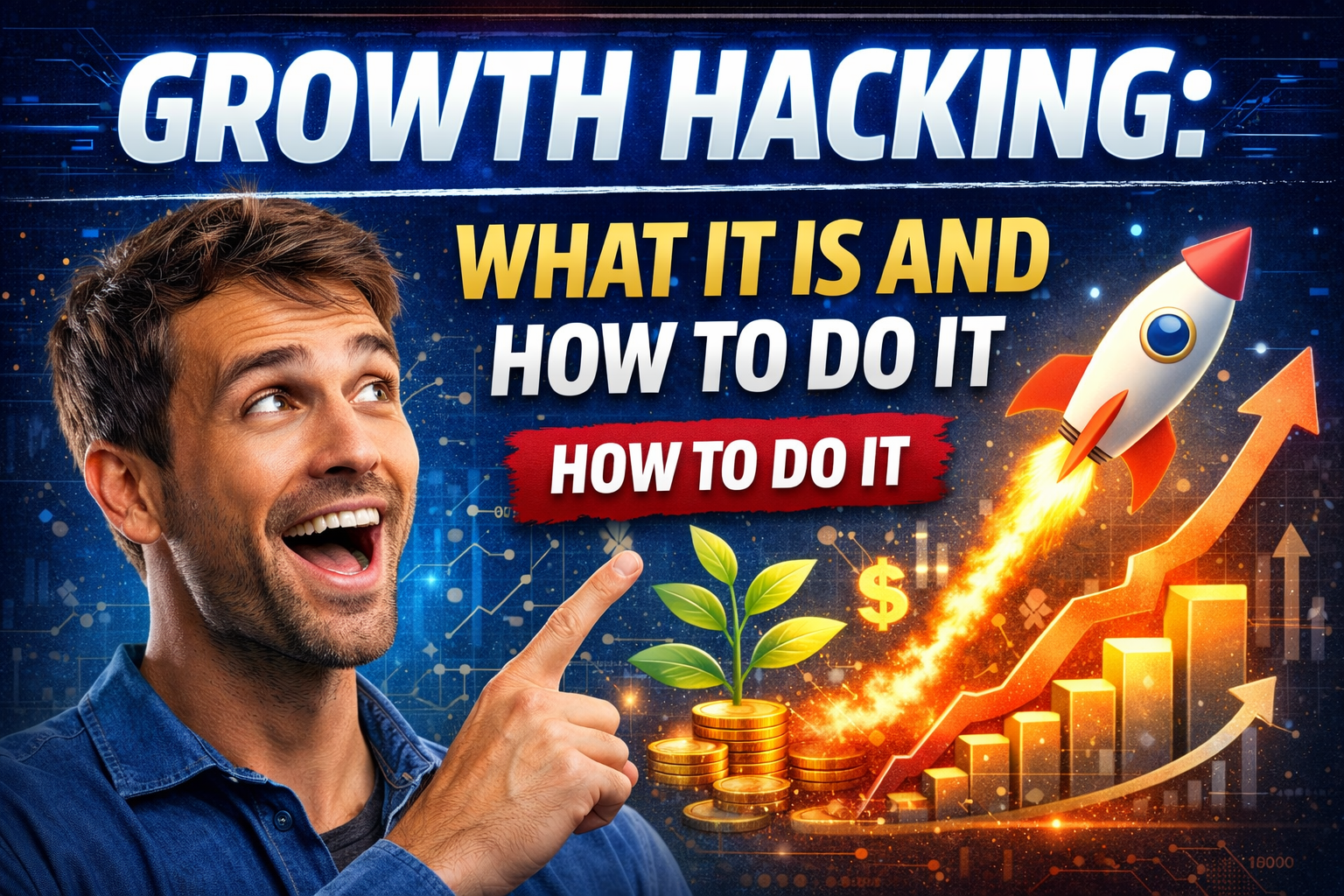
12 Apr Growth Hacking: What It Is and How to Do It
You’ve heard the stories.
Dropbox grew 3900% without spending a dime on ads. Airbnb piggybacked on Craigslist to reach millions. Hotmail added “PS: I love you. Get your free email at Hotmail” to every email footer and gained millions of users.
These aren’t fairy tales. They’re growth hacking. And for years, it’s been the secret weapon of startups who couldn’t afford traditional marketing.
But here’s the truth: growth hacking isn’t magic. It’s not a secret formula. It’s a mindset. A process. A way of thinking about growth that prioritizes experimentation, data, and creativity over big budgets.
And in 2026, growth hacking is more relevant than ever. Why? Because traditional marketing costs keep rising. Because customers are more skeptical than ever. Because the businesses that grow fastest aren’t the ones with the biggest budgets—they’re the ones that find creative, low-cost ways to acquire and retain customers.
Let me show you what growth hacking actually is, how it works, and how you can start doing it today—even with zero budget.
What Is Growth Hacking? (Simple Definition)
Growth hacking is a process of rapid experimentation across marketing channels and product development to identify the most effective, efficient ways to grow a business.
In plain English: it’s finding creative, low-cost, high-impact ways to get more customers.
A growth hacker isn’t a marketer. They’re not an engineer. They’re a hybrid. They understand marketing, data, psychology, and technology. They look at the entire customer journey—from first touch to retention—and find leverage points where small changes create big growth.
Key differences from traditional marketing:
- Traditional marketing asks: “What’s our budget for this campaign?”
- Growth hacking asks: “What experiment can we run today with almost nothing?”
- Traditional marketing focuses on acquisition (getting new customers)
- Growth hacking focuses on the entire funnel (acquisition, activation, retention, referral, revenue)
- Traditional marketing measures campaigns
- Growth hacking measures experiments
Growth hacking isn’t better than traditional marketing. It’s different. And for businesses with limited budgets, it’s often the only path to meaningful growth.
The Growth Hacking Mindset
Before we get into tactics, understand the mindset. Without it, tactics won’t work.
1. Experiment over campaign. Don’t plan a big campaign. Run small experiments. Test one variable at a time. Learn what works. Scale what works. Kill what doesn’t.
2. Data over opinion. Your opinion doesn’t matter. Your customer’s behavior matters. Let data guide decisions. Test assumptions. Be humble.
3. Speed over perfection. Launch fast. Learn fast. Iterate fast. Perfect is the enemy of done. Done is better than perfect.
4. Creativity over budget. You don’t need money. You need ideas. Constraints breed creativity. Small budgets force you to think differently.
5. Full funnel focus. Don’t just chase new customers. Improve activation (getting them to first value). Improve retention (keeping them). Improve referral (getting them to bring others). The biggest growth levers are often not at the top of the funnel.
Adopt this mindset, and you’re already halfway there.
The AARRR Framework: Your Growth Map
Growth hacking follows a framework called AARRR (pronounced “ah-arr”). It stands for Acquisition, Activation, Retention, Referral, Revenue. Every growth experiment fits into one of these stages.
Stage 1: Acquisition
How do people find you? SEO? Social media? Word of mouth? Ads? Referrals? Partnerships? This is the top of the funnel. Most marketers stop here. Growth hackers don’t.
Stage 2: Activation
How do you get users to their “first aha moment”? The point where they experience value for the first time. For Dropbox, it was saving their first file. For Twitter, it was following 10 accounts. Activation is where most businesses leak customers.
Stage 3: Retention
How do you keep users coming back? One-time purchases aren’t growth. Repeat usage is growth. Retention is the engine of sustainable growth.
Stage 4: Referral
How do you turn customers into advocates? How do they bring you new customers? Referral loops are the cheapest form of acquisition.
Stage 5: Revenue
How do you monetize? This isn’t just pricing. It’s about optimizing conversion, reducing friction, and increasing customer lifetime value.
Most businesses focus on acquisition and revenue. They ignore activation, retention, and referral. That’s where the biggest growth opportunities lie.
Acquisition Hacks (Getting People to Find You)
Let’s start with specific tactics for each stage.
1. Leverage existing platforms. Don’t build an audience from scratch. Go where people already are. Reddit, Quora, LinkedIn, Facebook groups, Twitter. Answer questions genuinely. Build reputation. Drive traffic naturally.
2. Create content that solves specific problems. “How to” content gets search traffic. Target long-tail keywords with low competition. Write detailed, helpful guides. One great piece of content can drive traffic for years.
3. Use product-led growth. Let your product be the marketing. Free trials. Freemium models. Shareable features. When users love your product, they tell others.
4. Partner with complementary businesses. Find businesses that serve the same audience but aren’t competitors. Cross-promote. Bundle offers. Co-create content.
5. Turn your team into marketers. Every employee has a network. Encourage sharing. Make it easy. Provide social copy. Celebrate when people share.
Example: A SaaS company wanted more signups. Instead of buying ads, they created a free tool related to their product. People used the free tool, loved it, and discovered the paid product. Zero ad spend. Thousands of signups.
Activation Hacks (Getting Users to First Value)
Acquisition is useless if people don’t activate. Here’s how to improve activation.
1. Remove friction from signup. Every field in your form reduces conversion. Ask for less. Email only? Even better: social login. Reduce steps. Make it painfully easy.
2. Guide users to the “aha moment.” Don’t assume they’ll figure it out. Show them. Onboarding tours. Tooltips. Checklists. Progress bars. Lead them to value.
3. Use email sequences to activate. Many users sign up but don’t complete activation. Send a sequence: “Here’s how to get started.” “Here’s a feature you might have missed.” “Here’s what others are doing.”
4. Personalize the experience. Ask what they want to do. Then tailor the onboarding. A blogger sees blogging features. An e-commerce user sees product features. Relevance increases activation.
5. Celebrate small wins. User uploaded a photo? Celebrate. Completed their profile? Celebrate. Made their first action? Celebrate. Micro-celebrations release dopamine. Dopamine creates habit.
Example: Twitter famously found that users who followed 10 accounts within their first week had much higher retention. So they built onboarding that suggested accounts to follow. Simple change. Massive impact on activation.
Retention Hacks (Keeping Users Coming Back)
Acquiring a customer is expensive. Keeping one is cheap. Retention is where growth compounds.
1. Build habits with triggers. Email digests. Push notifications. Weekly reports. Create reasons to return. But don’t spam—provide value with every touch.
2. Use the “rule of 7.” People need to see your brand 7 times before they take action. Don’t expect one email to retain them. Consistent, valuable touchpoints build habits.
3. Create streaks and milestones. “Day 3 of using our product.” “You’ve completed 10 workouts.” Streaks create commitment. Milestones create satisfaction.
4. Re-engage inactive users. “We miss you.” “Here’s what’s new.” “Here’s a tip you might have missed.” One well-timed email can bring back a lost customer.
5. Build community. Users who feel part of a community return more. Forums. Facebook groups. Slack channels. Events. Connection creates loyalty.
Example: Duolingo uses streaks and notifications masterfully. “You’re on a 30-day streak! Don’t break it now.” Users return daily because they don’t want to lose their streak. That’s retention hacking.
Referral Hacks (Turning Customers into Marketers)
Referral is the cheapest acquisition channel. Here’s how to make it work.
1. Make sharing easy. One click. Pre-written copy. Beautiful preview. The easier you make it, the more people share.
2. Incentivize both sides. Dropbox gave free storage to referrers AND referees. Both benefit. Both are motivated. The classic example for a reason.
3. Ask at the right moment. Don’t ask new users. They haven’t experienced value yet. Ask after the “aha moment.” After a win. After positive feedback. Timing is everything.
4. Create shareable moments. User achieved something? “Share your achievement.” Completed a milestone? “Invite friends to celebrate.” Make sharing part of the experience.
5. Use social proof in your ask. “X people have already shared. Join them.” Social proof increases conversion.
Example: Paytm’s referral program gave both parties cashback. Simple. Effective. Millions of users brought millions more. The cost was acquisition—cheaper than ads.
Revenue Hacks (Optimizing Conversion)
Revenue isn’t just about price. It’s about removing friction and increasing value.
1. Reduce friction at checkout. Guest checkout. Fewer fields. Multiple payment options. Progress indicators. Every click loses customers.
2. Use urgency and scarcity ethically. “Sale ends in 3 hours.” “Only 5 left in stock.” Honest scarcity triggers loss aversion. Loss aversion drives action.
3. Offer guarantees. Money-back guarantee. Free returns. Risk reversal removes hesitation. The brain relaxes. Purchase becomes easier.
4. Test pricing strategically. ₹997 vs ₹1000. ₹49/month vs ₹499/year (perceived lower). Anchoring (show higher price first). Small changes, big impact.
5. Use post-purchase upsells. Customer already bought. Their wallet is open. Offer a related product at discount. “Add this for only ₹199.” Works beautifully.
Example: Amazon’s “Frequently bought together” and “Customers who bought this also bought” are revenue hacks. One-click upsells. Massive revenue impact.
How to Run Growth Experiments (The Scientific Method)
Growth hacking is systematic. Here’s the process.
Step 1: Identify a problem. “Our activation rate is only 20%.” “Our retention drops sharply after week 2.” Be specific. Measure the current state.
Step 2: Form a hypothesis. “If we add an onboarding checklist, activation will increase to 35%.” One variable. Clear prediction. Measurable outcome.
Step 3: Design the experiment. Build the checklist. Set up tracking. Decide how long to run (usually 1-2 weeks). Decide success metric.
Step 4: Run the experiment. Launch to a segment (not all users). A/B test if possible. Measure results.
Step 5: Analyze results. Did activation increase? To 35%? If yes, roll out to all users. If no, what did you learn? Document. Iterate.
Step 6: Scale or kill. Winners get scaled. Losers get killed (or iterated). Don’t fall in love with your ideas. Fall in love with results.
Run 2-3 experiments per week. Small, fast, cheap. Over time, winners compound.
Tools for Growth Hacking (No-Code Options)
You don’t need to code. Here are tools for each stage.
Acquisition: BuzzSumo (find popular content), Ahrefs (SEO research), Typeform (create quizzes/lead magnets)
Activation: Appcues (onboarding tours), Intercom (in-app messages), Mailchimp (email sequences)
Retention: Customer.io (behavioral emails), Pushwoosh (push notifications), Metabase (analytics dashboards)
Referral: ReferralCandy, GrowSurf, Viral Loops (all no-code referral programs)
Revenue: Stripe (payments), Recurly (subscriptions), OptinMonster (exit-intent popups)
Experimentation: Google Optimize (A/B testing), VWO (testing platform)
Start with free tiers. Upgrade as you grow.
Real Growth Hacking Examples to Inspire You
Dropbox: Gave free storage for referrals. Users referred friends to get more storage. Viral loop. Grew 3900%.
Hotmail: Added “PS: I love you. Get your free email at Hotmail” to every email footer. Every email sent was an ad. Millions of signups.
Airbnb: Built a tool to cross-post listings to Craigslist. Tapped into existing user base. Genius, controversial, effective.
LinkedIn: Let users upload their email contacts. Then showed “Your colleague X is on LinkedIn. Connect?” Network effects drove growth.
Paytm: Cashback on referrals. Simple. Effective. Scaled massively in India.
Notice the pattern: none of these required huge ad budgets. They required creativity, understanding of user behavior, and smart execution.
Common Growth Hacking Mistakes
Learn from others’ errors.
Mistake 1: Ignoring activation. Getting signups is useless if people don’t use your product. Activation is where real growth starts.
Mistake 2: Focusing only on acquisition. Retention is more valuable than acquisition. Keeping customers is cheaper than getting new ones.
Mistake 3: Running too many experiments at once. You can’t isolate what worked. Test one variable at a time.
Mistake 4: Not measuring properly. “Feels like it worked” isn’t data. Set clear metrics. Measure before and after.
Mistake 5: Giving up too early. One experiment fails. You quit. Most experiments fail. That’s normal. Learn. Iterate. Keep going.
Mistake 6: Copying others’ hacks. What worked for Dropbox might not work for you. Your audience is different. Your product is different. Adapt, don’t copy.
How to Start Growth Hacking Today
Ready to start? Here’s your action plan.
Step 1: Map your current funnel. Acquisition → Activation → Retention → Referral → Revenue. What are your numbers at each stage? Where is the biggest leak?
Step 2: Pick one stage to improve. Start with activation or retention—most businesses ignore these.
Step 3: Brainstorm 10 experiment ideas. Don’t judge. Just generate.
Step 4: Pick the simplest, cheapest experiment. The one you can run today with almost nothing.
Step 5: Run it. Measure. Learn.
Step 6: Document results. Scale winners. Kill losers.
Step 7: Repeat. Every week. Two experiments per week. 100 experiments per year. Winners compound.
You don’t need a big budget. You need a growth mindset, a willingness to experiment, and the discipline to measure and iterate.
Start today. Your first experiment is waiting.
Conclusion: Growth Hacking Is a Mindset, Not a Toolkit
Growth hacking isn’t about secret tactics. It’s about how you think.
It’s about being resourceful when you have no budget. It’s about testing when you don’t know. It’s about learning when you fail. It’s about scaling when you win.
You don’t need to be a genius. You need to be curious, disciplined, and relentless.
Every big business started small. Every growth story started with a first experiment. Yours can too.
What will you test today?
Frequently Asked Questions (FAQs)
1. Is growth hacking only for startups?
No. Startups popularized it because they had no budget. But any business can use growth hacking principles. Established businesses often have even more opportunities because they have existing customers, data, and traffic to experiment with.
2. Do I need to know how to code to be a growth hacker?
Not anymore. No-code tools have exploded. You can build landing pages, run A/B tests, set up email sequences, and create referral programs without writing a single line of code. Technical skills help, but they’re not required to start.
3. What’s the difference between growth hacking and digital marketing?
Traditional marketing focuses on acquisition (getting new customers). Growth hacking focuses on the entire funnel (acquisition, activation, retention, referral, revenue). Growth hacking is also more experimental, data-driven, and focused on low-cost, high-impact tactics. Marketing works with budgets. Growth hacking works with constraints.
4. How do I measure if a growth experiment worked?
Define success before you run the experiment. One clear metric. “Increase activation rate from 20% to 30%.” Measure before. Run experiment. Measure after. Compare. If it moved the metric, it worked. If not, it didn’t. Be honest. Kill losers.
5. What’s the most underrated growth hacking tactic?
Improving retention. Most businesses obsess over acquisition. But a 5% increase in retention can double your customer lifetime value. That’s often easier and cheaper than doubling acquisition. Keep the customers you have. They’re your best growth engine.
No Comments