
18 Apr On-Page SEO vs Off-Page SEO: What’s the Difference?
You’ve heard the terms. On-page SEO. Off-page SEO. Everyone talks about them like you’re supposed to know what they mean. But honestly? The difference can be confusing.
Here’s the simplest way to think about it:
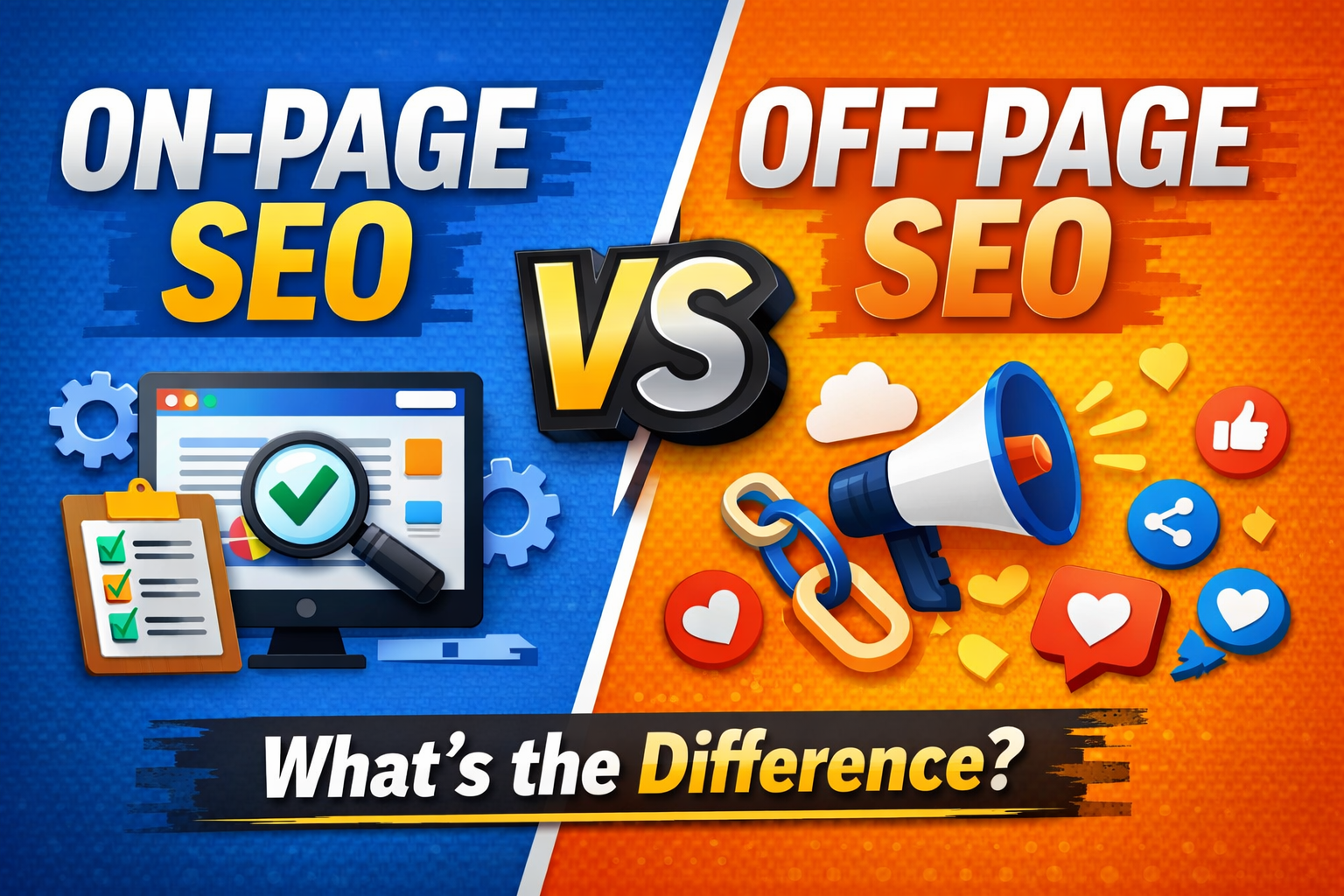
On-page SEO is everything you do on your website to help it rank. Content, keywords, headings, internal links, page speed, mobile-friendliness. You control it.
Off-page SEO is everything you do off your website to help it rank. Backlinks, social signals, brand mentions, guest posts, influencer relationships. You influence it, but you don’t control it.
Think of your website as a house. On-page SEO is how you decorate, organize, and maintain your house. Off-page SEO is what your neighbors say about your house. Both matter. Both affect whether people visit. But they’re completely different skills.
Let me break down exactly what each one means, why both matter, and how to do them right in 2026.
What Is On-Page SEO? (The Stuff You Control)
On-page SEO (sometimes called “on-site SEO”) refers to optimizing elements on your website that affect search rankings. You have direct control over all of it.
If Google were grading your website, on-page SEO is the homework portion. You can study, prepare, and submit exactly what you want. No surprises. No waiting for others to cooperate.
Here are the key components of on-page SEO.
1. Content Quality and Relevance
Google’s #1 priority is showing users the best answer to their question. Your content needs to be that answer.
Write comprehensive, useful, accurate content. Answer the question fully. Don’t leave readers searching elsewhere. Cover related topics. Add examples, data, and visuals.
Thin content (300 words with no value) won’t rank. Deep content (1500+ words that genuinely helps) will.
2. Keywords (Used Naturally)
Keywords are the words people type into Google. Your content needs to include them—naturally, not stuffed.
Put your primary keyword in: title tag, first 100 words, at least one H2 heading, meta description, URL, and naturally throughout the content.
Don’t force keywords. Write for humans first. Google understands synonyms and context. “Best running shoes” and “top sneakers for runners” are similar enough.
3. Title Tags and Meta Descriptions
The title tag is the clickable headline in search results. The meta description is the short summary below it. Both influence whether people click.
Title tags should be 50-60 characters, include your primary keyword, and make people want to click. Meta descriptions should be 150-160 characters, summarize the page, and include a call to action.
These don’t directly affect rankings, but they affect click-through rates. Higher CTR = more traffic = better rankings over time.
4. Headings (H1, H2, H3, H4)
Headings structure your content. H1 is the main title (one per page). H2s are major sections. H3s are subsections. H4s are sub-subsections.
Use headings to organize your content logically. Include keywords naturally. Make it easy for readers (and Google) to understand your page structure.
5. URL Structure
Clean, descriptive URLs help both users and search engines. Instead of “website.com/p=123,” use “website.com/on-page-seo-guide.”
Keep URLs short. Use hyphens between words. Include your primary keyword. Avoid numbers, symbols, and unnecessary words.
6. Internal Linking
Links from one page on your site to another page on your site. They help Google understand your site structure and distribute “link authority” across your pages.
Link to related content naturally. Use descriptive anchor text (the clickable words). Don’t just say “click here.” Say “learn more about on-page SEO.”
7. Image Optimization
Images make content engaging. But they also slow down your site if not optimized.
Compress images to reduce file size. Use descriptive file names (“on-page-seo-checklist.jpg” not “IMG_1234.jpg”). Add alt text describing the image (helps accessibility and gives Google context).
8. Page Speed
Slow pages rank lower. Users hate waiting. Google knows this.
Compress images. Use caching. Minimize code. Choose fast hosting. Test your site with Google’s PageSpeed Insights. Fix what it tells you to fix.
9. Mobile-Friendliness
Most searches happen on phones. If your site isn’t mobile-friendly, you won’t rank.
Use responsive design (site adapts to screen size). Make buttons big enough for thumbs. Ensure text is readable without zooming. Test with Google’s Mobile-Friendly Test tool.
10. Schema Markup (Structured Data)
Schema is code that helps Google understand your content. It can also create rich results in search (star ratings, event dates, recipe times).
Add schema for your content type: article, product, recipe, event, FAQ, how-to, etc. Not required but helps. Google’s Structured Data Markup Helper makes it easier.
What Is Off-Page SEO? (The Stuff You Influence)
Off-page SEO refers to actions taken outside your website that affect search rankings. You don’t have direct control, but you can influence them.
If on-page SEO is homework, off-page SEO is your reputation. You can’t force people to like you. But you can do things that make them more likely to.
Here are the key components of off-page SEO.
1. Backlinks (The Most Important)
Backlinks are links from other websites to your website. Google sees them as “votes of confidence.” More high-quality backlinks = higher rankings.
Not all backlinks are equal. A link from a respected news site is worth more than 100 links from spammy directories. A link from a relevant site in your industry is worth more than a link from an unrelated site.
Natural backlinks are earned through great content. Created backlinks are built through outreach. Avoid bought backlinks—they can get you penalized.
2. Brand Mentions (Unlinked)
Sometimes people mention your brand without linking. “I love Brand X’s new product.” Google notices these mentions. They count as trust signals, even without a link.
Track brand mentions using tools like Google Alerts, Mention, or Brand24. Engage with people who mention you. Politely ask if they’d consider adding a link.
3. Guest Posting
Writing articles for other websites in exchange for a link back to your site. When done well, it builds backlinks and reaches new audiences.
Focus on quality, relevant sites. Don’t spam low-quality directories. Write genuinely useful content. One good guest post is worth 50 bad ones.
4. Social Media Signals
Google has said social signals (likes, shares, retweets) are not direct ranking factors. But they amplify your content. More shares = more visibility = more backlinks = better rankings.
Share your content on social media. Engage with your audience. Build a following. The indirect SEO benefits are real.
5. Influencer Relationships
When influencers mention or link to you, their authority transfers to you (somewhat). Building relationships with influencers in your niche is valuable.
Engage genuinely. Share their content. Comment thoughtfully. Build relationships before asking for favors. Influencer marketing is relationship marketing, not transactional.
6. Forum and Community Participation
Answering questions on Reddit, Quora, and niche forums can build authority and drive traffic. Include links only when genuinely helpful—don’t spam.
Be helpful first. Link second. Communities punish self-promotion. Reward genuine expertise.
7. Local Citations (For Local SEO)
Mentions of your business name, address, and phone number on other websites (directories, review sites, social platforms). Important for local businesses.
Ensure your NAP (Name, Address, Phone) is consistent across all citations. Inconsistent citations confuse Google and hurt rankings.
8. Reviews and Ratings
Google reviews, Yelp reviews, and industry-specific reviews affect local SEO and trust. More positive reviews = higher local rankings.
Ask happy customers for reviews. Respond to all reviews (positive and negative). Never fake reviews—Google detects them.
The Key Differences at a Glance
| Aspect | On-Page SEO | Off-Page SEO | |——–|————-|—————| | Control | Full control | Influence only | | Location | On your website | Outside your website | | Examples | Content, keywords, speed, mobile | Backlinks, mentions, social, reviews | | Time to see results | Weeks to months | Months to years | | Cost | Time + sometimes tools | Time + sometimes outreach/budget | | Risk | Low (you control it) | Medium (others control it) | | Most important factor | Content quality | Backlink quality |
Which One Matters More?
The honest answer: both matter. But they matter at different stages.
For new websites: On-page SEO matters more. You need to establish a foundation. Without good content and proper optimization, no one will link to you anyway. Focus on creating excellent content first.
For established websites: Off-page SEO matters more. Once your on-page foundation is solid, the main differentiator between you and competitors is backlinks and authority. The site with more high-quality backlinks usually ranks higher.
For competitive niches: Both matter equally. Everyone has good on-page SEO. Everyone has some backlinks. The winner is the site that does both better than everyone else.
For local businesses: On-page SEO (especially Google Business Profile) matters most, followed by local citations and reviews (off-page). National backlinks matter less for local search.
Think of it as a recipe. On-page SEO is the ingredients. Off-page SEO is the cooking technique. Bad ingredients with great technique? Still bad. Great ingredients with bad technique? Also bad. You need both.
How to Prioritize Your Efforts
Here’s a simple priority order for most websites.
Priority 1: Content quality (on-page). Nothing else matters if your content isn’t genuinely helpful. Write for humans first. Answer the question completely. Add unique value.
Priority 2: Technical basics (on-page). Page speed, mobile-friendliness, proper headings, image optimization. These won’t make you #1, but they’ll keep you from being penalized.
Priority 3: Keyword optimization (on-page). Use your target keywords naturally in titles, headings, and content. Don’t overthink it. Write naturally.
Priority 4: Internal linking (on-page). Link your related content together. Helps Google understand your site and keeps users engaged.
Priority 5: Backlink building (off-page). Once your on-page foundation is solid, start building backlinks. Guest posts, outreach, shareable content, digital PR.
Priority 6: Brand mentions and social (off-page). Build your brand presence. Engage on social media. Get mentioned (with or without links).
Priority 7: Reviews and citations (off-page). Especially important for local businesses. Collect reviews. Ensure NAP consistency.
Don’t try to do everything at once. Master each priority before moving to the next.
Common Mistakes (And How to Avoid Them)
On-page mistakes:
- Keyword stuffing: Repeating the same keyword unnaturally. Google penalizes this. Write naturally.
- Thin content: Short pages with no value. Expand your content. Add depth.
- Ignoring mobile: Desktop-only design. Test on your phone. Fix mobile issues.
- Slow loading: Heavy images, bad hosting. Compress images. Upgrade hosting.
- No internal links: Isolated pages. Link related content together.
Off-page mistakes:
- Buying backlinks: Paid links from low-quality sites. Google penalizes this. Earn links naturally.
- Spammy guest posting: Low-quality articles on low-quality sites. Focus on quality, not quantity.
- Ignoring brand mentions: Not tracking or engaging with mentions. Set up alerts. Respond.
- Fake reviews: Creating fake positive reviews. Google detects them. Ask real customers instead.
- Inconsistent citations: Different NAP across directories. Audit your citations. Fix inconsistencies.
Tools for On-Page and Off-Page SEO
For on-page SEO:
- Google Search Console: Free. See how Google views your site. Identify technical issues.
- Google Analytics 4 (GA4): Free. Track traffic, behavior, and conversions.
- PageSpeed Insights: Free. Test and improve page speed.
- Mobile-Friendly Test: Free. Check mobile compatibility.
- Surfer SEO: Paid. Optimize content based on top-ranking pages.
- Yoast SEO / Rank Math: WordPress plugins. Help with on-page optimization.
For off-page SEO:
- Ahrefs: Paid. Analyze backlinks, competitor backlinks, and brand mentions.
- SEMrush: Paid. Backlink analysis, competitor research, position tracking.
- Google Alerts: Free. Track brand mentions across the web.
- Moz Link Explorer: Free tier available. Analyze backlink profiles.
- BrightLocal: Paid. Local SEO, citation tracking, review management.
Start with free tools. Upgrade as you need more data.
How On-Page and Off-Page SEO Work Together
They’re not separate strategies. They’re two halves of one whole.
Great on-page SEO makes off-page SEO easier. When your content is excellent, people naturally link to it. When your site is fast and mobile-friendly, people share it. When your content answers questions completely, influencers reference it.
Great off-page SEO makes on-page SEO more valuable. Backlinks drive traffic to your content. More traffic means more engagement signals. More engagement signals help Google understand that your content is valuable.
They feed each other. Don’t treat them as separate projects. Treat them as one unified SEO strategy.
Conclusion: Master Both, Rank Higher
On-page SEO is what you control. Off-page SEO is what you influence. You need both.
Start with on-page. Build a solid foundation of excellent content, proper optimization, and technical basics. Then build off-page. Earn backlinks, build relationships, get mentioned, collect reviews.
Ignore either, and you’ll struggle to rank. Master both, and you’ll dominate.
The sites at the top of Google didn’t get there by accident. They did the work. On-page and off-page. Consistently, over time.
You can too. Start with one thing today. Optimize a page. Write better content. Fix your page speed. Build one backlink. Small steps compound.
Your journey to better rankings starts now.
Frequently Asked Questions (FAQs)
1. Is on-page or off-page SEO more important for beginners?
On-page SEO. You need a solid foundation before you can effectively build off-page signals. Focus on creating excellent content, optimizing your site structure, and fixing technical issues. Once your on-page is solid, start building backlinks and brand mentions.
2. How long does it take to see results from on-page SEO?
2-6 months typically. Google needs time to crawl, index, and evaluate your changes. Content updates may show results faster (4-8 weeks). Technical fixes may show results in 2-4 weeks. Be patient. SEO is a long game.
3. How long does it take to see results from off-page SEO?
3-12 months typically. Building backlinks takes time. Earning authority takes even longer. The impact of a new backlink might not show for months. This is why you should start off-page SEO early and be consistent.
4. Can I rank without any backlinks?
For low-competition keywords, yes. Excellent on-page SEO can rank for niche, specific queries. For competitive keywords, no. You’ll need backlinks. Backlinks are how Google measures authority. Without them, you can’t compete for competitive terms.
5. What’s the single most important factor in each category?
For on-page SEO: content quality. Nothing else matters if your content isn’t genuinely helpful. For off-page SEO: backlink quality. One link from a respected, relevant site is worth more than 100 spammy directory links. Focus on quality in both categories.
No Comments