
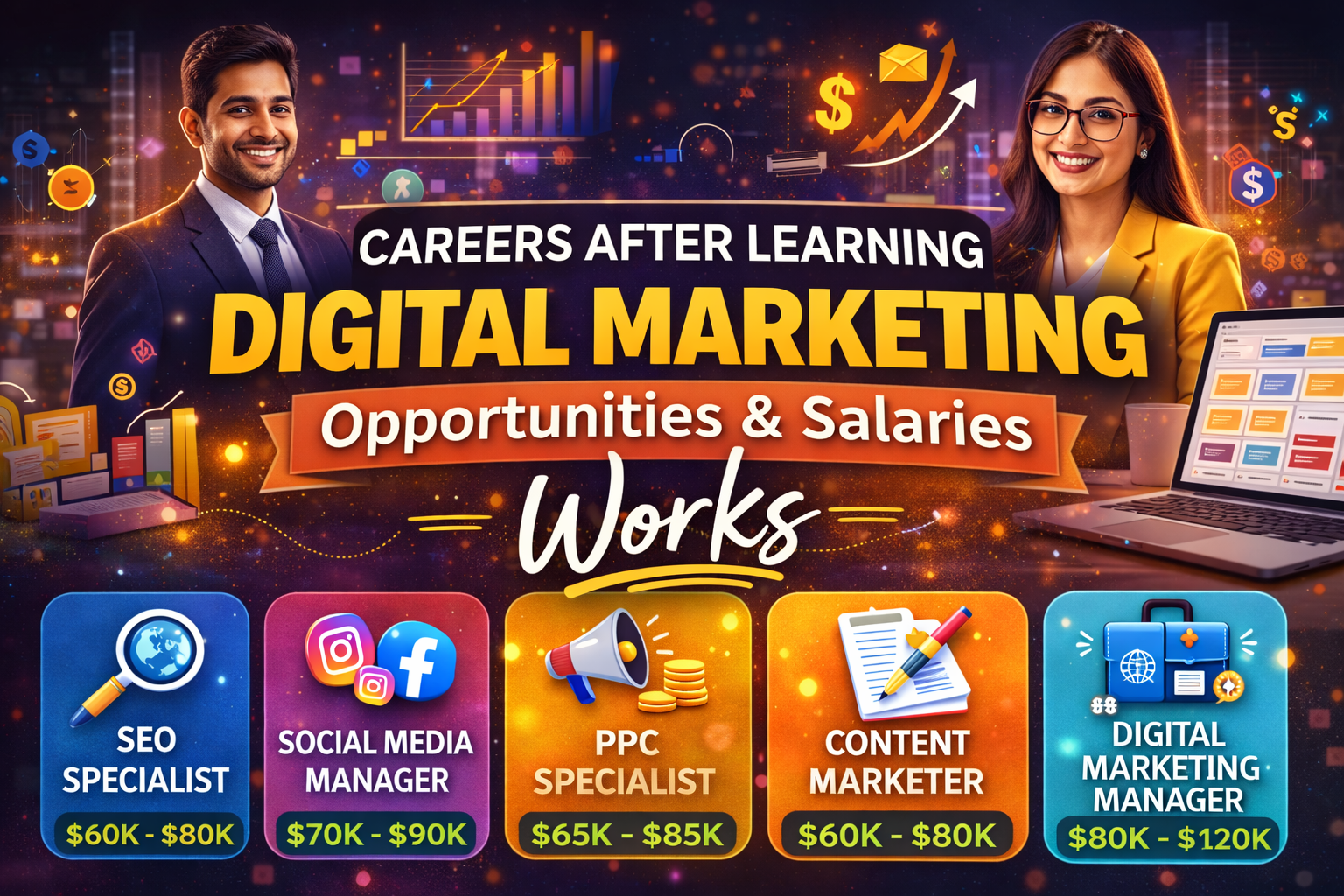
11 Mar Careers After Learning Digital Marketing: Opportunities & Salaries
You’ve learned digital marketing. Maybe through a course, maybe self-taught, maybe on the job. You’ve got the skills. You know the terms. You’ve built some work to show.
Now comes the question everyone asks but no one answers clearly: what actually comes next?
What jobs can you get? How much do they pay? Which path is right for someone like you?
These questions matter. Because digital marketing isn’t one career—it’s dozens of them. SEO specialist and social media manager do completely different work. Email marketers and content writers use different skills. PPC experts and brand strategists live in different worlds.
Choosing the right path matters. It determines your day-to-day happiness, your earning potential, and your long-term growth.
In this guide, I’m going to walk you through the real career options after learning digital marketing. No fluff. No “you can become a millionaire overnight” nonsense. Just honest opportunities, realistic salaries, and the paths that actually exist.
Let’s start.
The Landscape in 2026
Before we dive into specific roles, let’s understand where the industry stands.
Digital marketing is no longer new. It’s mature. Companies know they need it. Budgets are established. Roles are defined. This is good news—it means stability, clear career paths, and predictable salaries.
But it also means the “wild west” days are over. You can’t just call yourself a digital marketer and expect people to throw money at you. Specialization matters. Results matter. Proof matters.
In 2026, the most in-demand marketers are those who can point to specific results: “I increased organic traffic by 150% in six months.” “I generated ₹50 lakhs in revenue from ads with a 4x ROAS.” “I grew a social media account from zero to 100, followers.”
Generalists still have a place, especially in smaller companies. But specialists get paid more, get hired faster, and have clearer career paths.
Keep this in mind as we explore the options.
Career Path 1: Content Marketing
If you love writing, explaining, and telling stories, content marketing might be your path.
What you do: Create content that attracts and educates potential customers. Blog posts, articles, ebooks, whitepapers, email newsletters, video scripts. You’re the voice of the brand. You help people understand problems and discover solutions.
Common job titles: Content Writer, Content Strategist, Blog Manager, Content Marketing Manager, Copywriter.
Skills needed: Excellent writing, research, understanding of audience, basic SEO, ability to adapt tone for different platforms.
Who succeeds here: People who love words. People who can explain complex things simply. People who are curious and enjoy learning new topics deeply.
Entry-level salary (India): ₹3-5 lakhs per year
Mid-level (3-5 years): ₹6-10 lakhs per year
Senior/Lead (5+ years): ₹12-20 lakhs per year
Freelance potential: High. Good content writers are always in demand. Freelance rates range from ₹500-5, per article depending on experience and quality.
Career progression: Content Writer → Senior Writer → Content Strategist → Content Manager → Head of Content
Career Path 2: SEO (Search Engine Optimization)
If you’re analytical, patient, and enjoy understanding how systems work, SEO could be your thing.
What you do: Help websites rank higher on Google. Research keywords. Optimize content and technical aspects of websites. Build links. Track performance. Stay updated on algorithm changes.
Common job titles: SEO Executive, SEO Specialist, SEO Analyst, SEO Manager, Technical SEO Consultant.
Skills needed: Understanding of how search engines work, keyword research, analytics tools (Google Analytics, Search Console), basic technical knowledge, patience (SEO takes time).
Who succeeds here: Analytical minds. People who enjoy puzzles. Those who can handle delayed gratification (results take months). Detail-oriented folks.
Entry-level salary (India): ₹3-6 lakhs per year
Mid-level (3-5 years): ₹7-12 lakhs per year
Senior/Lead (5+ years): ₹15-25 lakhs per year
Freelance potential: Very high. Businesses always need SEO help. Consultants with proven results charge ₹50,000-2, lakhs per month retainers.
Career progression: SEO Executive → SEO Specialist → SEO Manager → SEO Head → SEO Consultant
Career Path 3: Social Media Marketing
If you’re creative, trendy, and love connecting with people, social media might be your space.
What you do: Manage brand presence on social platforms. Create content (posts, reels, stories). Engage with followers. Run community management. Track performance. Sometimes run ads. Stay on top of trends.
Common job titles: Social Media Executive, Social Media Manager, Community Manager, Social Media Strategist, Content Creator.
Skills needed: Content creation, basic design (Canva), video editing (CapCut), understanding of each platform’s algorithm, community management, trend spotting.
Who succeeds here: Creative people. Those who enjoy being “online.” People with good visual sense. Those who can write short, engaging copy.
Entry-level salary (India): ₹2.5-4 lakhs per year
Mid-level (3-5 years): ₹5-9 lakhs per year
Senior/Lead (5+ years): ₹10-18 lakhs per year
Freelance potential: Good. Brands need social media help. Freelancers charge ₹15,000-50, per month per client for management.
Career progression: Social Media Executive → Social Media Manager → Social Media Strategist → Head of Social Media
Career Path 4: Paid Ads (PPC/SEM)
If you love data, budgets, and measurable results, paid ads could be your sweet spot.
What you do: Run paid advertising campaigns on Google, Facebook, Instagram, LinkedIn, Amazon, etc. Manage budgets. Optimize for conversions. Test creatives. Report on ROI. Make money work harder.
Common job titles: PPC Executive, Ads Specialist, Performance Marketer, Google Ads Expert, Media Buyer.
Skills needed: Platform expertise (Google Ads, Meta Ads Manager), data analysis, budget management, A/B testing, Excel/Google Sheets, understanding of tracking and pixels.
Who succeeds here: Numbers people. Those who enjoy optimization. People who can handle pressure (ad spend is real money). Analytical thinkers.
Entry-level salary (India): ₹3-5 lakhs per year
Mid-level (3-5 years): ₹6-12 lakhs per year
Senior/Lead (5+ years): ₹15-25 lakhs per year (sometimes higher with performance bonuses)
Freelance potential: Excellent. Performance marketers are in high demand. Freelancers charge 10-20% of ad spend or fixed retainers of ₹50,000-1.5 lakhs per month.
Career progression: PPC Executive → Ads Specialist → Performance Marketing Manager → Head of Performance Marketing
Career Path 5: Email Marketing
If you’re organized, strategic, and enjoy direct communication, email marketing might surprise you.
What you do: Build and manage email lists. Write newsletters. Create automated sequences (welcome emails, abandoned cart emails). Segment audiences. Test subject lines. Track opens, clicks, and conversions.
Common job titles: Email Marketing Executive, Email Marketing Specialist, Marketing Automation Specialist, CRM Executive.
Skills needed: Email platform expertise (Mailchimp, HubSpot, Klaviyo), copywriting, basic design, understanding of automation, data segmentation.
Who succeeds here: Organized people. Those who enjoy strategy and planning. Writers who can be persuasive in short form.
Entry-level salary (India): ₹3-5 lakhs per year
Mid-level (3-5 years): ₹6-10 lakhs per year
Senior/Lead (5+ years): ₹12-18 lakhs per year
Freelance potential: Good. Many businesses need help setting up email sequences and newsletters. Freelancers charge ₹20,000-60, per project or monthly retainers.
Career progression: Email Executive → Email Specialist → Marketing Automation Manager → CRM Head
Career Path 6: Analytics and Data
If you love numbers, dashboards, and uncovering insights, analytics could be your path.
What you do: Track and measure marketing performance. Set up analytics tools. Create dashboards. Generate reports. Find insights in data. Help teams make data-driven decisions.
Common job titles: Marketing Analyst, Digital Analytics Executive, Web Analyst, Data Analyst (Marketing).
Skills needed: Google Analytics, Excel/Google Sheets, data visualization (Looker Studio, Tableau), understanding of marketing metrics, attention to detail.
Who succeeds here: Number lovers. Logical thinkers. Those who enjoy finding patterns. Detail-obsessed people.
Entry-level salary (India): ₹4-6 lakhs per year
Mid-level (3-5 years): ₹7-12 lakhs per year
Senior/Lead (5+ years): ₹15-22 lakhs per year
Freelance potential: Moderate. Companies need analytics setup and reporting help. Freelancers charge ₹30,000-80, per project for analytics setup and monthly retainers for reporting.
Career progression: Analytics Executive → Marketing Analyst → Analytics Manager → Head of Marketing Analytics
Career Path 7: E-commerce Marketing
If you’re interested in online stores and direct sales, e-commerce marketing combines many skills.
What you do: Manage marketing for online stores. Optimize product listings. Run promotions. Manage marketplace presence (Amazon, Flipkart). Coordinate with ads, content, and email teams.
Common job titles: E-commerce Executive, E-commerce Manager, Marketplace Specialist, Category Manager.
Skills needed: Understanding of e-commerce platforms (Shopify, WooCommerce), marketplace knowledge, basic ads knowledge, catalog management, conversion optimization.
Who succeeds here: Business-minded people. Those who enjoy seeing direct sales results. Multi-taskers who can coordinate different channels.
Entry-level salary (India): ₹3-5 lakhs per year
Mid-level (3-5 years): ₹6-11 lakhs per year
Senior/Lead (5+ years): ₹12-20 lakhs per year
Freelance potential: Good. Small e-commerce brands need help. Freelancers charge ₹25,000-75, per month for management.
Career progression: E-commerce Executive → E-commerce Manager → Head of E-commerce
Career Path 8: Marketing Generalist
If you like variety and don’t want to specialize yet, generalist roles exist—especially in smaller companies.
What you do: A bit of everything. Social media, content, basic ads, email, whatever the team needs. You’re a Swiss Army knife.
Common job titles: Digital Marketing Executive, Digital Marketing Manager, Marketing Coordinator.
Skills needed: Broad understanding of all channels, ability to learn quickly, willingness to do different things, good project management.
Who succeeds here: Flexible people. Those who enjoy variety. People still figuring out their specialization. Jacks-of-all-trades.
Entry-level salary (India): ₹2.5-4 lakhs per year
Mid-level (3-5 years): ₹5-8 lakhs per year
Senior/Lead (5+ years): ₹10-15 lakhs per year
Freelance potential: Moderate. Some businesses want a generalist, but specialists usually command higher rates.
Career progression: Often leads to specialization after a few years, or to marketing leadership in smaller companies.
Career Path 9: Freelancing and Consulting
Not everyone wants a traditional job. Freelancing offers freedom, variety, and uncapped income.
What you do: Work with multiple clients. Deliver specific services (content, ads, SEO, social). Manage your own time, rates, and clients.
Common titles: Freelance Digital Marketer, Consultant, Contractor.
Skills needed: Strong skills in your niche, client management, self-discipline, business development, financial management.
Who succeeds here: Self-starters. Those who don’t want bosses. People who can manage themselves. Those comfortable with income fluctuations.
Income potential: Highly variable. Beginners earn ₹20,000-40, per month. Experienced freelancers earn ₹1-3 lakhs per month. Top consultants earn ₹5 lakhs+ per month.
Challenges: Irregular income, client hunting, no benefits, isolation, managing everything yourself.
Career progression: Freelancer → Specialist Consultant → Agency Owner (if you hire others)
Career Path 10: Agency Roles
Agencies are where many digital marketers start and grow. Fast pace, many clients, steep learning curve.
What you do: Work with multiple clients, usually in a specific service area (SEO agency, ads agency, content agency). Fast-paced, varied work.
Common titles: Account Executive, Client Servicing, Specialist roles with agency names.
Skills needed: Strong execution skills, client communication, ability to manage multiple projects, speed.
Who succeeds here: People who thrive on variety. Those who want to learn fast. Those who enjoy client interaction.
Salaries: Similar to in-house roles but often with faster growth and higher stress. Performance bonuses common.
Career progression: Executive → Senior → Team Lead → Account Manager → Agency Partner/Founder
Which Path Should You Choose?
With so many options, how do you decide?
Ask yourself these questions:
What do you enjoy doing in your free time? If you love writing, content makes sense. If you love analyzing things, SEO or analytics. If you’re always on social media, social media marketing.
What are you naturally good at? Not what you wish you were good at—what actually comes easily? Play to your strengths.
What kind of work environment do you want? Fast-paced agency? Stable in-house? Solo freelancing? Each path has different environments.
How important is money vs. enjoyment? Some paths pay more but might be less enjoyable. Be honest about your priorities.
Do you want to specialize or generalize? Specialists earn more but have narrower options. Generalists have more flexibility but earn less early on.
There’s no wrong answer. But clarity on these questions helps you choose wisely.
How Salaries Grow Over Time
Let me give you a realistic picture of how earnings progress.
Year 0-2 (Learning phase): ₹2.5-5 lakhs. You’re building skills, proving yourself, learning the ropes. Focus on learning, not maximizing income.
Year 3-5 (Competent phase): ₹6-12 lakhs. You know your stuff. You can work independently. You deliver results. Companies value you.
Year 5-8 (Expert phase): ₹12-20 lakhs. You’re a specialist or manager. You lead teams or complex projects. Your experience commands premium.
Year 8+ (Leadership phase): ₹20-50 lakhs+. You’re a head, director, or top consultant. You shape strategy, not just execution.
Freelancers and consultants can earn more than these ranges but face more variability. Agency owners can earn much more but carry significant risk and responsibility.
The key takeaway: digital marketing rewards experience and results. The longer you stay, the more you earn.
How to Stand Out and Earn More
In a competitive field, how do you accelerate your growth?
Specialize early. Generalists are everywhere. Specialists are harder to find and get paid more. Pick one area and become genuinely good at it.
Build proof, not just resume. Certificates don’t convince anyone. Results do. Build case studies. Document your wins. Show, don’t just tell.
Learn related skills. An SEO who understands content is more valuable. An ads person who understands design is more valuable. T-shaped skills win.
Network intentionally. Opportunities come through people. Connect with others in your field. Be helpful. Stay visible.
Never stop learning. Digital marketing changes constantly. Yesterday’s tactics won’t work tomorrow. Stay curious. Keep updating your skills.
Deliver more than expected. In every role, do more than your job description. Solve problems before they’re asked. Be the person people trust.
Conclusion: Your Future Starts Now
Digital marketing offers more career paths than almost any other field. Writing, analytics, creativity, strategy, management—there’s something for every personality and skill set.
The salaries are real. The opportunities are real. But they’re not handed out automatically. They go to people who learn the right skills, build real proof, and keep showing up.
Wherever you are in your journey—just starting, considering a switch, or looking to level up—there’s a path forward. You don’t need to have it all figured out today. You just need to take the next step.
Learn one skill. Create one piece of proof. Apply for one role. Message one potential client.
The career you want exists. It’s waiting for you to claim it.
Frequently Asked Questions (FAQs)
1. Which digital marketing career pays the most?
Performance marketing (PPC/ads), SEO (at senior levels), and analytics roles typically pay the highest salaries because they directly impact revenue and require specialized skills. At leadership levels, all paths can pay well, but these three have the highest earning potential early on.
2. Can I get a digital marketing job without a degree?
Yes. Digital marketing cares more about skills and results than degrees. Many successful marketers never went to college or studied unrelated fields. Build a portfolio, create case studies, and show what you can do. That matters more than any certificate.
3. How long does it take to get a job after learning?
With focused learning (3-6 months) and consistent portfolio building, many people land entry-level roles within 6-12 months of starting. Some move faster, some slower. It depends on your time commitment, location, and how well you present your skills.
4. Should I freelance or get a job first?
For most people, getting a job first is better. You learn faster, have structured feedback, and build experience without the pressure of finding clients. After 2-3 years of experience, you can decide whether to stay, switch companies, or start freelancing from a position of strength.
5. Which career path is best for work-from-home?
Almost all digital marketing roles can be done remotely. Content writing, SEO, social media, and analytics are particularly remote-friendly. Freelancing obviously offers the most flexibility, but many companies now offer permanent work-from-home or hybrid options.
No Comments