
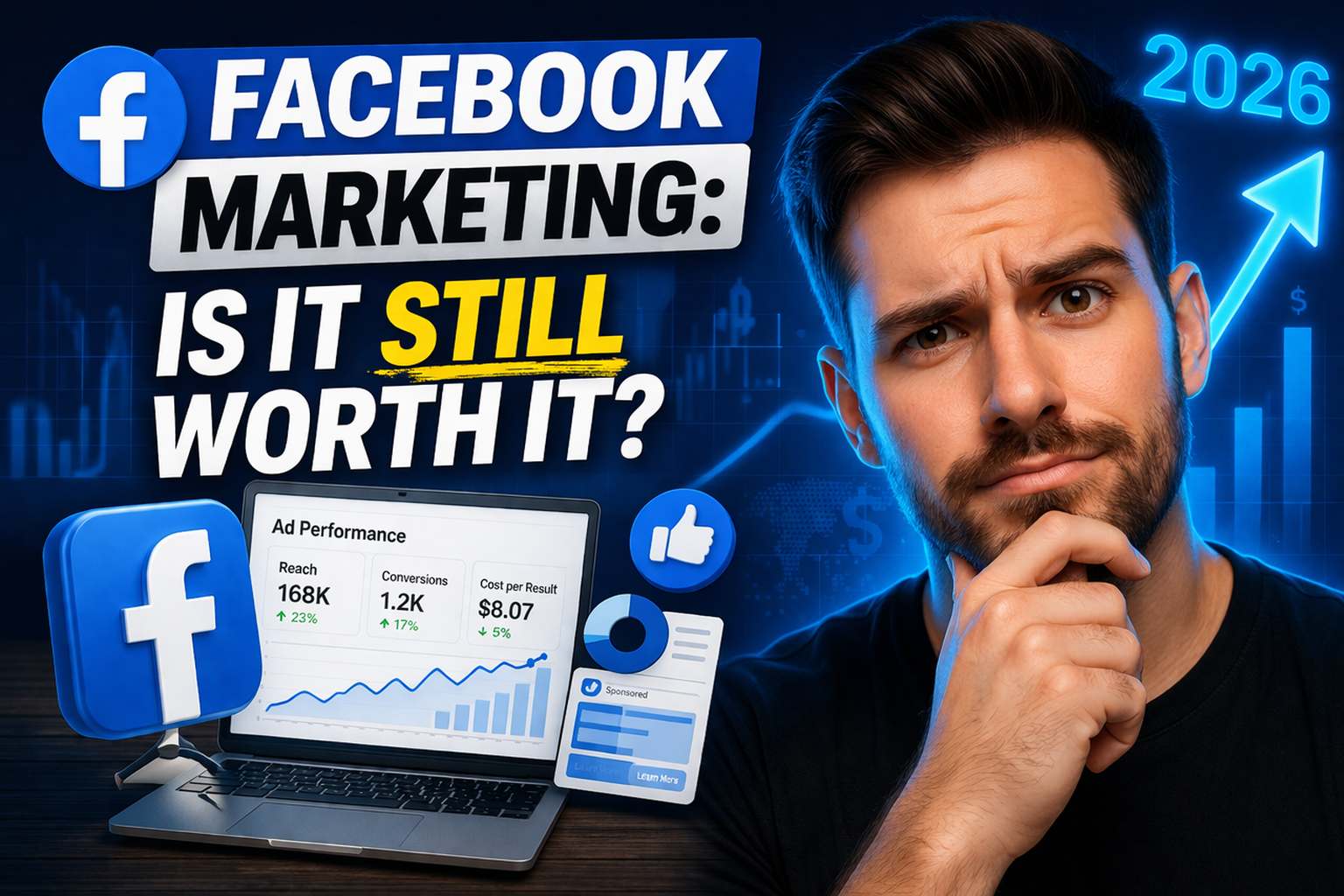
26 Mar Facebook Marketing: Is It Still Worth It in 2026?
Let’s be honest. Facebook has a reputation problem.
Younger audiences call it “the place where my aunty shares memes.” Ad costs have gone up. Organic reach is basically zero. Every year, someone declares Facebook dead for business. And in 2026, with TikTok, Instagram Reels, and AI taking over, the question feels more urgent than ever.
Should you still bother with Facebook? Is it worth your time, your budget, your sanity?
I’ve looked at the data. Talked to business owners. Analyzed what’s working and what’s not. Here’s the honest answer: it depends.
For some businesses, Facebook is still a goldmine. For others, it’s a money pit. The difference isn’t Facebook itself. It’s whether you understand what Facebook is in 2026—and whether your business fits what it does well.
Let’s break it down.
The Hard Truth: Facebook Has Changed
Let’s not sugarcoat it. The Facebook of 2015 is gone. Dead. Buried.
Organic reach is near zero. In 2012, a business page post reached about 16% of its followers. In 2026? Less than 1-2% for most pages. If you’re not paying, you’re not playing. That’s the reality.
Audience is aging. The platform’s fastest-growing demographic is 35-65. Teens and young adults are on TikTok, Instagram, Snapchat. If your target is under 25, Facebook is not your primary platform.
Ad costs have risen. More businesses competing. More sophisticated targeting. CPMs (cost per thousand impressions) are 2-3x what they were in 2018. You need bigger budgets to see results.
Algorithm favors content from friends and family. Business pages get deprioritized. Unless your content generates conversation, it disappears.
This sounds bleak. So why do I say Facebook is still worth it for some?
Because while Facebook lost its reach, it gained something else: targeting precision, mature advertising tools, and a user base with money to spend.
Who Facebook Is Still For in 2026
Facebook in 2026 is not for everyone. But for certain businesses, it’s still the best platform. Here’s who should be there.
1. Local Businesses
If you have a physical location—restaurant, salon, clinic, shop—Facebook is still essential. Why? Because people use Facebook to find local businesses. Events. Recommendations. Reviews. Community groups. Local Facebook groups are thriving. If you’re not visible there, you’re invisible to a huge local audience.
Example: A local bakery posts daily specials. Joins neighborhood groups. Runs local awareness ads. Drives foot traffic. Works beautifully.
2. Businesses Targeting 35+ Audiences
If your customers are 35-65, Facebook is where they are. They have money. They make purchasing decisions. They’re not on TikTok. They’re on Facebook, checking updates, sharing memories, following brands they trust.
Example: Retirement planning services. Luxury travel. Home improvement. Senior care. These businesses thrive on Facebook.
3. E-commerce with Visual Products
Facebook and Instagram (owned by Meta) are integrated. If you’re selling visually appealing products—fashion, home decor, gifts, beauty—Facebook’s ad platform (combined with Instagram) is still one of the most powerful. The targeting options are unmatched. The shopping features are mature.
Example: A boutique clothing store uses Facebook ads to target women in specific cities, with specific interests. Retargeting. Catalog ads. Dynamic product ads. Works.
4. Businesses with High-Value, Considered Purchases
If your product or service requires trust, education, and multiple touchpoints—consulting, coaching, courses, high-ticket items—Facebook is ideal. Why? Because it’s a relationship platform. People don’t buy a ₹50,000 coaching program from a TikTok video. They buy after seeing your content, joining your group, watching your videos, building trust over time. Facebook enables this.
Example: Business coaches. Financial advisors. High-end real estate. Premium courses. These build audiences on Facebook over months, then convert.
5. Niche Communities
Facebook Groups are still thriving. If your business can build or participate in niche groups—hobbyists, professionals, enthusiasts—the engagement is unmatched. Groups are where real conversations happen. Where trust is built. Where loyal customers are made.
Example: A gardening supply company runs a “Gardening in India” group. Thousands of members. Daily engagement. Trusted recommendations. Sales follow naturally.
Who Should Rethink Facebook
For some businesses, Facebook is no longer worth the investment. Be honest with yourself.
1. Businesses Targeting Under 25s
If your audience is teens and young adults, they’re not on Facebook. They’re on TikTok, Instagram, Snapchat. You’re wasting your budget.
Example: A trendy streetwear brand targeting college students. Facebook ads will have high costs, low engagement. TikTok is where they should be.
2. Low-Budget, B2C Products
If you sell low-cost items with thin margins (₹500 products), and you have no budget for ads, Facebook organic reach won’t cut it. You need scale to make ads work. Without scale, you’ll struggle.
Example: A ₹300 phone case business. To sell profitably, you need high volume. High volume requires ad spend. If you can’t afford it, Facebook won’t work.
3. Businesses with No Content Strategy
Facebook rewards engagement. If you’re not creating content that people want to comment on, share, react to, you’ll get zero reach. “Posting for the sake of posting” doesn’t work. If you don’t have a content engine, Facebook won’t reward you.
Example: A B2B industrial parts supplier. Their audience isn’t on Facebook. Their content is technical, not emotional. Facebook isn’t the right platform.
4. Businesses Expecting Quick Returns
Facebook is a relationship platform. It takes time. If you need sales today, paid ads can work. But organic growth? That’s months of consistency. If you’re impatient, you’ll be disappointed.
What Works on Facebook in 2026
If you decide Facebook is for you, you need to know what actually works. The tactics have changed.
1. Facebook Groups, Not Pages
Pages have near-zero organic reach. Groups have high engagement. Smart businesses are shifting focus to groups. Build a community around your niche. Be the facilitator. The trust you build there translates to sales.
Action: Create a group. Invite customers. Post daily. Answer questions. Facilitate conversations. Don’t sell—build relationships. Sales will follow.
2. Video, Video, Video
Facebook prioritizes video. Native video (uploaded directly, not YouTube links) gets more reach. Live video gets even more. Short-form Reels (shared to Facebook from Instagram) perform well.
Action: Post video weekly. Behind-the-scenes. Tips. Customer stories. Live Q&A. Reels. Video is non-negotiable.
3. Paid Ads (But Do It Right)
Organic reach is dead. If you want results, you’ll need to pay. But don’t just boost posts. Use the full ad platform.
Action: Use Facebook’s targeting. Create custom audiences (website visitors, email lists). Use lookalike audiences to find new customers. Test creatives. Track conversions. Scale winners. Cut losers.
4. Retargeting
This is where Facebook shines. Most website visitors don’t buy on first visit. Facebook retargeting shows them ads later, reminding them, building trust, driving them back.
Action: Install Meta Pixel. Create retargeting audiences. Show ads to people who visited but didn’t buy. Offer discount. Share testimonial. Answer objection.
5. Facebook Marketplace
Underrated. For local businesses selling physical products, Marketplace is free traffic. People searching for items near them.
Action: List products. Optimize titles. Use good photos. Respond quickly. Build reputation.
6. Events
Facebook Events still work, especially for local businesses. Promote events. Get RSVPs. Send reminders. Drive attendance.
Action: Create event page. Invite followers. Promote with small ad budget. Track attendance. Follow up with attendees.
7. Messenger Marketing
People still use Messenger. Automated sequences, broadcast messages, conversational commerce—all possible.
Action: Set up automated responses. Use Messenger ads. Collect subscribers. Send broadcasts (sparingly). Offer customer support.
Facebook Ads: What You Need to Know
If you’re going to run ads, understand the landscape.
Costs are higher. CPMs are up. But ROI can still be excellent if targeting is precise and creative is strong.
Creative matters more than ever. With higher costs, generic ads fail. You need strong visuals, clear copy, compelling offers. Test multiple creatives. Let data decide.
Video ads outperform image ads. Test both, but video usually wins.
Retargeting is essential. Cold audiences convert at 1-2%. Warm audiences (website visitors, email subscribers) convert at 5-10%. Retargeting is where ROI lives.
Advantage+ (AI-driven campaigns) works. Facebook’s AI now manages targeting, placement, optimization. Often outperforms manual setups. Test it.
Track everything. Install Meta Pixel. Set up conversions. Use UTM parameters. Measure ROI per campaign. Cut what doesn’t work. Scale what does.
Facebook Groups vs Pages: The Real Debate
This is the shift no one talks about enough.
Facebook Pages are for broadcasting. You post, followers see (if they’re lucky, 1-2%). Engagement is low. Connection is shallow.
Facebook Groups are for community. Members join because they want to be there. They see posts in their feed. They engage. They connect. They trust.
If you’re building a brand today, you need a group. Not a page. The group is where your superfans live. Where real conversations happen. Where sales are made.
Action: Create a group. Invite customers. Post valuable content. Facilitate discussions. Don’t just sell—build community. Your business will grow with it.
The Instagram Factor
Facebook owns Instagram. And in 2026, many businesses use Facebook for ads and Instagram for presence. The platforms are integrated.
You can run ads that appear on both. You can manage both from Meta Business Suite. You can cross-post content.
For many, the strategy is: Instagram for brand presence (visual, younger), Facebook for ads and groups (targeting, community). Both serve different purposes. Both matter.
If you’re already on Instagram, adding Facebook isn’t a big lift. Use the same content. Run the same ads. Extend reach.
The Verdict: Is It Worth It?
Let me give you a straight answer.
For local businesses: Yes. Facebook is still essential. Groups, Marketplace, local targeting, events—these work.
For businesses targeting 35+: Yes. Your audience is there. Build trust through groups and content. Convert through ads.
For e-commerce with visual products: Yes, combined with Instagram. The ad platform is powerful. Retargeting works.
For high-value, considered purchases: Yes. Facebook is a relationship platform. Build trust over time. Convert high-ticket.
For businesses targeting under 25: No. Focus on TikTok, Instagram, Snapchat.
For low-budget, low-margin products: Probably not. Organic reach is dead. Ads need scale. If you can’t afford to test and scale, you’ll struggle.
For businesses with no content strategy: No. Facebook rewards engagement. If you’re not creating content people want to engage with, you’ll see zero results.
Facebook in 2026 is not a magic bullet. It’s a mature platform. It requires strategy, budget, and consistency. But for the right businesses, it still delivers.
Conclusion: Don’t Abandon, Adapt
The question isn’t “Is Facebook dead?” It’s “Is Facebook right for my business?”
For many, the answer is yes—but only if you adapt. Forget the old playbook. Organic reach is gone. Pages are less relevant. Groups are where community lives. Ads are how you scale. Video is non-negotiable.
Facebook in 2026 is a different animal. But it’s still a powerful one. If you understand it, use it right, and match it to your business, it can still be one of your best marketing channels.
If you’re using it like it’s 2015, you’ll waste money. If you adapt to 2026, you’ll win.
The choice is yours.
Frequently Asked Questions (FAQs)
1. Is organic reach on Facebook really zero?
For business pages, organic reach is around 1-2% of followers. That means if you have 10,000 followers, about 100-200 see your post. Groups have higher reach (members see posts in their feed). If you’re not running ads or building a group, organic reach is minimal.
2. How much should I spend on Facebook ads to see results?
Start small—₹5,000-10,000 per month to test. Find what works. Scale winners. For serious results, many businesses spend ₹50,000-1,00,000 monthly. It depends on your margins, audience, and goals. Test, measure, scale.
3. Should I create a Facebook Page or a Group?
Both. But prioritize the group. Page is for basic presence, branding, ad campaigns. Group is for community, engagement, trust-building. Page reaches few. Group builds loyalty. If you have to choose one, choose group.
4. How do I get people to join my Facebook Group?
Invite existing customers. Promote in email newsletters. Add link to website. Run small ads targeting your audience to join. Post valuable content consistently—people join when they see value. Make joining worthwhile.
5. Is Facebook better than Instagram for business?
It depends. Instagram is better for visual brands, younger audiences, organic reach (though declining). Facebook is better for targeting, ads, local business, older audiences, and groups. Most businesses benefit from both—Instagram for presence, Facebook for community and ads.
No Comments