
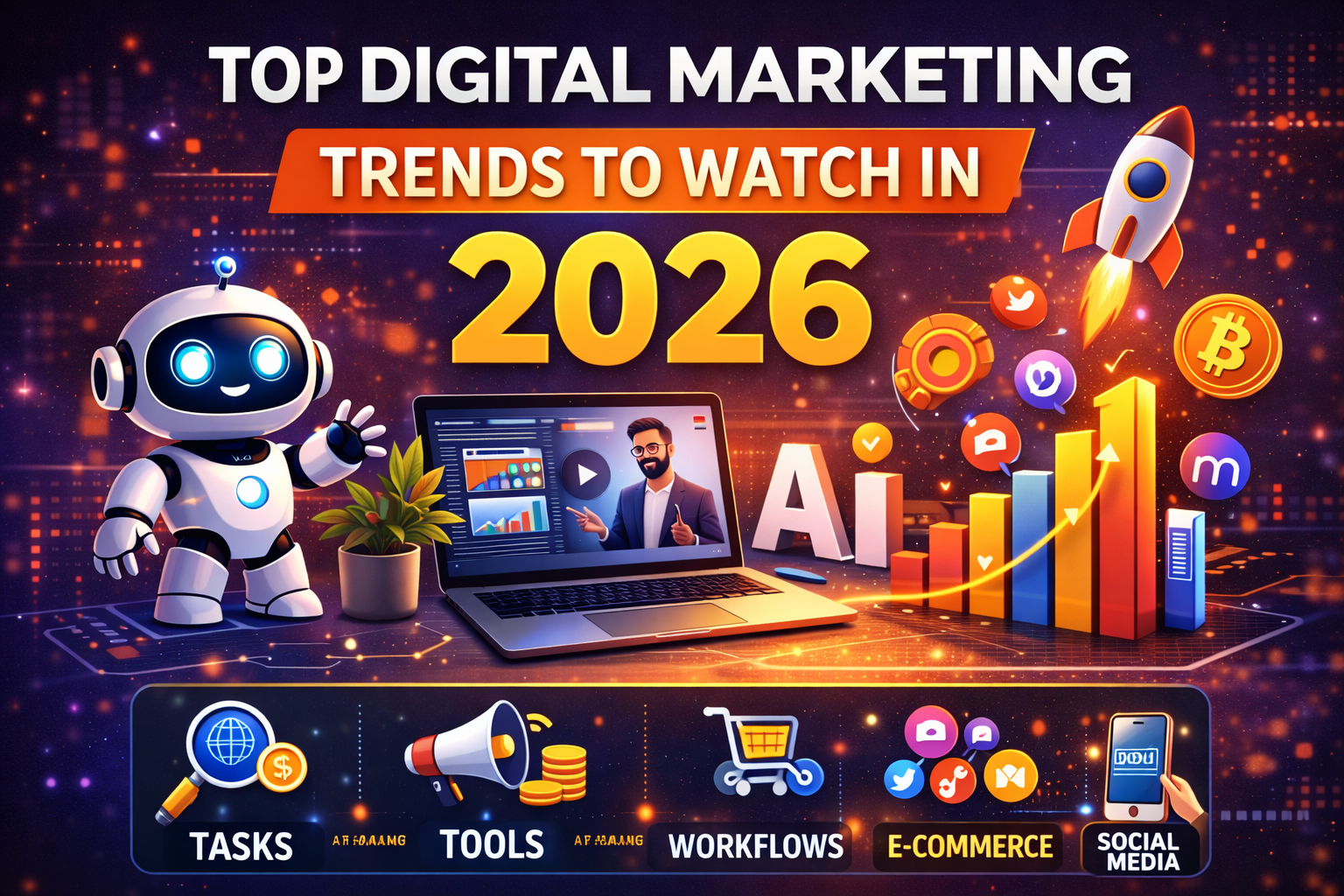
16 Mar Top Digital Marketing Trends to Watch in 2026
March 2026. We’re already three months in. The year is moving fast. And if you’re still planning your marketing strategy based on what worked last year, you’re already behind.
Not because everything changed on January 1st. It didn’t. Trends don’t flip like a switch. They build slowly, quietly, until one day you look around and realize the game is different.
That’s where we are now. The signals are clear. The direction is set. And the marketers who pay attention to what’s coming will have a massive advantage over those who don’t.
I’ve been watching the data, talking to industry leaders, and testing what’s working right now. Here’s what I see coming for the rest of 2026.
No hype. No “this one weird trick.” Just the trends that actually matter for real businesses trying to reach real people.
The Big Picture: Where We Are in 2026
Before we dive into specific trends, let’s understand the landscape.
2026 is the year of maturity. The chaos of the AI explosion (2023-24) has settled. The metaverse hype has faded. The pandemic-driven digital surge has normalized. What’s left is something more boring—and more useful.
Marketers are no longer asking “what’s the next big thing?” They’re asking “what actually works?”
Platforms are no longer chasing growth at any cost. They’re optimizing for retention and revenue.
Users are no longer impressed by shiny objects. They want value, authenticity, and connection.
Against this backdrop, here are the trends that will define the rest of 2026.
Trend #1: AI Agents Replace AI Tools
Remember when ChatGPT felt like magic? Now it’s just another tab open in your browser.
The shift in 2026 is from AI tools (things you use) to AI agents (things that work for you).
What’s changing: Instead of opening a chatbot and typing prompts for every task, you’ll give goals to agents that work in the background. They’ll research, create, schedule, and optimize without you micromanaging.
Example: Not “write a blog post about SEO” (a prompt). But “manage our SEO content strategy” (a goal). The agent researches keywords, creates a content calendar, writes drafts, schedules posts, and reports back weekly.
What this means for you: The skill of “prompt engineering” is fading. The new skill is “agent management”—knowing how to set goals, provide feedback, and supervise digital workers. Marketers who master this will do the work of teams.
Where we see it: Microsoft Copilot, Google’s Project Astra, OpenAI’s Operator, and dozens of specialized agents for marketing tasks.
Trend #2: Search Everywhere (Not Just Google)
For years, “search” meant Google. Not anymore.
In 2026, people search everywhere:
- Younger users search TikTok before Google (especially for recommendations)
- Professionals search LinkedIn for industry insights
- Shoppers search Amazon for products
- Community members search Reddit for honest opinions
- Chat users search ChatGPT for answers
What’s changing: SEO now means optimizing for multiple platforms. Your content needs to be found on YouTube, Amazon, Reddit, and AI chatbots—not just Google.
Example: A restaurant in 2026 needs to show up on Google Maps (obvious), but also on Instagram Explore (for foodies), on TikTok (for viral dishes), on Zomato (for orders), and on ChatGPT (when someone asks “where should I eat in this neighborhood?”).
What this means for you: Platform diversification isn’t optional. Your audience is searching in many places. You need to be found in all of them.
Where we see it: TikTok’s search ads, LinkedIn’s SEO for profiles and articles, Reddit’s rising Google visibility, Amazon’s dominance in product search.
Trend #3: Video Is Still King (But Longer)
Short-form isn’t dying. Reels and Shorts still work. But 2026 is seeing a surprising shift toward longer video.
What’s changing: After years of shrinking attention spans, something flipped. People want depth again. YouTube channels posting 20-40 minute videos are growing faster than they have in years. Podcasts are being watched, not just listened to. Webinars that actually teach something are outperforming quick tips.
Example: A cooking channel that posts 3-minute recipe videos gets views. A cooking channel that posts 30-minute deep dives into techniques builds a community that buys their cookware, attends their workshops, and trusts their recommendations.
What this means for you: Mix your formats. Keep short-form for reach and awareness. Add long-form for depth and trust. The brands that do both will win.
Where we see it: YouTube’s push for podcasts, Spotify’s video support, Instagram’s longer Reels limit, LinkedIn’s native video growth.
Trend #4: Communities Over Audiences
Having followers is nice. Having a community is better.
What’s changing: Brands are shifting from broadcasting to one-way audiences to facilitating conversations within communities. The metrics are different: not impressions and reach, but engagement, loyalty, and member-generated content.
Example: A fitness brand with 100,000 Instagram followers (audience) vs a fitness brand with 5,000 paying community members who share workouts, motivate each other, and buy every product (community). The second is smaller and more valuable.
What this means for you: Build spaces where your audience can talk to each other, not just to you. WhatsApp groups, Discord servers, Slack communities, paid memberships. Owned spaces where algorithms can’t interrupt.
Where we see it: WhatsApp Communities, Discord’s brand partnerships, Circle and Mighty Networks for paid communities, Facebook Groups (still huge for niches).
Trend #5: Zero-Click Content
More and more, people get answers without clicking through to websites.
What’s changing: Google’s AI Overviews (formerly SGE) answer questions directly in search results. ChatGPT gives complete answers. Social platforms keep users on-platform with native content. The result? Fewer clicks to websites.
Example: Someone searches “how to clean leather shoes.” Google’s AI shows a step-by-step guide right in the search results. The user never clicks any website. Your detailed blog post gets zero traffic—even though it answered the question.
What this means for you: Your content needs to work even when people don’t click. Optimize for being the source that AI pulls from. Make your content so good that platforms choose you as their answer. And build direct relationships (email, communities) so you’re not dependent on search traffic.
Where we see it: Google AI Overviews, ChatGPT citations, Perplexity AI, social platforms keeping users on-platform.
Trend #6: Authenticity Becomes the Only Differentiator
AI can generate content. It can’t generate genuine experience.
What’s changing: Audiences have gotten extremely good at detecting AI-generated content. Generic, bland, “corporate voice” content gets scrolled past. Content that feels human—with real opinions, real stories, real personality—stands out.
Example: Two LinkedIn posts about marketing tips. One is polished, generic, and clearly AI-written. The other is slightly messy, has a strong opinion, and shares a personal failure. The second gets 10x the engagement.
What this means for you: Let your humanity show. Share your failures, not just successes. Have opinions, not just tips. Be specific, not generic. The things AI can’t do—be vulnerable, be opinionated, be weird—are now your competitive advantage.
Where we see it: Every platform. The accounts growing fastest are the ones that feel most human.
Trend #7: LinkedIn’s Quiet Domination
While everyone obsessed over TikTok and Instagram, LinkedIn quietly became essential.
What’s changing: LinkedIn is no longer just for job seekers and recruiters. It’s become the default platform for professional content, B2B marketing, and thought leadership. Engagement is up. Video is working. Text-only posts are thriving.
Example: A B2B software company in 2026 spends 70% of its content budget on LinkedIn. Not because it’s trendy, but because that’s where its customers actually are—reading, engaging, and making buying decisions.
What this means for you: If you’re in B2B or professional services, LinkedIn is non-negotiable. Post consistently. Engage genuinely. Build a presence where decisions get made.
Where we see it: LinkedIn’s record engagement, video push, newsletter platform, and growing ad revenue.
Trend #8: WhatsApp as a Primary Channel
In India and many other markets, WhatsApp has become the primary communication channel for everything—including business.
What’s changing: WhatsApp Business is no longer just for support. It’s for marketing, sales, and community building. Broadcast lists, status updates, and one-on-one conversations are replacing email for many businesses.
Example: A local restaurant in 2026 doesn’t just have a website. They have a WhatsApp channel where they send the daily menu, take orders, and build relationships with regulars. Customers love it because it’s convenient and personal.
What this means for you: Meet your customers where they already are. For billions of people, that’s WhatsApp. Build a strategy for conversational marketing—real conversations, not just broadcasts.
Where we see it: WhatsApp Business app, WhatsApp API for large businesses, Meta’s integration with ads.
Trend #9: Performance Max and Smart Bidding Dominate Ads
Google and Meta’s AI-powered ad products are now mature. And they’re beating humans at optimization.
What’s changing: Manual bid management is dying. Performance Max (Google) and Advantage+ (Meta) use AI to allocate budgets across channels, audiences, and creatives. The results? Often better than human optimization—when set up correctly.
Example: An e-commerce brand in 2026 doesn’t have a person managing Google Shopping, another for YouTube, another for Display. They have one person managing Performance Max, setting goals and budgets, and letting AI do the rest.
What this means for you: The skill is shifting from manual optimization to strategic direction. You need to understand how these tools work, what inputs matter, and how to interpret results. The days of granular manual bidding are ending.
Where we see it: Google Performance Max, Meta Advantage+, automated bidding across platforms.
Trend #10: Privacy-First Marketing
Third-party cookies are finally gone. Tracking is harder. Privacy regulations are tighter.
What’s changing: Marketers can no longer rely on tracking users across the web. The signals that powered retargeting and audience building for years are fading.
Example: A brand in 2026 can’t just track someone from blog to Facebook to purchase and attribute it all. They need different approaches: first-party data, contextual targeting, and relationships that don’t need tracking.
What this means for you: Build your first-party data. Email lists. WhatsApp contacts. Community members. Customer information you own, not rent. And get good at contextual advertising—reaching people based on what they’re reading now, not what they did months ago.
Where we see it: Google’s Privacy Sandbox, Apple’s App Tracking Transparency, the slow death of third-party cookies.
Trend #11: Micro-Influencers > Celebrities
The era of paying celebrities millions for one post is fading. Micro-influencers (1,000-100,000 followers) are delivering better ROI.
What’s changing: Audiences trust people who feel like them. A micro-influencer with 10,000 engaged followers often drives more sales than a celebrity with 10 million passive followers. The connection is real. The recommendation feels genuine.
Example: A skincare brand in 2026 works with 50 micro-influencers—real users who genuinely like the product—instead of one big celebrity. The cost is lower, the content is more authentic, and the sales are higher.
What this means for you: Look for influence, not just followers. Engagement rate matters more than reach. Authentic fit matters more than fame. Build relationships with creators who actually love what you do.
Where we see it: Every platform. Micro-influencers now drive the majority of influencer marketing ROI.
Trend #12: Sustainability Marketing (Done Right)
Consumers care about sustainability. But they’re also skeptical of greenwashing.
What’s changing: Generic “we care about the planet” messaging doesn’t work anymore. Consumers want specifics, proof, and transparency. They’ll punish brands that make vague claims without backing them up.
Example: A fashion brand in 2026 doesn’t just say “sustainable.” They show exactly where materials come from, how workers are paid, and what their carbon footprint is. They invite scrutiny. They’re transparent even when it’s not perfect.
What this means for you: If sustainability is part of your brand, be specific. Be honest. Be transparent. If it’s not, don’t fake it. Consumers can smell inauthenticity from miles away.
Where we see it: B Corp certification, carbon labeling, supply chain transparency, and consumer demand for proof.
What This Means for Your Business
Looking at these trends, a few themes emerge:
AI is now infrastructure, not novelty. Use it everywhere, but don’t lead with it. The goal is to be more human, not more automated.
Own your channels. Algorithms change. Platforms fade. Build relationships you control—email, WhatsApp, communities.
Depth beats frequency. One great piece of content outperforms 20 mediocre ones. Long-form is back because people want real value.
Humanity is the differentiator. In a world of AI-generated everything, being genuinely human is your biggest advantage.
Meet people where they are. Search is everywhere. Video is everywhere. Communities are everywhere. Be present where your audience actually spends time.
The rest of 2026 belongs to marketers who understand these shifts. Not the ones who chase every new shiny object. The ones who see where things are heading and position themselves accordingly.
That could be you.
Frequently Asked Questions (FAQs)
1. Which trend is most important for small businesses?
For small businesses, focus on Trend #8 (WhatsApp as a primary channel) and Trend #4 (communities over audiences). These allow you to build direct, personal relationships without big budgets. You can’t outspend large competitors, but you can out-connect them. WhatsApp and community building level the playing field.
2. Do I need to be on every platform mentioned?
Absolutely not. The worst strategy is trying to be everywhere. Pick 2-3 platforms where your actual customers spend time. Do them exceptionally well. Ignore the rest. Depth on the right platforms beats presence on all platforms.
3. How do I prepare for zero-click search?
Focus on being the source that AI pulls from. Create authoritative, well-structured content. Build direct relationships (email, communities) so you’re not dependent on search traffic. And optimize for visibility even when clicks don’t happen—brand mentions matter.
4. Is short-form video dead?
Not dead, but oversaturated. Short-form still works for reach and awareness. But the bar is higher. You need either exceptional production or genuine originality to stand out. Consider adding long-form to build deeper trust.
5. How do I make my brand feel more human?
Show your flaws. Share failures, not just successes. Have opinions. Be specific about your experiences. Let real people from your team talk (not polished spokespeople). Respond to comments like a human, not a robot. The more you try to sound “professional,” the less human you sound. Relax. Be yourself.
No Comments