
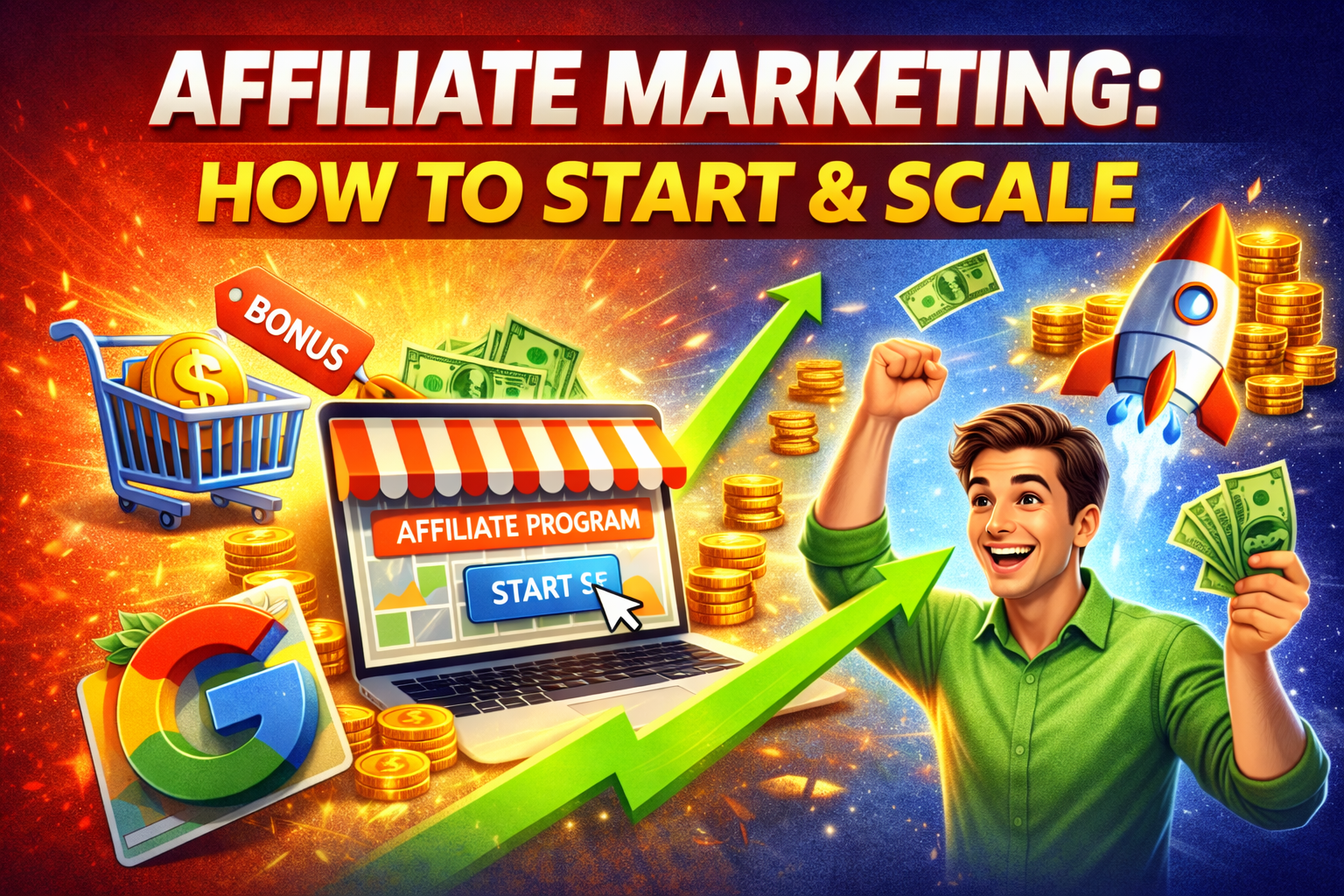
06 Apr Affiliate Marketing: How to Start and Scale in 2026
Imagine earning money while you sleep. You create content once. Months later, someone clicks your link and buys. You wake up to a commission notification. You did nothing. You weren’t even awake.
That’s affiliate marketing. And it’s not a dream. It’s a real business model that millions of people use to earn full-time incomes.
But here’s what the gurus won’t tell you: it’s not easy money. It’s not “post a link and get rich.” It takes work. Strategy. Patience. Most people quit because they expect results in weeks. The ones who succeed treat it like a real business.
In 2026, affiliate marketing is more competitive than ever. But it’s also more accessible. The tools are better. The programs are everywhere. And the fundamentals that worked ten years ago still work today.
Let me show you how to start from zero and scale to real income—without hype, without shortcuts, and without buying expensive courses that promise the world.
What Is Affiliate Marketing? (Simple Explanation)
In plain language: you recommend a product. Someone buys through your unique link. You get a commission. That’s it.
You’re essentially a digital salesperson. But instead of working for one company, you work for yourself, promoting products you actually believe in.
Example: You have a blog about fitness. You write a post about the best running shoes. You include an Amazon link to a shoe you recommend. Someone reads your post, clicks the link, buys the shoes. Amazon pays you a percentage of the sale. You made money by helping someone make a good decision.
The product creator wins (they made a sale). The customer wins (they got a good recommendation). You win (you earned a commission). Everyone wins.
That’s affiliate marketing.
Why Affiliate Marketing in 2026?
You might wonder: isn’t this old news? Hasn’t everyone already done it?
Yes, affiliate marketing has been around for decades. But here’s why 2026 is actually a great time to start:
Trust is scarce. People are tired of being sold to by big brands. They trust individuals—bloggers, YouTubers, reviewers—more than they trust companies. That’s you.
AI changed content creation. You can now create content faster than ever. AI helps with research, outlines, drafts, and editing. The barrier to entry is lower.
More programs than ever. Every company with a product wants affiliates. From Amazon to small Etsy shops, there’s a program for everything.
Passive income still works. Create something once, earn from it for years. That dream is real—if you build the right way.
Low barrier to entry. You can start with zero rupees. No product to create. No inventory to hold. No customer service. Just promotion.
Sounds good? Let’s talk about how to actually do it.
Step 1: Pick Your Niche (The Most Important Decision)
This is where most beginners fail. They pick something “profitable” that they don’t care about. Or they pick something they love that nobody buys.
You need both: interest AND demand.
How to find your niche:
Start with what you know. What are you genuinely interested in? Fitness? Cooking? Parenting? Gaming? Personal finance? Travel? Tech? Write down everything.
Now check if people actually spend money there. Go to Amazon. Search for products in your interest area. Are there bestsellers? Are there multiple brands? That’s demand.
Check competition. Google your topic. Are there blogs, YouTube channels, influencers? Competition is good—it means money is being made. No competition usually means no money (or a very tiny market).
Narrow it down. Not “fitness.” That’s too broad. “Fitness for women over 40.” “Home workouts without equipment.” “Yoga for beginners.” Specific niches are easier to dominate.
Good niches in 2026:
- Health and wellness (always huge)
- Personal finance (money never goes out of style)
- Tech and gadgets (new products constantly)
- Parenting and baby (emotional purchases = higher conversions)
- Home improvement (people spend on their spaces)
- Pet care (pet parents spend without thinking)
- Sustainable living (growing demand)
- Online learning (courses, tools, software)
- Hobbies (gardening, gaming, photography, cooking)
- Digital marketing (meta, but works if you’re genuinely helpful)
Pick one. Commit. Don’t second-guess for at least six months. Niche hopping kills progress.
Step 2: Choose Your Platform (Where Will You Build?)
You need a place to reach people. In 2026, you have options.
Blog/Website: The classic. You own it. Google sends traffic for years. Best for long-term, passive income. Requires writing skills and patience (SEO takes time).
YouTube: Video is powerful. People trust faces. Great for product reviews, tutorials, demonstrations. Harder to scale (video takes time), but loyal audience.
Social Media (Instagram, TikTok, Facebook): Faster growth, but shorter content lifespan. Links are harder (bio only, not in posts on some platforms). Great for visual niches.
Email Newsletter: Direct connection. No algorithm. High trust. But you need to build the list first, which takes time.
Multiple platforms: The best strategy. Start with one primary platform, then repurpose content to others. Blog post becomes YouTube video becomes social posts becomes newsletter.
For beginners in 2026, I recommend starting with a blog + YouTube. Blog for long-term search traffic. YouTube for building trust and face-to-face connection. Both feed each other.
Step 3: Find Affiliate Programs to Join
Once you have a niche and platform, you need products to promote.
Types of affiliate programs:
Marketplaces (Amazon Associates, Flipkart Affiliate, CJ Affiliate, ShareASale): One account, thousands of products. Easy to start, but lower commissions (1-10%). Good for beginners.
Individual brand programs: Many companies run their own affiliate programs. Higher commissions (10-50%), but you need to apply and get approved.
Digital products (courses, software, memberships): Often 30-50% commissions. No shipping, no inventory. Great for niches like online learning, marketing tools, SaaS.
Service-based (web hosting, SaaS tools, consulting): Recurring commissions (you earn every month as long as customer stays). Best for long-term passive income.
How to find programs:
- Google “[your niche] + affiliate program”
- Check products you already use and love—they often have programs
- Join affiliate networks and search your category
- See what competitors are promoting (use tools to see their links)
Start with 3-5 products you genuinely believe in. Don’t promote junk for a quick commission. Your reputation is all you have.
Step 4: Create Content That Helps (Not Just Sells)
This is the work. The actual creating. And it’s where most people quit.
Your content should help people make better decisions. Not “buy this.” But “here’s what to look for, here are your options, here’s what I recommend and why.”
Content types that work for affiliate marketing:
Product reviews: Honest, detailed, personal. What’s good, what’s not, who it’s for, who it’s not for. Include your affiliate link.
Comparison posts: Product A vs Product B. Which is better for which situation? Help people choose.
Best-of lists: “Top 10 running shoes for beginners.” “Best laptops for students.” Roundups convert well.
How-to guides: “How to start yoga at home.” Naturally recommend products within the guide (mats, blocks, clothes).
Tutorials: Show people how to use a product. Video works great for this.
Gift guides: Seasonal. “Best gifts for dad.” “Gifts under ₹1000.” Perfect for conversions.
The key: be genuinely helpful. If your only goal is to sell, people will feel it. If your goal is to help, sales follow naturally.
Step 5: Drive Traffic (Getting People to Your Content)
You have content. You have links. But nobody’s visiting. Traffic is the engine.
Free traffic methods:
SEO (Search Engine Optimization): The long game. Write content that answers what people search for. Takes 3-6 months to see results, but traffic keeps coming for years. Worth the wait.
Social media: Share your content on platforms where your audience hangs out. Pinterest is underrated for blog traffic. Instagram and TikTok for visual niches. LinkedIn for B2B.
YouTube: Videos rank in Google and YouTube search. One video can bring traffic for years.
Email list: Build it slowly. Send your content to subscribers. They’re your most loyal audience.
Quora/Reddit: Answer questions genuinely. Include your link only when truly helpful. Don’t spam—you’ll get banned.
Paid traffic (once you have money): Facebook/Instagram ads, Google Ads, Pinterest ads. Only do this after you’ve proven your content converts. Test small, scale what works.
For beginners, focus on SEO and one social platform. Free, sustainable, builds over time.
Step 6: Build Trust (The Real Currency)
Here’s the secret: people don’t buy through links from strangers. They buy from people they trust.
How to build trust:
Be honest. If a product has flaws, mention them. If it’s not for certain people, say so. Honesty builds credibility.
Only promote what you’ve used. Or at least researched deeply. Your reputation is on the line with every recommendation.
Show your face. Video, photos, about page. People trust humans, not logos.
Be consistent. Show up regularly. Post on schedule. Respond to comments.
Add value first. Most of your content should help without asking for anything. The 80/20 rule: 80% helpful, 20% promotional.
Disclose affiliate links. It’s legally required and builds trust. “This post contains affiliate links. If you buy through them, I earn a commission at no extra cost to you.” Honest and transparent.
Trust takes time. There are no shortcuts. But once you have it, you have an asset that pays forever.
How to Scale (From Pocket Money to Real Income)
You’ve started. You’re earning a little. Now you want more. Here’s how to scale in 2026.
1. Create more content. More helpful content = more traffic = more commissions. Simple math. Double your content, double your income (eventually).
2. Update old content. Products change. Prices change. Information becomes outdated. Refresh your old posts, and they’ll perform like new.
3. Add higher-commission programs. Amazon commissions are low (1-10%). Find direct programs with 20-50% commissions. Promote those alongside Amazon.
4. Build an email list. Your website visitors leave and never return. Capture emails. Send them helpful content and product recommendations. Email converts better than any other channel.
5. Master one traffic source. Deep expertise in SEO or YouTube beats being average at many. Go deep. Become the expert.
6. Create your own products. Eventually, create your own course, ebook, or tool. 100% profit. No affiliate commission. This is the ultimate scale.
7. Hire help. When you have money, hire writers, video editors, virtual assistants. Create more without doing more yourself.
Common Mistakes Beginners Make
Learn from others’ failures so you don’t make them yourself.
Mistake 1: Promoting everything. Every product, every program, every link. You look like a spammer, not a trusted advisor. Be selective.
Mistake 2: No niche. General blog about everything = no one trusts you on anything. Pick a niche and own it.
Mistake 3: Ignoring SEO. Social media traffic stops when you stop posting. SEO traffic keeps coming. Learn basic SEO early.
Mistake 4: No email list. You’re renting traffic from Google and social platforms. Build an email list you own.
Mistake 5: Quitting too early. Affiliate marketing takes time. Six months of work might show nothing. Then month seven takes off. Quitting at month six is tragic.
Mistake 6: Not disclosing links. Hiding affiliate links destroys trust and can get you in legal trouble. Be transparent.
Mistake 7: Thin content. 300-word posts with affiliate links don’t rank and don’t convince. Create real value. 1000+ words minimum for reviews and guides.
Realistic Income Expectations
Let’s be honest about money. No “make ₹1 lakh in your first week” nonsense.
Month 1-3: Zero rupees. Maybe a few hundred if you’re lucky. You’re building foundation.
Month 4-6: ₹5,000-15,000 per month if you’re consistent. First real earnings.
Month 7-12: ₹20,000-50,000 per month. Content compounding starts working.
Year 2: ₹50,000-1.5 lakhs per month. You have a real business.
Year 3+: ₹2 lakhs+ per month. Scaling with team, multiple sites, higher-ticket products.
These are ranges. Some do better, some worse. But this is realistic for someone who treats it like a real business, not a hobby.
Tools You’ll Need in 2026
For website: WordPress + hosting (Hostinger, SiteGround, Bluehost). Or Blogger for free (limited but possible).
For email: ConvertKit, MailerLite, Mailchimp. Free tiers available.
For SEO: Ubersuggest (free tier), Google Keyword Planner (free), Ahrefs (paid).
For analytics: Google Analytics 4 (free).
For link management: Pretty Links (WordPress plugin) or Bitly (free).
For design: Canva (free).
For research: Amazon bestsellers, Reddit, Quora, YouTube comments.
Start with free tools. Upgrade when you have income.
Conclusion: Start Today, Get Paid for Years
Affiliate marketing in 2026 isn’t a get-rich-quick scheme. It’s a get-rich-slowly, build-something-real, create-assets-that-last business.
The beauty? You can start with zero rupees. No product to create. No inventory. No customer service. Just you, your knowledge, and your willingness to help people make better decisions.
One piece of content can pay you for years. One YouTube video can bring commissions for a decade. One blog post can fund your life.
But only if you start. Only if you stick with it when the early months show nothing. Only if you keep creating when it feels like no one’s watching.
The people who do that? They’re the ones earning while they sleep. They’re the ones with freedom. They’re the ones who look back and say “I’m so glad I started when I did.”
That could be you. Today is the best day to begin.
Frequently Asked Questions (FAQs)
1. How much money do I need to start affiliate marketing?
Zero rupees. You can start with a free Blogger blog, free Canva for images, and free social media accounts. As you earn, reinvest in hosting, email tools, and better content. Many successful affiliates started with nothing but time and effort.
2. Do I need a website? Can’t I just use social media?
You can use social media alone, but it’s risky. Platforms change algorithms, ban accounts, and limit reach. A website you own is permanent. Best strategy: use social media to drive traffic to your website, where you control the experience and capture emails.
3. How do I get people to click my links?
By creating content that’s genuinely helpful. People click when they trust you and when the link clearly leads to something useful. Don’t hide links or trick people. Be transparent: “Here’s the product I recommend. Here’s my link if you want to check it out.”
4. Is affiliate marketing saturated?
Some niches are crowded, but “saturated” is the wrong word. There’s always room for someone who provides genuine value, has a unique voice, and truly helps people. Most “competition” is mediocre. Be better, be more helpful, be more human—you’ll find your audience.
5. How long until I see my first commission?
With consistent effort, most people see their first commission within 3-6 months. It might be small—₹500 from one sale. But that first sale proves it works. From there, it compounds. The key is not quitting before that first sale happens.
No Comments