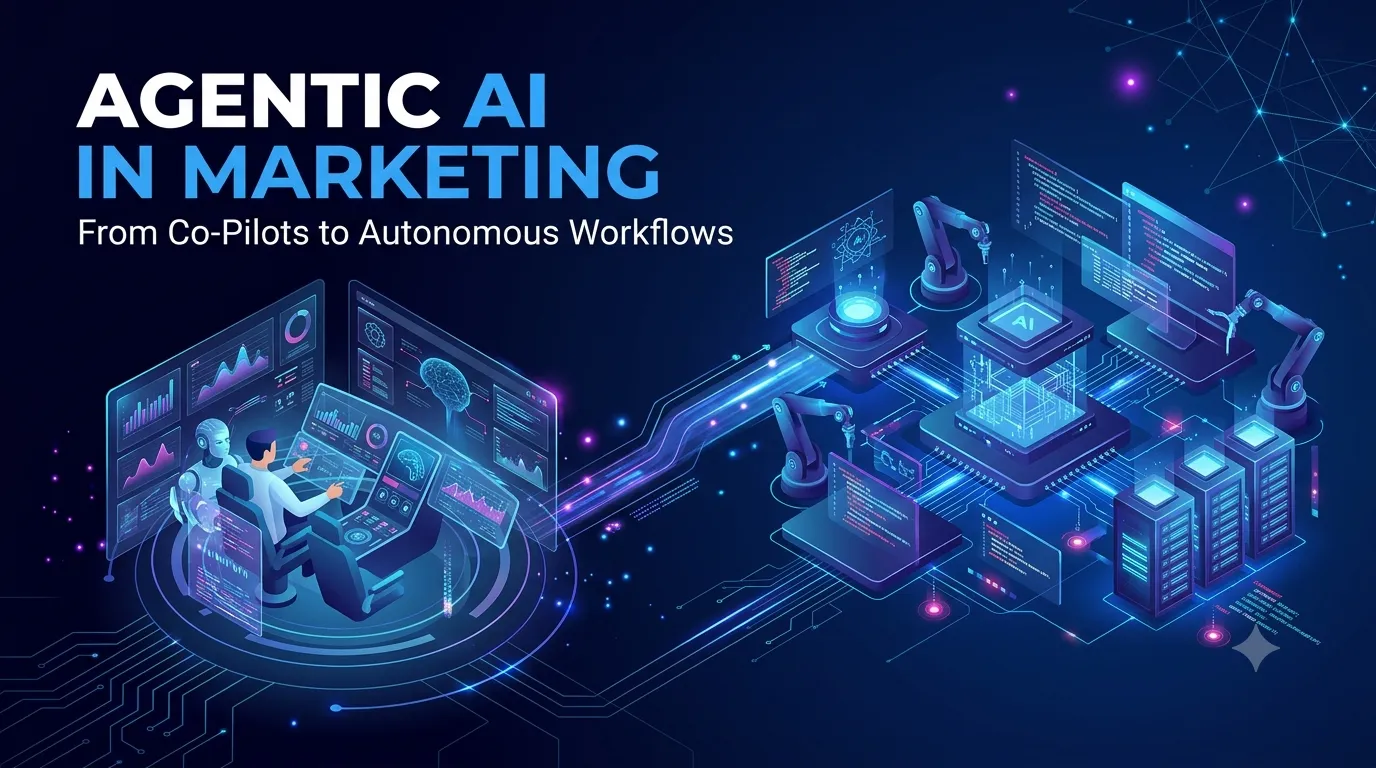
Let me ask you something. How many times have you used ChatGPT to draft an email, write a caption, or brainstorm ideas? If you're like most digital marketing professionals, the answer is: "All the time."
Generative AI has been a game-changer. It's made us faster, more efficient, and more creative. But here's the thing: Generative AI is just the beginning. We're now entering a new era — the era of Agentic AI. And it's going to transform marketing in ways that make ChatGPT look like a calculator.
In this guide, I'll explain what agentic AI is, how it's different from generative AI, and how it's shifting marketing from co-pilots to autonomous workflows. Whether you're a digital marketing professional, a business owner, or a student taking a digital marketing course, this is your introduction to the next big thing.
Let's dive in.
1. What Is Agentic AI? (And Why It's Not Just Generative AI)
First, let's get clear on the difference. Generative AI creates content. You give it a prompt, and it generates text, images, or video. It's reactive — it waits for you to ask it something [citation:8].
Agentic AI does something much more powerful. It doesn't just generate content. It perceives, reasons, acts, and learns [citation:8].
- Perceives: It understands its environment and gathers information
- Reasons: It processes information and makes decisions
- Acts: It executes actions autonomously to achieve goals
- Learns: It adapts and improves over time based on feedback
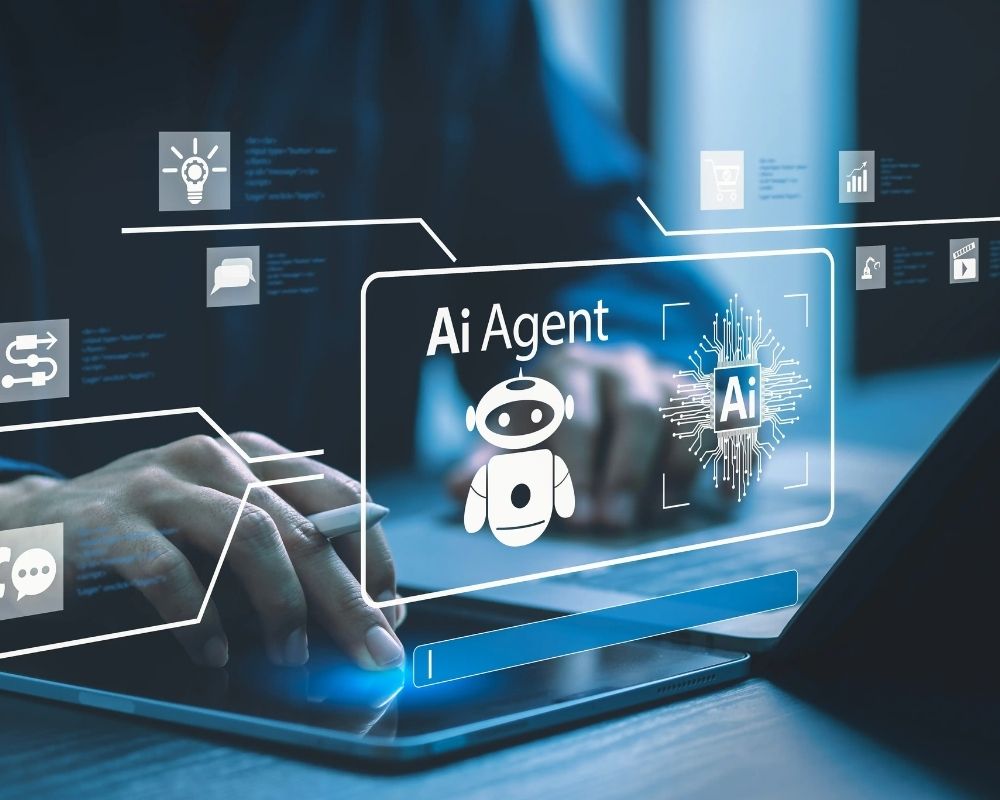
Think of it this way: Generative AI is like a talented assistant who does what you ask. Agentic AI is like a teammate who understands your goals, takes initiative, and gets things done without being told every step [citation:4].
2. Why Agentic AI Matters for Marketing
Here's the reality: Marketing teams are overwhelmed. According to Salesforce, 41% of workers' time is lost to low-value, repetitive tasks [citation:7]. Marketers are spending hours on manual segmentation, campaign setup, and performance analysis — time that could be spent on strategy and creativity.
Agentic AI is designed to fix this. It automates the repetitive work and gives marketers time to focus on what matters: strategy, creativity, and building relationships [citation:8].
2.1 The Shift from "Ask AI" to "Give AI an Objective"
This is the key shift. With generative AI, you ask: "Write me a caption." With agentic AI, you say: "Here's my goal — build a campaign that achieves it." The AI takes over from there [citation:3].
It can monitor signals, detect opportunities, recommend actions, and even execute workflows with human approval [citation:3].
3. How Agentic AI Works in Marketing
Agentic AI isn't just one tool. It's a system of autonomous agents that work together. Appier, a leading AI-native software company, recently launched eight specialized AI agents across its product portfolio [citation:1].
3.1 AI Agents Across the Customer Journey
These agents are purpose-built for specific tasks [citation:1]:
- Coding Agent: Auto-generates playable ads and interactive videos
- Director Agent: Produces ad creatives, brand videos, and interactive assets while enforcing brand style
- ROI Agent: Automates incrementality testing to maximize revenue impact
- Campaign Agent: Automates campaigns end-to-end from planning through execution
- Sales Agent: Uses conversational interactions to uncover purchase intent and drive conversions
- Service Agent: Provides 24/7 customer support grounded in the brand's knowledge base
- Audience Agent: Leverages predictive segmentation to architect the most profitable audience strategies
- Insight Agent: Transforms data into real-time, visual insights
When these agents interconnect, they establish seamless agentic workflows that further improve precision and efficiency [citation:1].
4. What Agentic AI Looks Like in Action
Let's look at some real-world examples of agentic AI in marketing.
4.1 Launching a New Product Campaign
Imagine you want to launch a new credit card product targeting young adults. Instead of spending weeks on briefs and meetings, you start with a simple prompt: "Help me create a campaign to support the launch of a new credit card product targeting 20- to 30-year-olds." [citation:4]
Agentic AI then [citation:4]:
- Pulls performance data from past campaigns to identify the right audience
- Refines the target segment based on recent engagement trends
- Designs a tailored customer journey with the right channels and timing
- Generates personalized messaging and creatives for each step
All of this happens in hours, not weeks [citation:4].
4.2 Smart Personalization
Adobe's Journey Agent lets marketers generate multistep customer experiences using natural language. You can say: "Design a holiday journey for gold-tier travelers with a follow-up push notification," and the agent builds it [citation:5].
It also monitors performance, flags audience overlap, detects underperforming journeys, and suggests optimizations — all automatically [citation:5].
5. The Benefits of Agentic AI for Marketers
5.1 Hyper-Personalization at Scale
Agentic AI enables true one-to-one personalization by analyzing customer behavior in real-time and dynamically adjusting targeting, content, and timing [citation:8].
As Gartner predicts, 60% of brands will use agentic AI to deliver streamlined one-to-one interactions by 2028 [citation:9].
5.2 End-to-End Campaign Automation
Agentic AI can handle the entire campaign lifecycle [citation:8]:
- Campaign ideation and content generation
- Audience selection
- Multi-channel deployment
- Performance monitoring and real-time optimization
5.3 Reduced Reacquisition Costs
One of the biggest wins is customer retention. According to Netcore, only about 10% of marketing budgets go to retention, while 70% of spend goes to reacquiring past customers [citation:10]. Agentic AI breaks this cycle by keeping customers engaged and loyal.
6. What This Means for Your Career
Here's the truth: Agentic AI isn't replacing marketers. It's elevating them.
As AI handles more execution work, marketing roles are shifting [citation:2]:
- From tactical execution to strategic oversight
- From campaign management to supervising intelligent systems
- From repetitive tasks to creativity and innovation
Skills like strategic thinking, digital dexterity, and cross-functional problem-solving are becoming core to how marketing teams create value [citation:2].
7. How to Prepare for Agentic AI
7.1 Get Your Data Foundation Right
Agentic AI needs accurate, permissioned, and connected data [citation:6]. As Deloitte advises: "Invest in data quality before layering on advanced activation. If I had to choose one, I'd choose data quality." [citation:12]
7.2 Establish AI Governance
Every organization needs an AI strategy that outlines what is permissible and ensures accountability and auditability [citation:12].
7.3 Shift Your Mindset
Start thinking about AI as a teammate, not a tool. The most successful marketers will be those who know how to work alongside AI agents [citation:8].
8. Conclusion: The Future Is Agentic
Agentic AI is the next frontier in digital marketing. It moves us from "asking AI for answers" to "giving AI an objective and letting it operate like a teammate." It's not just about faster content creation — it's about entirely new ways of working [citation:3].
But here's the good news: Agentic AI is designed to amplify human potential, not replace it. It takes care of the routine, repetitive work so marketers can focus on what matters most — strategy, creativity, and building relationships [citation:8].
The choice is yours. Keep doing things the old way, or embrace the agentic future.
Join the best Digital Marketing Course to master AI-powered digital marketing and stay ahead of the curve.
Frequently Asked Questions (5 Unique FAQs)
❓ 1. What's the difference between generative AI and agentic AI?
Generative AI creates content based on prompts. Agentic AI perceives, reasons, acts, and learns autonomously to achieve goals. Generative AI is reactive; agentic AI is proactive and can take action without constant human prompting [citation:8].
❓ 2. Will agentic AI replace marketing jobs?
No. Agentic AI is designed to elevate marketers, not replace them. It automates repetitive tasks so teams can focus on strategic thinking, creativity, and building relationships. Marketing roles are shifting from execution to oversight and strategy [citation:8].
❓ 3. What's the biggest challenge with adopting agentic AI?
Data quality and governance. Agentic AI needs accurate, permissioned, and well-connected data to make good decisions. Without it, AI agents can't deliver value. Organizations also need clear AI policies to ensure accountability and compliance [citation:12].
❓ 4. When will agentic AI become mainstream in marketing?
Gartner predicts that by 2028, 60% of brands will use agentic AI to deliver one-to-one interactions [citation:9]. Major platforms like Adobe, Salesforce, and Appier are already rolling out agentic AI capabilities [citation:1][citation:5][citation:7].
❓ 5. How can I start preparing for agentic AI today?
Start by getting your data foundation right — clean, unified customer data is essential. Establish clear AI governance and policies. Then start experimenting with AI agents available in your existing martech stack [citation:12][citation:2].


