Let me ask you something. As an ecommerce business owner, what's your biggest challenge? Is it getting more traffic? Converting more visitors? Or dealing with the endless cycle of returns?
If you're like most ecommerce owners, the answer is: "All of the above." Ecommerce is competitive. You're fighting for attention, trying to convert visitors into customers, and dealing with the costly problem of returns. It's exhausting.
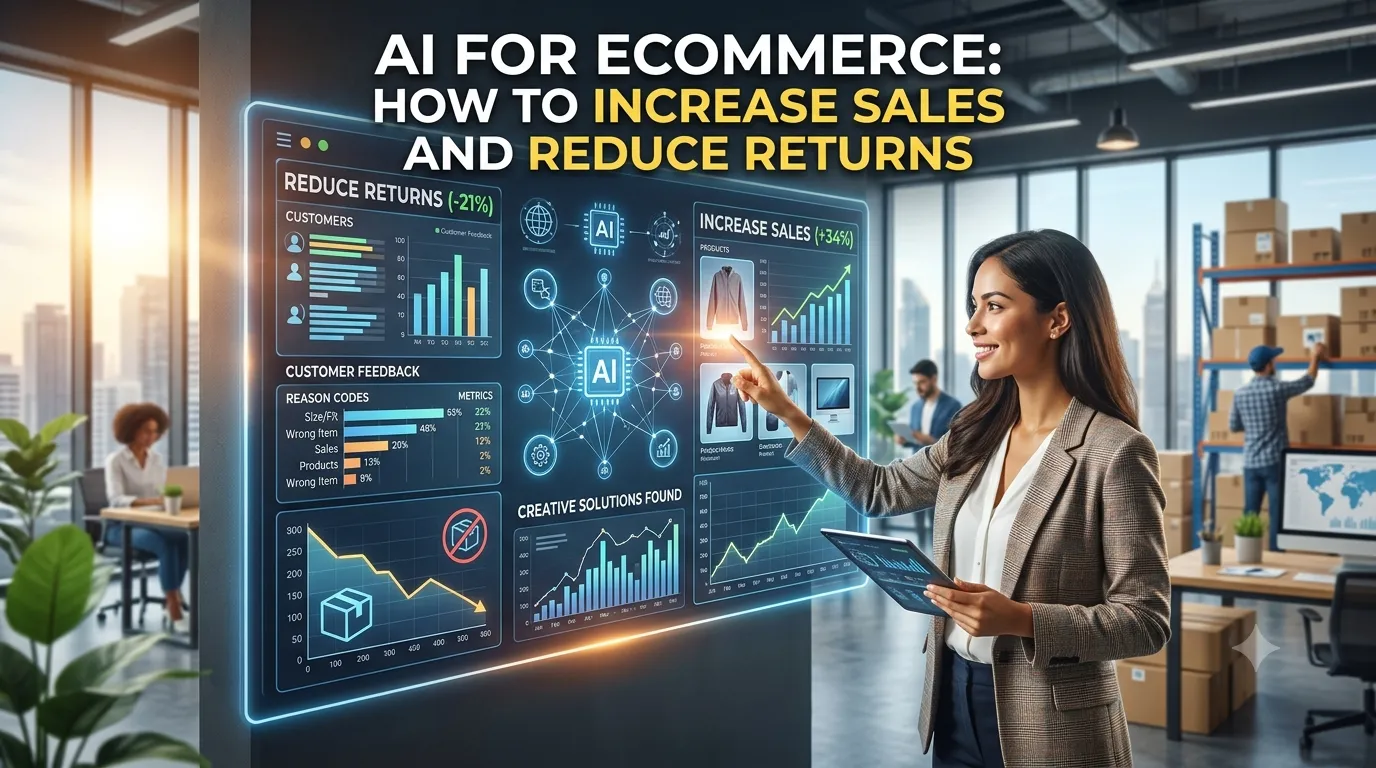
Here's the good news: AI can transform your ecommerce business. It helps you increase sales, reduce returns, and build a more profitable store. In this guide, I'll show you how to use AI for ecommerce to grow your business.
Whether you're an ecommerce owner, a digital marketing professional, or a student taking a digital marketing course, this is your blueprint for AI-powered ecommerce success in 2026.
Let's dive in.
1. Why Ecommerce Businesses Need AI
Ecommerce is challenging. Here's why AI gives you an edge.
1.1 The Competition Challenge
- Thousands of stores compete for the same customers
- Price competition erodes margins
- Standing out requires strong marketing
- Customer acquisition costs are rising
1.2 The Conversion Challenge
- Most visitors don't buy
- Cart abandonment is high
- Product pages need to convince and convert
- Personalization is expected but hard to scale
1.3 The Returns Challenge
- Returns are costly and time-consuming
- Returns reduce profitability
- Many returns are due to poor product descriptions or photos
- Managing returns requires significant resources
1.4 The AI Advantage
- AI helps you attract more qualified traffic
- AI improves conversion rates
- AI reduces returns by improving product information
- AI automates customer service and follow-ups
2. How AI Transforms Ecommerce
AI can help in every area of your ecommerce business. Here's how.
2.1 Product Descriptions That Sell
- AI writes compelling product descriptions
- AI highlights benefits, not just features
- AI optimizes descriptions for SEO
- AI creates unique descriptions for every product
2.2 Personalized Shopping Experiences
- AI recommends products based on browsing and purchase history
- AI personalizes the homepage and category pages
- AI sends personalized emails and offers
- AI delivers the right message to the right customer
2.3 Reducing Returns
- AI provides accurate sizing and fit information
- AI generates realistic product photos and videos
- AI answers customer questions before purchase
- AI sets proper expectations, reducing returns
2.4 Customer Service
- AI chatbots handle common questions 24/7
- AI automates order tracking and updates
- AI manages returns and exchanges
- AI provides personalized support
2.5 Marketing and Advertising
- AI creates ad copy and visuals
- AI optimizes ad campaigns in real-time
- AI writes email sequences that convert
- AI creates social media content that drives traffic

3. The Best AI Tools for Ecommerce
Here are the top AI tools for ecommerce.
3.1 For Product Descriptions
- ChatGPT: Product descriptions and SEO optimization
- Jasper: Brand voice and ecommerce copy
- Describely: Bulk product descriptions for large catalogs
3.2 For Personalization
- Klaviyo: AI-powered email and SMS personalization
- Dynamic Yield: AI-powered personalization for ecommerce
- Nosto: AI-powered product recommendations
3.3 For Reducing Returns
- ChatGPT: Accurate product descriptions and expectations
- Canva AI: Realistic product visuals
- Fit Analytics: AI-powered sizing and fit recommendations
3.4 For Customer Service
- Tidio: AI-powered chatbots for ecommerce
- Gorgias: AI-powered customer support
- Zendesk AI: AI-powered help desk
3.5 For Marketing
- ChatGPT: Ad copy, emails, and social media
- Canva AI: Visuals and ad creatives
- AdCreative.ai: AI-powered ad creative optimization
4. How to Use AI in Your Ecommerce Business
Here's a step-by-step process for using AI to increase sales and reduce returns.
Step 1: Optimize Your Product Pages
- Use AI to write compelling product descriptions
- Highlight benefits, not just features
- Include accurate sizing and fit information
- Optimize for SEO
AI Prompt: "Write a product description for [product]. Highlight key features, benefits, and sizing information. Optimize for SEO with keywords like [list keywords]."
Step 2: Personalize the Shopping Experience
- Use AI to recommend products based on behavior
- Personalize the homepage and category pages
- Send personalized emails and offers
AI Prompt: "Create a personalized email recommendation for a customer who recently viewed [product] but didn't purchase. Include complementary products and a special offer."
Step 3: Reduce Returns with Better Information
- Provide accurate sizing and fit information
- Use realistic product photos and videos
- Answer common questions before purchase
- Set proper expectations
AI Prompt: "Create a sizing guide for [product] that helps customers choose the right size. Include measurements, fit notes, and common questions."
Step 4: Automate Customer Service
- Use AI chatbots for common questions
- Automate order tracking and updates
- Manage returns and exchanges efficiently
AI Prompt: "Write a chatbot response for a customer asking about return policy. Include key details and a helpful tone."
Step 5: Optimize Your Marketing
- Use AI to create ad copy and visuals
- Optimize campaigns in real-time
- Create email sequences that convert
AI Prompt: "Write a 5-email abandoned cart sequence for [product]. Include urgency, social proof, and a special offer."
Step 6: Measure and Improve
- Track conversion rates, average order value, and return rates
- Identify what's working and what's not
- Double down on what works
AI Prompt: "Analyze my ecommerce data. What's driving sales? What's causing returns? Suggest improvements."
5. Real-World Example: The AI-Powered Ecommerce Store
Here's how an ecommerce store used AI to transform their business:
- Challenge: They were struggling with low conversion rates and high return rates.
- Solution: They used AI to optimize product descriptions, personalize recommendations, and automate customer service.
- Result: Conversion rates increased by 40%. Returns decreased by 30%. Revenue grew by 60%.
6. Conclusion: Increase Sales and Reduce Returns with AI
Ecommerce is challenging. Competition is fierce. Customers expect personalization. Returns eat into profits. AI changes the equation. It helps you create better product pages, personalize the shopping experience, reduce returns, and automate customer service. You can increase sales and reduce returns—without working more hours.
But here's the good news: You can start today. Use AI to write one product description. Create one personalized email. Automate one customer service response. Small changes lead to big results.
The choice is yours. Keep struggling with low conversions and high returns, or start using AI to grow your ecommerce business.
Join the best Digital Marketing Course to master AI-powered ecommerce marketing and digital strategy in 2026.
Frequently Asked Questions (5 Unique FAQs)
❓ 1. Can AI really help reduce ecommerce returns?
Yes. AI improves product descriptions, provides accurate sizing information, and sets proper expectations. This reduces returns by ensuring customers know exactly what they're getting.
❓ 2. How does AI personalize the shopping experience?
AI analyzes customer behavior—browsing history, purchase history, and preferences—to recommend products, personalize content, and send targeted offers. This increases conversion rates and average order value.
❓ 3. What's the best AI tool for ecommerce?
It depends on your needs. ChatGPT is great for product descriptions. Klaviyo is excellent for email personalization. Tidio is ideal for customer service. Use them together for the best results.
❓ 4. How do I use AI to increase sales?
Use AI to optimize product pages, personalize recommendations, create targeted ads, and automate follow-ups. AI helps you attract more qualified traffic and convert more visitors into customers.
❓ 5. What's the biggest mistake ecommerce owners make with AI?
Using AI to replace their brand voice and personal touch. Customers buy from brands they trust. Use AI for efficiency, but always add your unique voice and personality.