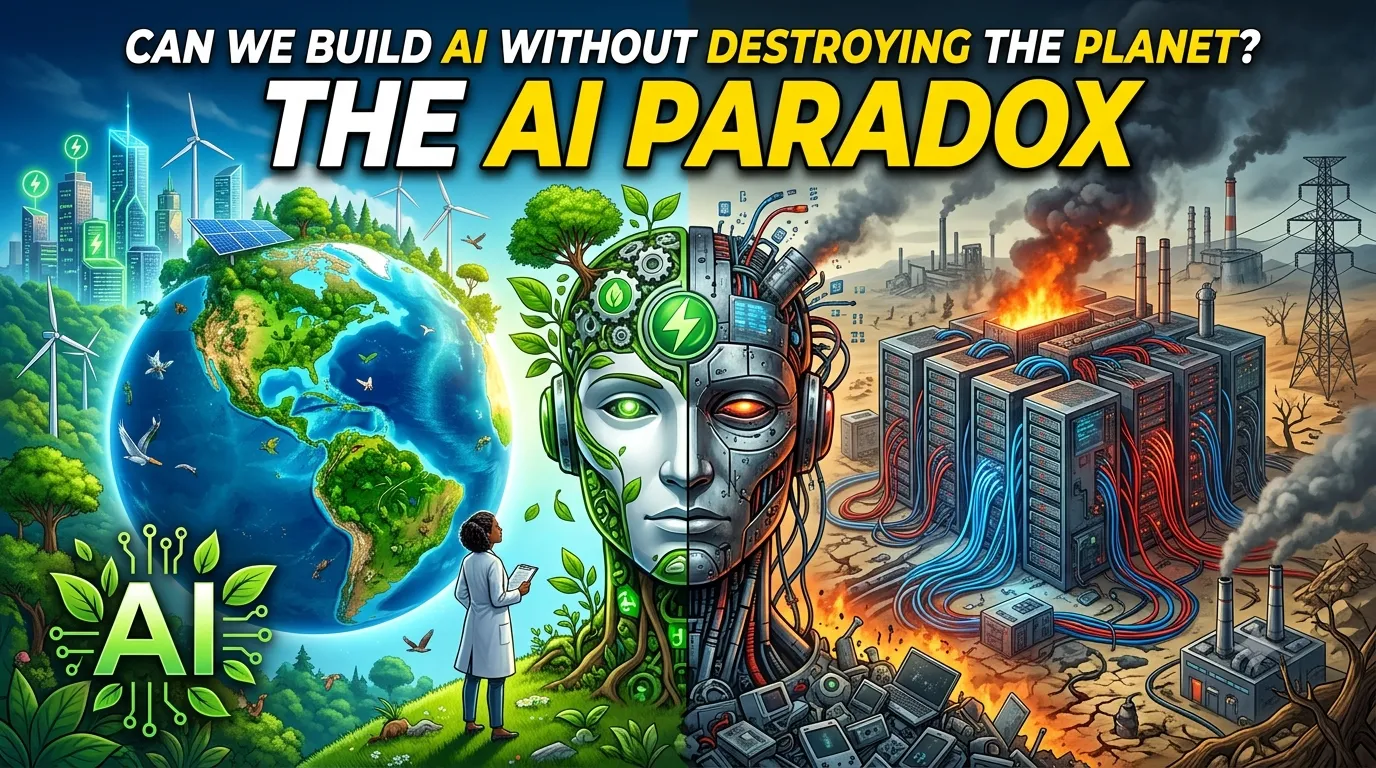
Let me ask you something. Have you ever thought about the environmental cost of the AI tools you use every day? The energy consumption, water usage, and carbon emissions behind every ChatGPT query and AI-generated image?
If you're like most digital marketing professionals, the answer is: "No. I never really thought about it." And you're not alone. Most people don't realize that AI has a significant environmental footprint.
Here's the reality: AI consumes massive amounts of energy and water. Training large models produces significant carbon emissions. And as AI adoption grows, so does its environmental impact. This is the AI sustainability paradox—we want AI's benefits without its environmental costs.
In this guide, I'll explore the AI sustainability paradox—the environmental cost of AI, what's being done to make it sustainable, and what you can do. Whether you're a digital marketing professional, a business owner, or a student taking a digital marketing course, this is an important conversation for anyone using AI.
Let's dive in.
1. The Environmental Cost of AI
AI is energy-intensive. Here's a look at the numbers.
1.1 Energy Consumption
- Training: Training a large AI model can use as much electricity as hundreds of homes in a year.
- Inference: Every query to an AI model consumes energy—and queries are growing exponentially.
- Data centers: AI runs on data centers that consume massive amounts of electricity and water.
1.2 Water Usage
- Data centers use water for cooling
- A single data center can consume millions of gallons of water annually
- Water scarcity is a growing concern in many regions
1.3 Carbon Emissions
- AI training produces significant carbon emissions
- Cloud computing contributes to global carbon footprint
- Regions with coal-based electricity have higher emissions
1.4 E-Waste
- AI hardware has a limited lifespan
- Rapid hardware upgrades create electronic waste
- E-waste poses serious environmental and health risks
2. The AI Sustainability Paradox
Here's the paradox: we want AI's benefits—but we don't want its environmental costs.
2.1 The Conflict
- AI is solving environmental problems (e.g., climate modeling, energy optimization)
- AI itself is creating environmental problems (e.g., energy consumption, carbon emissions)
- The more we use AI, the more energy we consume
- We need AI to solve environmental problems, but AI is part of the problem
2.2 The Opportunity
AI can also help solve environmental problems. It can optimize energy usage, improve renewable energy, and help us understand climate change. The challenge is to maximize AI's benefits while minimizing its environmental costs.
3. What's Being Done to Make AI Sustainable
Here's what the industry is doing to reduce AI's environmental impact.
3.1 Energy-Efficient Models
- Smaller models: Smaller models use less energy
- Efficient architectures: New model designs require less computation
- Quantization: Reducing model precision reduces energy consumption
3.2 Renewable Energy
- Many data centers are switching to renewable energy
- Google, Microsoft, and AWS are committing to net-zero emissions
- Renewable energy is becoming more affordable and accessible
3.3 Carbon Offsetting
- Some companies are offsetting AI emissions through carbon credits
- Investing in reforestation and conservation projects
- Supporting renewable energy projects
3.4 Research and Innovation
- Researchers are developing more efficient AI algorithms
- New hardware is becoming more energy-efficient
- AI is being used to optimize energy consumption
4. What You Can Do as a Marketer
Here's how you can reduce your AI environmental footprint.
4.1 Choose Green AI Providers
- Research providers' sustainability commitments
- Choose companies using renewable energy
- Support companies with net-zero targets
4.2 Use AI Efficiently
- Don't generate unnecessary content
- Use smaller models when possible
- Avoid running AI for tasks that don't need it
4.3 Advocate for Sustainability
- Ask your AI providers about sustainability
- Encourage your company to adopt green practices
- Share information about AI sustainability
4.4 Measure Your Impact
- Track your AI usage and environmental impact
- Set sustainability goals
- Report on your progress
5. Real-World Example: Sustainable AI in Action
Here's how a digital marketing agency reduced their AI footprint:
- Challenge: They were generating thousands of AI videos and images—and their energy consumption was high.
- Solution: They switched to AI providers using renewable energy. They optimized their usage to reduce unnecessary queries.
- Result: Their carbon footprint decreased by 40%. They also saved money on energy costs.
6. Conclusion: Build AI Responsibly
AI has an environmental cost. But it also has the potential to help solve environmental problems. The key is to use AI responsibly—choosing green providers, using AI efficiently, and advocating for sustainability.
But here's the good news: You can make a difference. Every AI query you run has an environmental impact. Every choice you make about AI providers matters. By using AI responsibly, you can be part of the solution—not the problem.
The choice is yours. Ignore AI's environmental cost, or start building AI sustainably.
Join the best Digital Marketing Course to master AI-powered marketing and responsible AI use in 2026.
Frequently Asked Questions (5 Unique FAQs)
❓ 1. How much energy does a single AI query consume?
It varies. A single AI query can consume significantly more energy than a Google search. The larger and more complex the model, the more energy it requires. But estimates vary widely, and many companies are working to improve efficiency.
❓ 2. Which AI providers are most sustainable?
Google, Microsoft, and AWS have committed to net-zero emissions and use renewable energy. However, sustainability commitments vary—research each provider's practices to ensure they align with your sustainability goals.
❓ 3. Can AI help solve environmental problems?
Yes. AI is already being used for climate modeling, optimizing renewable energy, improving agriculture, and monitoring deforestation. The key is to use AI for environmental good while minimizing its own environmental footprint.
❓ 4. What can I do as an individual to reduce AI's environmental impact?
Use AI efficiently—don't generate unnecessary content. Choose green AI providers. Support companies with sustainability commitments. Advocate for responsible AI use in your organization.
❓ 5. Is sustainable AI more expensive?
Not necessarily. Many sustainable AI providers offer competitive pricing. In fact, efficient AI usage often saves money. The cost of sustainable AI is often comparable—or lower—than non-sustainable alternatives.