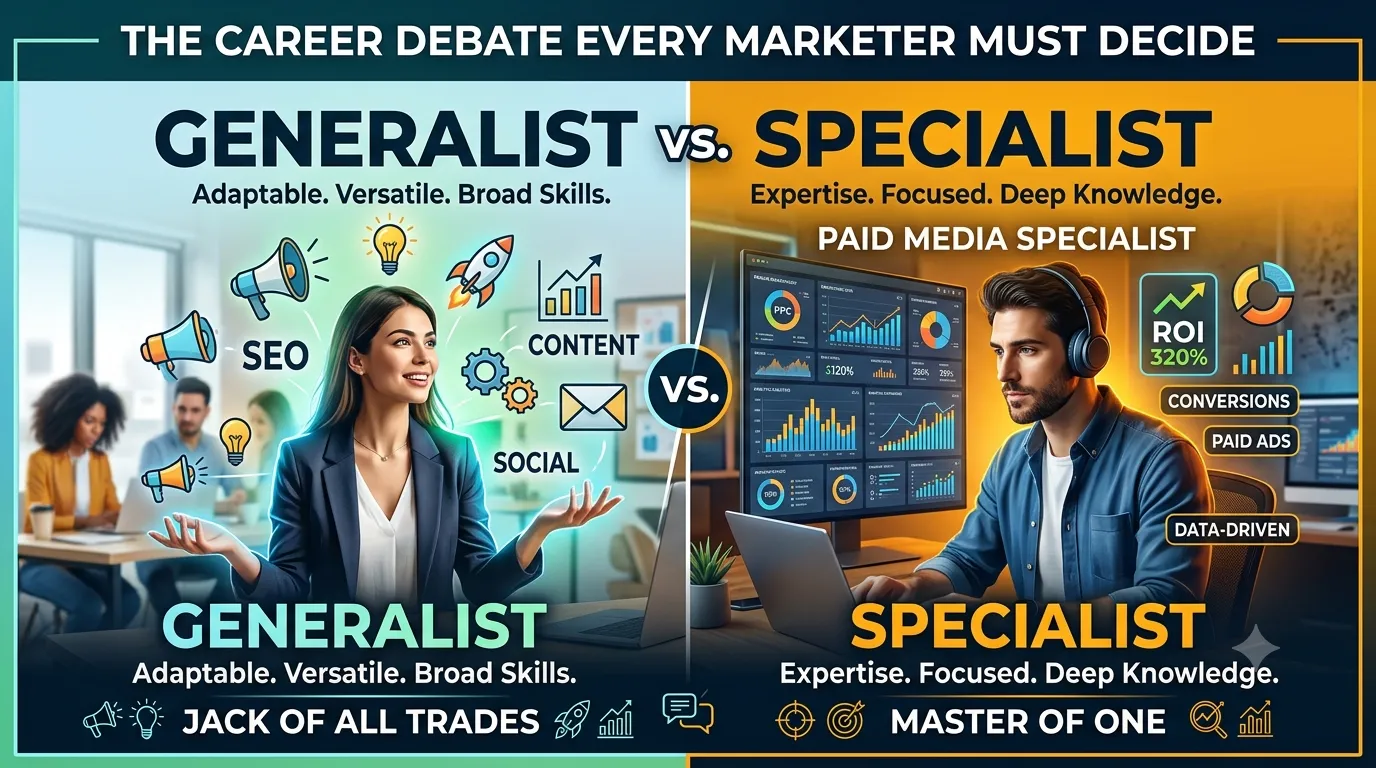
Let me ask you something. Have you ever looked at your career and wondered: "Should I go deep in one area, or should I learn a little bit of everything?"
If you're a digital marketing professional in 2026, you've probably asked yourself this question. It's one of the biggest career debates of our time—and the answer is more nuanced than you might think.
This isn't just about personal preference. It's about survival, growth, and relevance in a world where AI tools are reshaping marketing faster than ever. In this guide, I'll break down the generalist vs. specialist debate for marketers, weigh the pros and cons, and help you decide which path is right for you.
Let's dive in.
1. The Great Career Debate: Generalist vs. Specialist
In marketing, as in many fields, there's an ongoing debate: which career path is better for long-term success and job security? The answer isn't black and white, but understanding both perspectives is the first step to deciding your career path.
Historically, there have been two clear paths. Specialists go deep in one area, becoming masters of a single domain like SEO, social media marketing, or analytics. Generalists spread their knowledge across multiple domains, often working at smaller companies or in leadership roles where they need to understand the big picture.

2. What Does It Mean to Be a Specialist?
A specialist is a marketer with deep, focused expertise in one specific area. They know their domain inside and out, often spending years honing their skills. Their knowledge is narrow but profound.
Specialists understand the history of their domain, the latest innovations, and the specifics of what works and why. They're the go-to people for complex challenges. In a specialist's career path, the learning is deep, the focus is clear, and the expertise is hard to replace.
2.1 Examples of Marketing Specialists
- SEO Specialist: Deep expertise in search engine optimization, keyword strategy, technical SEO, and link building
- Social Media Marketing Specialist: Expert in platform strategies, content creation, community management, and social advertising
- Content Marketing Specialist: Deep understanding of content strategy, distribution, and storytelling
- Email Marketing Specialist: Expert in email automation, deliverability, personalization, and retention strategies
- Analytics Specialist: Deep knowledge of data analysis, attribution, and performance optimization
2.2 The Specialist Advantage
- Highly valued expertise: Specialists are often more expensive to hire because they have rare and deeply specific knowledge.
- Competitive edge: You become the "go-to" person in your field.
- Higher salary potential: In many cases, specialists command higher fees than generalists.
- Credibility and authority: Deep expertise builds trust and positions you as a leader in your field.

2.3 The Specialist Disadvantage
- Limited scope of opportunities: Your deep focus may limit where you can work.
- Risk of automation: AI tools are getting better at specialized tasks, which could threaten some specialist roles.
- Lack of flexibility: It can be harder to pivot to new areas if your field changes.
- Potential redundancy: Deep expertise can become irrelevant if the industry evolves beyond your specific niche.
3. What Does It Mean to Be a Generalist?
A generalist is a marketer with a broad range of knowledge across multiple marketing disciplines. They don't dive deep into any one area, but they understand enough to oversee and connect the dots. Their value lies in breadth, not depth.
A generalist's career path involves broader learning, often touching on many aspects of marketing. They're the strategic glue that holds campaigns together, often with less specialized career security but more flexibility.
3.1 Examples of Marketing Generalists
- Marketing Manager: Oversees strategy across channels
- Growth Marketer: Works across acquisition, retention, and optimization
- Digital Marketing Generalist: Handles everything from content to analytics
- Small Business Owner: Does it all—social media, ads, email, and strategy
- Marketing Director: Coordinates multiple teams and strategies
3.2 The Generalist Advantage
- Flexibility: You can work in a wider range of roles and industries.
- Strategic thinking: Generalists are often better at seeing the big picture, which is essential for leadership roles.
- Resilience: If one marketing channel declines, your other skills remain relevant.
- Broad project management: You can often oversee cross-functional teams more effectively.
3.3 The Generalist Disadvantage
- Less deep expertise: You may not have the authority or credibility of a specialist in any single area.
- Lower salary premium: In many cases, generalists earn less than specialists who have rare, deep expertise.
- Competition: Generalists are more common, so competition for roles can be higher.
- Perception as a "jack of all trades": Sometimes seen as someone who knows a little about everything but isn't an expert in anything.
4. The T-Shaped Marketer: The Best of Both Worlds
In recent years, a new model has emerged that blends the best of both worlds: the T-shaped marketer.
Imagine a "T." The horizontal bar represents your broad marketing knowledge (generalist). The vertical bar represents deep expertise in one or two specific areas (specialist). This combination offers flexibility, resilience, and credibility.
- Broad knowledge (horizontal bar): You understand different marketing channels, strategies, and business metrics. You can connect the dots and see the big picture.
- Deep expertise (vertical bar): You have a specialized skill that sets you apart—such as advanced SEO, data analytics, or paid media.
4.1 The T-Shaped Advantage
- Highly employable: You're valuable as a specialist but also flexible as a generalist.
- Adaptable: You can pivot as the industry changes without losing your core value.
- Strategic leader: You can lead teams because you understand both the technical details and the broader business context.
- Unique value proposition: You offer a rare combination of depth and breadth that few can match.
5. How AI Is Changing the Generalist vs. Specialist Debate
AI is reshaping this debate in significant ways.
5.1 AI Is Leveling the Playing Field
AI tools are making it easier for generalists to perform specialist tasks. A generalist with good AI tools can create visuals, write SEO-optimized content, run ad campaigns, and analyze data—all without specialist expertise.
5.2 AI Is Threatening Some Specialist Roles
Some specialist tasks are being automated. If your role is purely executional and doesn't involve strategic thinking, AI could replace you. Specialists who survive will be those who combine deep expertise with strategic judgment.
5.3 AI Is Creating New Specialist Roles
New roles are emerging—AI marketing strategists, prompt engineers, AI workflow architects. These roles require specialist knowledge of AI tools and their integration into marketing workflows. Mastery of AI tools is quickly becoming the next "specialist" skill.
5.4 The Human Element Is More Important Than Ever
AI can execute, but it can't provide strategic direction, build relationships, or understand human psychology. Human skills like communication, creativity, and emotional intelligence are becoming more important, not less.
6. Which Path Should You Choose?
There's no single right answer. The best choice depends on your goals, strengths, and circumstances.
6.1 Go Specialist If:
- You're passionate about a specific area
- You want to become a recognized expert
- You enjoy diving deep into one topic
- You want to command higher fees
- You prefer focused work
6.2 Go Generalist If:
- You enjoy variety and learning new things
- You want flexibility in your career
- You aspire to leadership roles
- You're building a startup or small business
- You want to oversee multiple areas
6.3 Go T-Shaped If:
- You want the best of both worlds
- You're early in your career
- You're considering AI's impact on marketing
- You want to maximize your value and job security
- You're interested in leadership roles but also want deep expertise
7. How to Build Your T-Shaped Skills
Here's how to develop into a T-shaped marketer.
7.1 Step 1: Choose Your Deep Specialization
Pick one or two areas to dive deep into. This could be SEO, analytics, social media, or anything else. Spend time building your skills and knowledge in that area.
If you're not sure where to start, consider what aligns with your interests and market demand. AI literacy, prompt engineering, and AI workflow design are excellent areas to specialize in for 2026.
7.2 Step 2: Build Broad Marketing Knowledge
Learn about other areas of marketing so you can understand how your work fits into the bigger picture. Take a comprehensive digital marketing course or SEO course to fill in the gaps in your knowledge and understand how the pieces fit together.
7.3 Step 3: Learn How to Use AI Tools
AI is the future of marketing. Learn how to use AI tools to amplify your skills. Whether you're a specialist or a generalist, AI literacy is essential.
7.4 Step 4: Develop Human Skills
Don't neglect your emotional intelligence, communication, and strategic thinking. These skills will make you irreplaceable, even as AI gets better.
7.5 Step 5: Stay Curious and Keep Learning
The marketing landscape is constantly evolving. Stay curious, read industry news, and never stop learning. This will keep you adaptable and resilient.
8. Real-World Example: The T-Shaped Marketer in Action
Here's how a digital marketing professional built a T-shaped career:
- Deep expertise: She specialized in SEO, becoming an expert in on-page, off-page, and technical SEO for B2B SaaS companies.
- Broad knowledge: She also learned social media marketing, content strategy, email marketing, and analytics—enough to understand how they connect and support the customer journey.
- AI skills: She mastered AI tools for content creation, keyword research, and data analysis, making her far more efficient than her peers.
- Result: She became a high-value hire, commanding a premium salary while having the flexibility to move into leadership roles.
9. Conclusion: Choose the Path That Fits You
The debate between generalists and specialists is more nuanced than ever in 2026. The best path depends on your goals, strengths, and circumstances. But the most compelling and resilient option for many marketers today is to become T-shaped—building deep expertise in one area while cultivating broad knowledge across marketing.
But here's the good news: You don't have to choose today. Start with one focus and keep your options open. With the right approach, you can evolve your career as the marketing landscape evolves.
The choice is yours. Stay narrow, stay broad, or become T-shaped. Just make sure you're learning, growing, and adapting.
Join the best Digital Marketing Course to build your T-shaped marketing skills and future-proof your career in 2026.
Frequently Asked Questions (5 Unique FAQs)
❓ 1. Can I switch from being a specialist to a generalist later in my career?
Yes. Many marketers start as specialists and later broaden their skills to move into management or leadership roles. A digital marketing course can help you fill in the gaps in your knowledge and make the transition smoother.
❓ 2. Which role is more secure in 2026—specialist or generalist?
Both can be secure. Specialists in high-demand areas (AI, data analytics, advanced SEO) are very valuable. Generalists who can connect the dots and lead strategic initiatives are equally valuable. The T-shaped approach offers the most resilience.
❓ 3. Do T-shaped marketers earn more than specialists?
It depends on the context. A highly specialized expert in a scarce field can command a premium. However, T-shaped marketers often have more flexibility and can move into leadership roles with higher salaries.
❓ 4. What's the best specialization for a marketer in 2026?
AI literacy, prompt engineering, AI workflow design, and data analytics are excellent areas to specialize in. Also consider technical SEO or paid media if those areas interest you.
❓ 5. Can I build a T-shaped career without a formal marketing background?
Absolutely. Many successful marketers come from diverse backgrounds. Start with a digital marketing course to build foundational knowledge, then develop your specialization through practice and study.