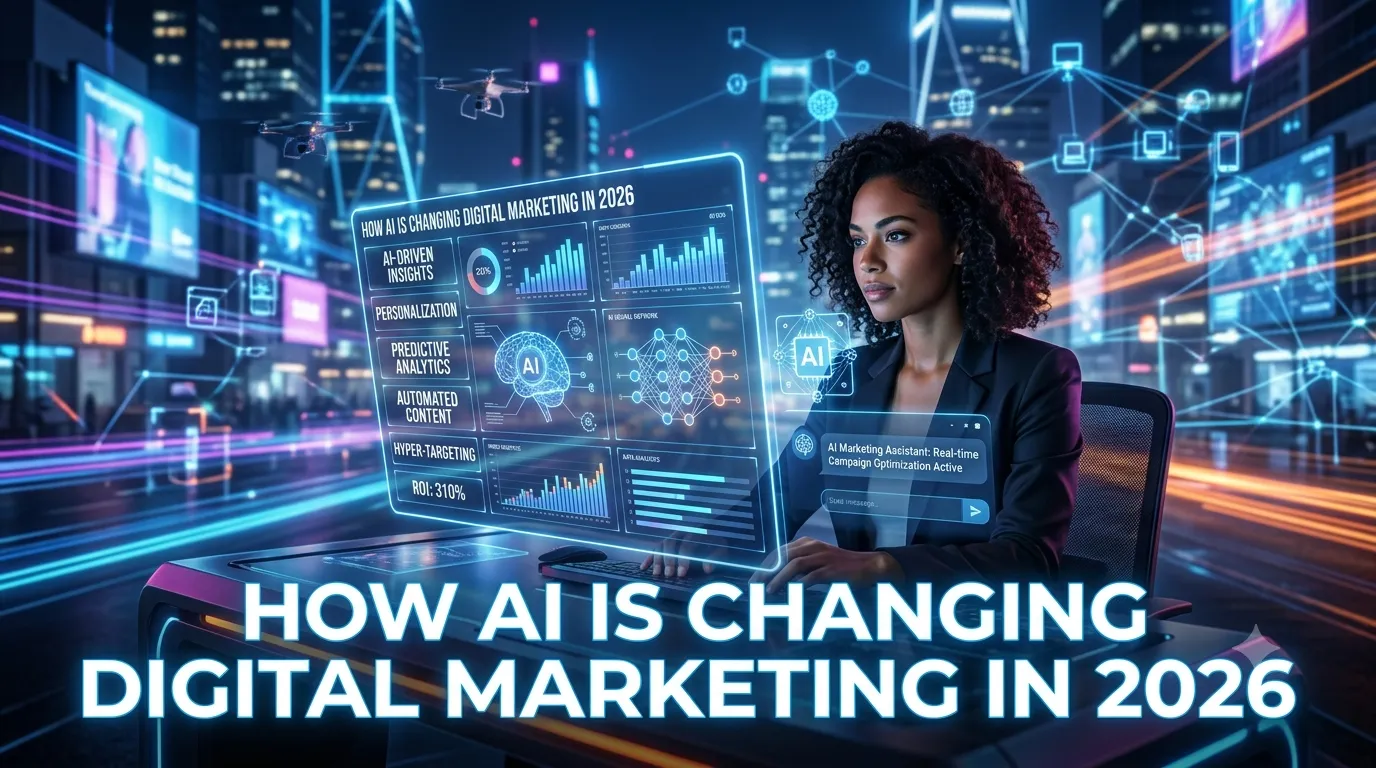
Let's take a moment to appreciate how much has changed. Just three years ago, AI in digital marketing meant basic chatbots and automated email sequences. Today? It's a completely different world.
In 2026, AI isn't just a tool — it's the engine driving digital marketing. It's reshaping how we create content, understand audiences, run campaigns, and measure success. The marketers who embrace this transformation are thriving. Those who resist are being left behind.
In this guide, I'll break down exactly how AI is changing digital marketing in 2026 — the trends, the tools, and the strategies you need to stay ahead. Whether you're a marketing professional, a business owner, or a student taking a digital marketing course, this is your roadmap to the future.
Let's dive in.
1. The Big Picture: AI Is Now the Marketing Engine
Here's what's changed. In previous years, AI was a helper — something you used occasionally to speed up tasks. In 2026, AI is the operating system for marketing. It's integrated into every stage of the marketing funnel, from awareness to conversion to retention.
Data from PwC shows that businesses using AI in marketing are seeing 2-3x higher ROI than those that don't. Salesforce reports that 84% of marketers are now using AI in their workflows, up from just 25% in 2022.
This isn't a trend. It's a fundamental shift in how marketing works.
1.1 The Speed Revolution
One of the most dramatic changes is speed. Campaigns that used to take weeks to plan and execute can now be launched in hours — or even minutes. AI handles the heavy lifting: audience research, creative generation, copywriting, and optimization.
This means marketers can test more, learn faster, and iterate continuously. The days of long campaign cycles are over.
1.2 The Personalization Explosion
Personalization was once a nice-to-have. In 2026, it's table stakes. Consumers expect experiences tailored to their preferences, behaviors, and needs. AI makes this possible at scale.
AI analyzes customer data in real-time to deliver personalized content, product recommendations, and messaging across every channel. This level of personalization drives significantly higher engagement and conversion rates.

2. AI-Powered Content Creation: The New Normal
One of the most visible changes is in content creation. In 2026, AI tools are essential for producing content at scale.
2.1 Writing and Copywriting
AI writing tools are now sophisticated enough to generate high-quality blog posts, social media captions, email copy, and even long-form content. Tools like ChatGPT, Claude, and Jasper are used by over 70% of marketers for content creation.
But here's the key: AI is a draft generator, not a replacement for writers. The best marketers use AI to create first drafts, then add their unique voice, insights, and expertise. The human element is what makes content compelling.
2.2 Visual and Video Content
AI image generators like DALL-E, Leonardo, and Midjourney are creating stunning visuals. AI video tools like Kling, Runway, and Pika are making high-quality video production accessible to everyone.
In 2026, creating a professional product video is as easy as writing a prompt. This has democratized visual content creation and dramatically reduced production costs.
2.3 Content Repurposing
AI excels at repurposing content. A single blog post can be automatically transformed into social media posts, email newsletters, video scripts, and infographics. This allows marketers to maximize the value of every piece of content they create.
3. AI-Driven Audience Understanding
Understanding your audience has always been critical. In 2026, AI makes it easier — and more powerful — than ever.
3.1 Predictive Analytics
AI can now predict customer behavior with remarkable accuracy. It analyzes past interactions, purchase history, browsing patterns, and social media activity to forecast what customers will do next.
This means you can anticipate needs, prevent churn, and personalize offers before your customer even knows they want something. This is a massive competitive advantage.
3.2 Sentiment Analysis
AI tools analyze social media conversations, reviews, and customer feedback to understand sentiment in real-time. You can see how people feel about your brand, products, and campaigns — and respond immediately.
This real-time feedback loop allows marketers to adjust strategies on the fly rather than waiting for end-of-campaign reports.
3.3 Hyper-Segmentation
Traditional segmentation based on demographics is outdated. AI enables hyper-segmentation based on behavior, interests, intent, and even emotional states. You can create thousands of micro-segments and deliver tailored messaging to each one.
4. AI in Advertising and Campaign Management
Paid advertising has been transformed by AI. In 2026, running an ad campaign without AI is like trying to navigate with a paper map in the age of GPS.
4.1 Automated Ad Optimization
AI handles the optimization of ad campaigns automatically. It tests headlines, visuals, audiences, and bidding strategies in real-time. It allocates budget to the best-performing combinations and scales winning campaigns.
This eliminates guesswork and manual optimization, freeing marketers to focus on strategy and creative direction.
4.2 Dynamic Creative Optimization
AI can generate and test thousands of creative variations automatically. It learns which combinations of images, copy, and calls to action resonate best with different audience segments.
This means every user sees the ad that is most likely to convert them — and campaigns achieve significantly higher performance.
4.3 Predictive Bidding
AI predicts the optimal bid for each impression, maximizing ROI while minimizing wasted spend. This level of precision is impossible to achieve manually.
5. AI and SEO: The New Rules of Search
SEO has always been about understanding what people are searching for. In 2026, AI has completely transformed how we approach search optimization.
5.1 AI-Generated Content for SEO
AI tools now generate SEO-optimized content that ranks well on search engines. They analyze top-ranking pages, identify relevant keywords, and structure content for maximum visibility.
However, quality still matters. Google's algorithms are sophisticated enough to detect thin, low-value content — even if it's optimized for keywords. The winning strategy is to use AI for research and drafting, then add unique value that only a human can provide.
5.2 Semantic Search and Intent Matching
AI has made search engines better at understanding user intent. They don't just match keywords; they understand the context and meaning behind searches. This means content must be comprehensive and genuinely helpful, not just keyword-stuffed.
5.3 SEO Analytics and Insights
AI-powered SEO tools like Surfer SEO and Semrush provide deeper insights than ever. They analyze competitors, identify content gaps, recommend optimizations, and predict how changes will impact rankings.
6. AI in Social Media Marketing
Social media marketing has been transformed by AI in multiple ways.
6.1 Content Creation and Scheduling
AI tools now create entire social media content calendars, generate post ideas, write captions, and schedule posts for optimal times. This saves hours of work and ensures consistency.
6.2 Engagement Automation
AI chatbots and automated engagement tools handle routine interactions on social media. They answer questions, provide recommendations, and even resolve issues — all without human intervention.
This allows your team to focus on meaningful, high-value interactions rather than routine replies.
6.3 Trend Spotting
AI monitors social media conversations to identify emerging trends, viral content, and shifting audience sentiment. This allows marketers to stay ahead of the curve and create content that's timely and relevant.
7. AI in Email Marketing and Automation
Email marketing has been reborn through AI.
7.1 Personalization at Scale
AI analyzes customer data to send the right message, to the right person, at the right time. It personalizes subject lines, content, and offers based on individual behavior and preferences.
7.2 Send-Time Optimization
AI determines the optimal time to send emails to each recipient for maximum open rates. It learns from past behavior to deliver emails when people are most likely to engage.
7.3 Automated Workflows
AI creates and manages automated email sequences that guide customers through the funnel. It triggers emails based on specific actions, adapts content based on engagement, and continuously optimizes for better performance.
8. The Skills You Need to Succeed in 2026
With all these changes, what skills do you need to thrive as a digital marketer in 2026?
8.1 Strategic Thinking
AI can handle execution. Strategy is where you add value. You need to understand the big picture, set direction, and make decisions about where to invest resources.
8.2 AI Literacy
You don't need to be a programmer, but you do need to understand how AI tools work, what they can and cannot do, and how to use them effectively. This is becoming a baseline requirement.
8.3 Creativity and Originality
AI can generate variations, but it can't create breakthrough ideas. Creativity is more valuable than ever. The ability to think differently and create something genuinely new is a superpower.
8.4 Data Interpretation
AI provides massive amounts of data. The skill is not in collecting data but in interpreting it, finding insights, and turning those insights into action.
8.5 Emotional Intelligence
Marketing is ultimately about people. Understanding human psychology, building connections, and communicating with empathy are skills that AI cannot replicate.
9. What to Learn: The Best Digital Marketing Course for 2026
If you're serious about building a career in digital marketing, you need to learn both the fundamentals and the cutting-edge AI applications. A comprehensive digital marketing course or SEO course should cover:
- AI tools: How to use ChatGPT, Claude, Canva AI, video generation tools, and automation platforms
- SEO strategy: How to optimize content for search in an AI-driven world
- Social media marketing: How to create engaging content and run AI-powered campaigns
- Content marketing: How to create value-driven content that builds trust and authority
- Analytics and data: How to measure, interpret, and optimize performance
- Strategic thinking: How to develop marketing strategies that drive business growth
The best courses don't just teach you tools — they teach you how to think like a marketing leader.
10. The Bottom Line: AI Is Amplifying Marketing, Not Replacing It
Here's what all this means for you. AI is not coming to replace you. AI is coming to amplify you.
Marketers who embrace AI are working faster, creating better content, understanding customers more deeply, and achieving better results. They are more valuable than ever — because they can do what used to take a team of people in a fraction of the time.
The future of digital marketing isn't about AI doing everything. It's about humans using AI to do more. The combination of human creativity and AI efficiency is unstoppable.
If you're ready to build a career that thrives in this new world, the time to learn is now. Invest in your skills. Master the AI tools. Develop your strategic thinking. Build your personal brand. And never stop learning.
Frequently Asked Questions (5 Unique FAQs)
❓ 1. Will AI replace digital marketers entirely?
No. AI will replace certain tasks, but it won't replace marketers. The role is shifting from execution to strategy. Marketers who embrace AI will be more valuable than ever. Those who resist will find themselves obsolete.
❓ 2. What's the most important AI tool for digital marketers in 2026?
The most important tool depends on your role. For content creation, ChatGPT or Claude is essential. For visuals, Canva AI. For analytics, Google Analytics AI. For SEO, Surfer SEO or Semrush. A combination of these tools creates a powerful marketing stack.
❓ 3. How can I learn to use AI in digital marketing effectively?
Start by experimenting with free AI tools. Read industry blogs. Take a digital marketing course that covers AI applications. Practice consistently. The best way to learn is by doing.
❓ 4. Will AI make SEO obsolete?
No. AI is changing SEO, but it's not making it obsolete. The fundamentals — creating quality content that serves user intent — remain the same. AI helps with research and optimization, but human strategy is still essential.
❓ 5. How much should I rely on AI for content creation?
Use AI as a draft generator and assistant, not a replacement for your voice. AI can create 70-80% of the content, but the final 20-30% — the unique insights, personal experiences, and emotional connection — must come from you. That's where the value is.


