Let me ask you something. How many times have you typed a prompt into Claude, ChatGPT, or another AI tool, and the response was... underwhelming? It wasn't wrong, exactly. It just wasn't right. It was generic. It was surface-level. It could have been written by anyone.
If you've been using AI for digital marketing, content creation, or business strategy, you've probably experienced this frustration. You know AI is powerful. You've seen what it can do. But somehow, you're not getting those results.
Here's the secret the pros know: A perfect prompt is the difference between generic AI output and content that converts.
In this guide, I'll break down the anatomy of a perfect Claude prompt — the exact structure that turns AI into a world-class strategist. Whether you're a digital marketing professional, a business owner, or a student taking a digital marketing course, this is your blueprint for getting the best results from AI.
Let's dive in.
1. Why Most Prompts Fail
Before we get into what works, let's understand what doesn't. Most prompts fail because they're vague, generic, and lack context.
1.1 The Generic Prompt Problem
Here's what most prompts look like: "Write a LinkedIn post about building a personal brand." That's it. No context. No audience. No voice. No goal. And what do you get? A generic post that could be written by anyone.
1.2 The Missing Context
AI doesn't know who you are, who you're talking to, or what you want to achieve. Without context, it defaults to generic patterns. The output is correct but meaningless.
1.3 The Voice Problem
AI doesn't know your voice. It doesn't know how you talk, what words you use, or what tone resonates with your audience. Without voice guidance, it sounds like a robot — or worse, like everyone else.
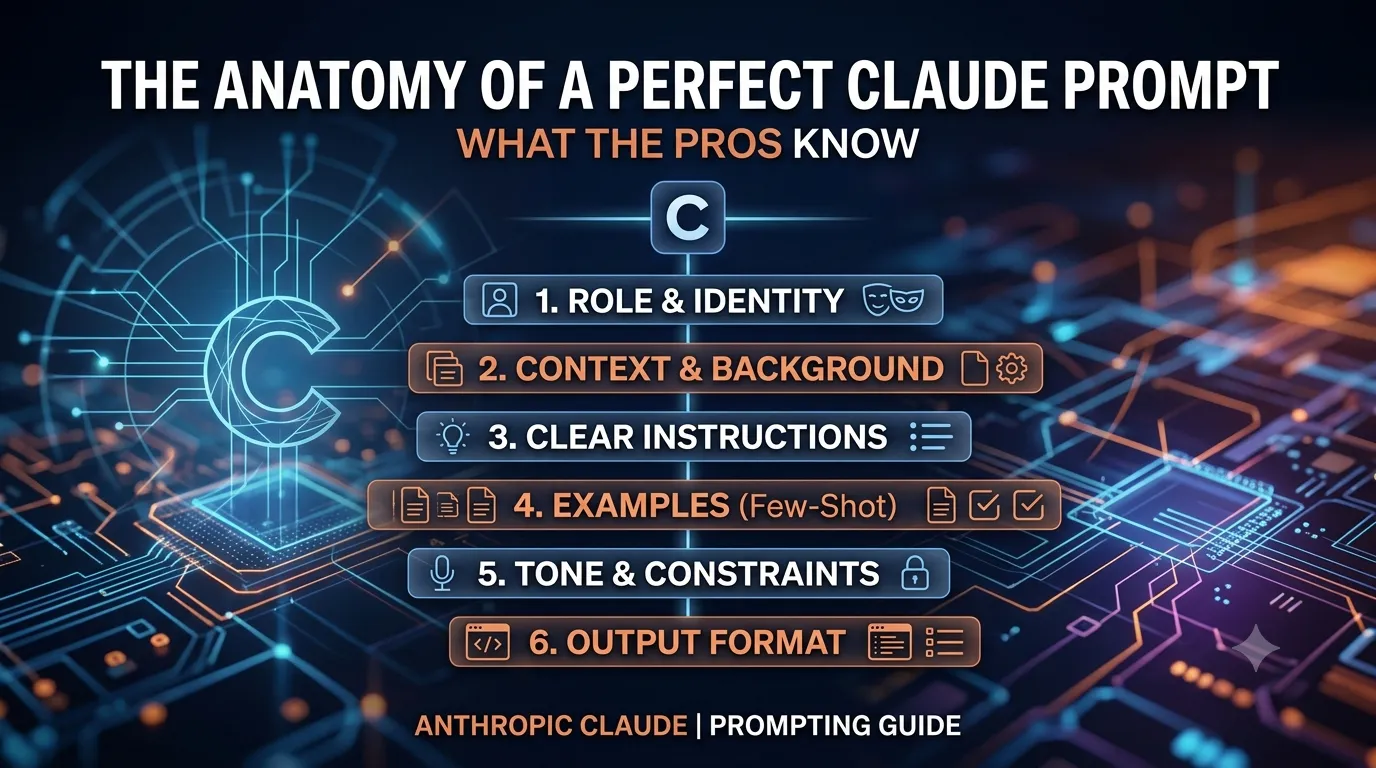
2. The Anatomy of a Perfect Prompt
A perfect prompt has eight essential components. Each one builds on the last to create a clear, detailed brief that AI can follow precisely.
2.1 ROLE: Who Is the AI?
You don't just want an AI. You want a world-class positioning strategist. A copywriting expert. A growth hacker. Define the role so AI knows the perspective to take.
Example: "You are a world-class positioning strategist who has helped 20+ year corporate experts turn their experience into an independent practice clients pay a premium for."
2.2 TASK: What Are You Doing?
Be specific about what you want. Not "write a post" but "write a LinkedIn post that gets former banking leaders to book a call with me, not just like the post."
Why it works: Specificity drives clarity. When you know exactly what you want, AI can deliver exactly what you need.
2.3 CONTEXT: What's the Situation?
Describe the situation. Who is the audience? What's the background? Why does this matter? The more context, the better.
Example: "I spent 27 years selling on behalf of UBS. Now I'm the product. I've posted for 3 months and booked zero calls."
2.4 FILES TO REFERENCE: What Should AI Know?
Upload relevant files — voice guides, past content, brand guidelines. This gives AI the material it needs to match your style and context.
2.5 FORMAT: What Should It Look Like?
Be specific about format. Length, structure, tone, delivery format. This ensures the output is ready to use.
Example: "150-200 words, short lines, one idea per line, warm and direct tone, copy-paste ready for LinkedIn."
2.6 CONSTRAINTS: What Should AI Avoid?
Tell AI what not to do. This is as important as telling it what to do. It prevents generic, corporate, or AI-sounding output.
Example: "No corporate speak, no 'hope,' no 'unlock your potential.' They could be written by anyone."
2.7 EXAMPLES: Show, Don't Just Tell
Provide examples of what you want — and what you don't want. This calibrates AI to deliver exactly what you're looking for.
2.8 SUCCESS CRITERIA: What Does "Good" Look Like?
Define what success looks like. Emotion, intent, core problem, detail level, format check. This gives AI a target to aim for.
3. Real-World Example: The Perfect LinkedIn Post Prompt
Here's a complete example of a perfect prompt for creating a LinkedIn post that converts — based on the guide in the image.
ROLE
You are a world-class positioning strategist who has helped 20+ year corporate experts turn their experience into an independent practice clients pay a premium for.
TASK
Your task is to write a LinkedIn post that gets former banking / pharma / consulting leaders to book a call with me, not just like the post.
CONTEXT
- Who is your audience: Senior professionals, 20+ years in their industry, recently out of corporate or about to leave, know their expertise has value but have never had to sell themselves.
- What's the situation: I spent 27 years selling on behalf of a major institution. Now I'm the product. I've posted for 3 months and booked zero calls.
FILES TO REFERENCE
- my-voice.md — how I actually talk, my peer-to-peer tone, words I never use
FORMAT
- Length: 150-200 words
- Structure: Short lines, one idea per line
- Tone: Warm, direct, never salesy
- Delivered as: Copy-paste ready for LinkedIn
CONSTRAINTS
- No corporate speak, no "hope," no "unlock your potential"
- No generic advice that could be written by anyone
- No asking for a like instead of a conversation
SUCCESS CRITERIA
- Emotion: The reader should feel "she's describing my exact situation"
- Intent: They should want to comment one word so an AI agent can open a DM conversation
- Core problem: They don't know how to get clients on their own
- Detail level: Sharp diagnosis, not a how-to (the "how" is what I sell)
BEFORE YOU BEGIN
- Ask pointed questions if anything is unclear
- Do not invent client results or numbers
- Restate my task in one sentence and confirm it's correct before you write a word
4. Why This Prompt Structure Works
Let's break down why each component is essential.
4.1 ROLE Sets the Perspective
When you define a role, you're telling AI how to think. Not "generic assistant" but "world-class strategist." This changes the quality of the output dramatically.
4.2 TASK Creates Focus
Specific tasks lead to specific outputs. "Write a post that gets calls" is much more effective than "write a post about personal branding."
4.3 CONTEXT Provides Understanding
Context helps AI understand the situation. Who is this for? What's the background? Why does this matter? Without context, AI is flying blind.
4.4 CONSTRAINTS Prevent Generic Output
Constraints are just as important as instructions. They prevent the generic, AI-sounding language that kills authenticity.
4.5 SUCCESS CRITERIA Set a Target
When you define success, AI knows what to aim for. It can evaluate its own output against clear criteria.
5. Common Mistakes to Avoid
Here are the most common mistakes people make when writing prompts — and how to fix them.
5.1 Mistake #1: Being Vague
Wrong: "Write about personal branding." Right: "Write a LinkedIn post that positions my experience as a corporate leader into a compelling reason for clients to book a call."
5.2 Mistake #2: Forgetting Context
Wrong: "Write a post." Right: "Write a post for senior professionals who have never had to sell themselves."
5.3 Mistake #3: No Constraints
Wrong: No constraints. Right: "No corporate speak, no generic advice, no asking for likes."
5.4 Mistake #4: No Success Criteria
Wrong: No definition of success. Right: "The reader should feel 'she's describing my exact situation.'"
6. How to Build Your Own Perfect Prompts
Here's a step-by-step process for building perfect prompts.
Step 1: Define the Role
Who do you want AI to be? A strategist? A copywriter? An analyst? Be specific.
Step 2: Define the Task
What exactly do you want AI to do? Be specific about the output and its purpose.
Step 3: Provide Context
Who is the audience? What's the situation? Why does this matter? Upload relevant files.
Step 4: Set Format
What should the output look like? Length, structure, tone, delivery format.
Step 5: Set Constraints
What should AI avoid? No corporate speak, no generic advice, no AI-sounding language.
Step 6: Provide Examples
Show AI what you want — and what you don't want. Calibrate the output.
Step 7: Define Success
What does "good" look like? Emotion? Intent? Detail level? Format check?
Step 8: Ask AI to Confirm
Before AI writes anything, ask it to restate your task. This ensures clarity.
7. Conclusion: Prompts That Convert, Content That Connects
The difference between generic AI output and content that converts is the prompt. A perfect prompt gives AI the context, constraints, and clarity it needs to deliver exceptional results.
But here's the good news: Anyone can learn to write perfect prompts. It's a skill. And like any skill, it gets better with practice. The more you use this structure, the more intuitive it becomes.
Stop settling for generic AI output. Start writing prompts that get real results.
Join the best Digital Marketing Course to master AI systems, workflows, and futuristic growth strategies.
Frequently Asked Questions (5 Unique FAQs)
❓ 1. How long should a perfect prompt be?
There's no strict length, but the best prompts are detailed enough to provide context and constraints. Most of the best prompts I see are 300-500 words. Don't be afraid to be thorough — quality input leads to quality output.
❓ 2. Do I need to include every component every time?
No. Some tasks require more context than others. But the ROLE, TASK, CONTEXT, and CONSTRAINTS sections are essential. Start with those and add more as needed.
❓ 3. How do I provide examples without overwhelming AI?
Keep examples focused. Provide 2-3 good examples and 2-3 bad examples. Explain why the good ones work and why the bad ones don't. This calibrates AI effectively.
❓ 4. Can I reuse prompts for different tasks?
Yes! Save your best prompts as templates. Then adapt them for different tasks by changing the TASK, CONTEXT, and CONSTRAINTS sections. This saves time and ensures consistent quality.
❓ 5. How do I know if my prompt is good enough?
Test it. Run the prompt and evaluate the output. If it's not what you wanted, refine the prompt. Add more context. Clarify constraints. Be more specific. Iteration is key to prompt mastery.


