Let's have an honest conversation. Everywhere you look, the message is the same: "AI will change your life!" "Learn AI and become unstoppable!" "The future belongs to AI!" And you know what? Some of that is true. AI is powerful, transformative, and genuinely exciting.
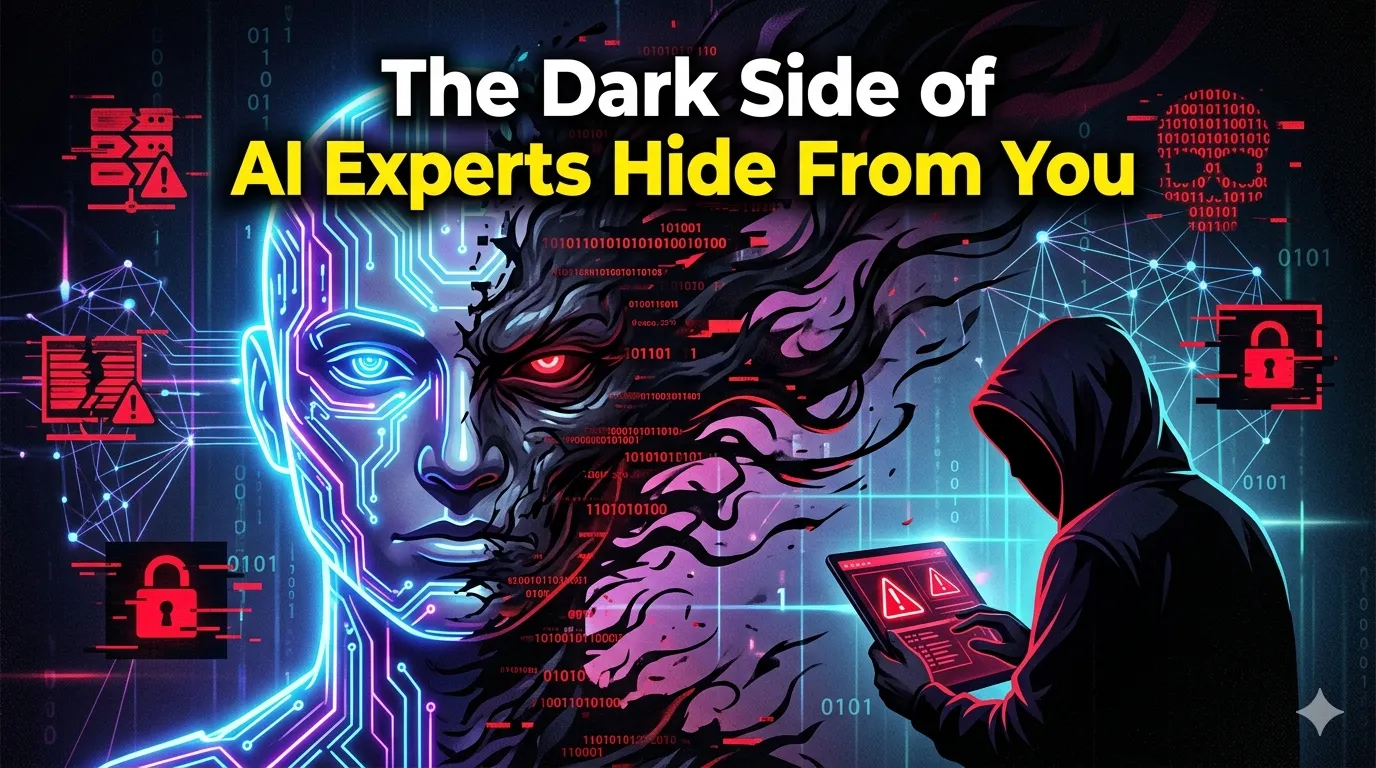
But here's what the gurus, course sellers, and tech evangelists conveniently forget to mention: AI has a dark side. Real limitations. Hidden costs. Dangerous blind spots. And if you're not aware of them, you're setting yourself up for failure — wasted time, wasted money, and potentially serious consequences.
In this guide, I'm pulling back the curtain on the uncomfortable truths about AI. Not to scare you, but to make you smarter, safer, and more effective. Whether you're a digital marketing professional, a business owner, or a student taking a digital marketing course, you need to know what the experts aren't telling you. Let's get into it.
1. The Core Limitations They Don't Advertise
These are the fundamental, non-negotiable limits of current AI. No matter how advanced the technology gets, these constraints remain.
1.1 AI Can Create Video But Can't Add Story or Emotion
AI video tools like Kling, Sora, and Runway are incredible. They generate stunning visuals — water splashes, hair movement, cinematic lighting. But here's the catch: they produce soulless imagery. There's no narrative arc, no emotional resonance, no cultural context.
Think about the last commercial that made you cry, or the last social media post that genuinely inspired you. It wasn't just the visuals — it was the story, the emotion, the human experience. AI doesn't understand why something is funny, tragic, or meaningful. It just remixes patterns. Great content connects emotionally. AI can't feel, so it can't connect.
1.2 AI Can Build a Website But Can't Integrate with Your Database
Sure, you can use AI to generate HTML, CSS, and even JavaScript. You'll get a beautiful-looking website in minutes. But try connecting it to your customer database, payment gateway, or inventory system. Suddenly, the AI-generated shell is useless.
Real business websites need backend logic, secure data handling, API integrations, and robust error handling. AI doesn't understand your database schema, your business rules, or your security requirements. It can't build a fully functional, integrated system. You get a digital facade, not a business engine.
1.3 AI Can Give You Steps But Can't Execute Them on Its Own
"Here's a 10-step plan to grow your business!" Great. But who's going to execute it? AI has no agency. It can't pick up the phone, send an email, run a campaign, or troubleshoot when something fails.
Planning is easy. Execution is where value is created. And AI can't execute. It can't adapt when a strategy doesn't work. It can't make judgment calls in real-time. AI gives you a map, but you still have to do the driving.
1.4 AI Can Offer Advice But Can't Make Decisions for You
AI will happily give you recommendations. It will analyze data, compare options, and present probabilities. But it can't weigh ethical implications, consider long-term consequences, or balance stakeholder interests.
When a decision involves moral ambiguity, emotional intelligence, or organizational politics, AI is clueless. And here's the kicker: when AI's advice leads to failure, the blame falls on you. You're the accountable one. You're the one making the final call.
2. The Hidden Costs & Risks Nobody's Talking About
Beyond the obvious limitations, there are serious risks that can cost you money, reputation, and trust. These are the shadows AI experts conveniently ignore.
2.1 AI Generates Convincing Falsehoods
This is arguably the most dangerous aspect of AI. Large language models hallucinate — they produce fabricated statistics, fake citations, and plausible-sounding nonsense. The problem? It feels true. It's written confidently. It looks legitimate.
I've seen AI generate entire blog posts with quotes from people who never said those things. I've seen it invent case studies that don't exist. If you're not an expert in the subject, you won't catch the errors. AI produces fluent bullshit that can damage your credibility if you don't fact-check.
2.2 AI Has No Ethical Compass
AI learns from human data — and humans are biased. It reflects and amplifies those biases in ways that can be discriminatory, misleading, or harmful. It doesn't understand fairness, representation, or harm.
Without human oversight, AI can generate sexist, racist, or culturally insensitive content. It can recommend hiring decisions that exclude qualified candidates. It can create marketing campaigns that alienate your audience. AI is ethically blind; you provide the moral compass.
2.3 AI Is Context-Blind
AI processes text and data but misses subtext, sarcasm, and emotional nuance. It doesn't understand "why" something matters — only "what" patterns exist.
Imagine using AI to draft a sensitive communication like a layoff notice or a difficult client email. Without human editing, the result can be tone-deaf, robotic, or even insulting. AI can't read the room because it doesn't know what a room is.
2.4 AI Creates Security Vulnerabilities
AI tools are increasingly targeted by malicious actors. Prompt injection attacks, data poisoning, and adversarial inputs can manipulate AI outputs. Your sensitive data — customer information, business strategy, financial details — can leak through AI tools.
Every time you paste confidential information into a free AI tool, you're taking a risk. Many platforms use your inputs to train their models. AI security is still in its infancy, and you're the first line of defense.
3. The Financial & Strategic Realities That Hurt
Let's talk money. AI isn't as cheap or easy as the hype suggests. There are serious financial and strategic considerations that can derail your plans.
3.1 AI Is Expensive to Run Well
Free tools exist, but they have hidden costs — limited capabilities, privacy risks, and scaling challenges. Enterprise-level AI requires massive infrastructure, ongoing maintenance, and continuous retraining. The total cost of ownership is often underestimated.
Building a custom AI solution costs six figures or more. Even using enterprise APIs can get expensive at scale. AI is a cost center, not a cost-saving measure — until you build systems properly.
3.2 AI Doesn't Understand Your Business Context
AI gives generic recommendations because it doesn't know your unique position, competition, resources, or constraints. It doesn't understand your industry nuances, your brand voice, or your customers' pain points.
When AI says "increase your marketing budget," it doesn't know you're bootstrapped. When it says "optimize for this keyword," it doesn't know your existing content strategy. Strategy without context is just noise — and AI is excellent at generating noise.
3.3 AI Creates Legal Liability
Who's responsible when AI-generated content infringes copyright? Who's liable when AI provides incorrect advice that causes financial loss? The answer is: you are.
AI can unintentionally plagiarize, generate defamatory content, or violate data privacy regulations. The legal framework around AI is still evolving, and courts are unlikely to let AI off the hook — they'll hold the users accountable. Every AI output is a legal risk you're taking.
4. The Human Skills AI Can't Replace (And Never Will)
Despite all the fear about job displacement, there are fundamental human capabilities that AI cannot replicate. These are the skills that will make you irreplaceable.
4.1 AI Can't Build Real Relationships
AI mimics empathy but doesn't feel it. It can generate caring-sounding emails, but it can't understand unspoken needs, build trust, or form genuine connections. Sales, leadership, and customer loyalty require human touch.
Think about your best client relationships. They're built on trust, mutual respect, and shared experiences. AI can't share a laugh, remember a personal detail, or show up when things get difficult. Relationships are the foundation of business; AI doesn't know how to build them.
4.2 AI Can't Adapt to Unexpected Situations
AI relies on patterns from its training data. When faced with genuinely novel situations — a global crisis, a unique customer request, an unprecedented market shift — AI breaks down. It has no intuition, no creativity, no improvisational ability.
Humans have adaptability. We can learn on the fly, make leaps of intuition, and solve problems that have never been solved before. When the unexpected happens, you can't call AI for help.
4.3 AI Has No Original Creativity
AI remixes what already exists. It's incredibly good at combining existing ideas in new ways, but it has no genuine insight or "aha" moments. Breakthrough innovations — the kind that change industries and create new markets — still require human imagination.
Steve Jobs didn't ask AI to invent the iPhone. Einstein didn't use ChatGPT to develop relativity. Original creativity is uniquely human, and it's more valuable than ever.
4.4 AI Can't Take Accountability
When AI fails, it doesn't get fired. You do. AI has no skin in the game. It doesn't care about your reputation, your career, or your business. Ultimately, you are responsible for every output, every decision, and every outcome. AI is just a tool, not a partner. And tools don't take blame.
5. The Opportunity Cost You're Paying
Beyond the direct costs and risks, there's a hidden price you pay when you rely too heavily on AI: the erosion of your own skills and judgment.
5.1 Over-Reliance on AI Dulls Human Skills
The more you let AI think for you, the less you practice your own judgment, creativity, and expertise. It's like relying on a calculator for basic math — eventually, you lose the ability to do it yourself.
I see this happening with junior marketers who depend on AI for content, strategy, and analysis. They can generate outputs, but they can't evaluate quality, spot errors, or adapt when AI fails. Your skills are like muscles — they atrophy without use.
5.2 AI Creates a False Sense of Expertise
Using AI tools doesn't make you an expert. It makes you a "prompter." Without foundational knowledge, you can't verify, critique, or improve AI outputs. You become dependent on the tool and vulnerable to its mistakes.
True expertise comes from deep understanding, extensive practice, and real-world experience. AI can help, but it can't replace the journey of becoming a professional. Don't confuse tool proficiency with expertise.
6. The Framework: How to Use AI Wisely
So, with all these limitations, should you avoid AI? Absolutely not. But you need to use it strategically. Here's how to harness AI's power while avoiding its pitfalls.
6.1 Use AI as an Assistant, Not a Replacement
AI is a tool, not a colleague. Use it for ideation, drafting, and data analysis. But always verify, edit, and add your human judgment. AI generates possibilities; you select and execute.
6.2 Develop Your Human Skills Intentionally
While AI handles routine tasks, invest in skills that AI can't replicate: strategic thinking, emotional intelligence, creativity, leadership, and relationship-building. These are your competitive advantages.
6.3 Build Practical AI Literacy
Understand how AI works, its limitations, and its risks. Learn to spot hallucinations, recognize bias, and evaluate outputs critically. This is more valuable than learning to write prompts.
6.4 Combine AI with Human Insight
The most valuable professionals in 2026 are "AI translators" — people who bridge AI capabilities and business decisions. They understand both the technology and the human context. That's what employers actually want.
7. Conclusion: Don't Be Fooled by the Hype
AI is powerful, transformative, and genuinely exciting. But it's not magic. It's not a replacement for human judgment, creativity, or accountability. The experts who sell you AI as a silver bullet are doing you a disservice.
The real opportunity lies in combining AI's capabilities with human insight. Use AI for what it's good at — speed, scale, pattern recognition — but never forget what it can't do: understand emotion, build relationships, adapt to the unexpected, create original ideas, or take responsibility.
If you're serious about mastering digital marketing, SEO, and social media marketing, don't just learn ai tools — learn strategy, psychology, and business fundamentals. That's what a comprehensive digital marketing course or SEO course provides. Because in 2026, the most valuable professionals aren't just AI users — they're AI translators who combine technical fluency with human expertise.
Be smart. Be skeptical. And never stop developing the skills that make you human.
Frequently Asked Questions (5 Unique FAQs)
❓ 1. Is AI really dangerous, or is this just fear-mongering?
AI isn't inherently dangerous — it's a tool. The danger comes from over-reliance, unrealistic expectations, and misuse. When you treat AI as infallible or use it without understanding its limitations, you create risks. Used wisely, AI is incredibly valuable. Used recklessly, it can cost you credibility, money, and trust.
❓ 2. How can I spot AI hallucinations and false information?
Always verify AI outputs against trusted sources. Check citations, cross-reference facts, and apply your own expertise. Be skeptical of confident-sounding claims without evidence. If something feels off, investigate. Developing a "critical eye" for AI outputs is a skill you need to build intentionally.
❓ 3. Should I stop using AI for content creation because of these issues?
No — but you should use it strategically. AI is excellent for drafting, brainstorming, and summarizing. But never publish or act on AI-generated content without human review, editing, and strategic oversight. Think of AI as a junior assistant, not a senior strategist.
❓ 4. What human skills should I focus on developing alongside AI?
Focus on strategic thinking, emotional intelligence, creativity, relationship-building, and ethical judgment. These are the capabilities that AI can't replicate and that employers increasingly value. Communication, adaptability, and critical thinking are consistently ranked as the most sought-after skills in 2026.
❓ 5. Will AI eventually overcome these limitations?
Some limitations will be reduced over time — less hallucination, better context understanding. But some are fundamental: AI will never feel emotion, build genuine relationships, or take accountability. These are inherently human capabilities. The future isn't AI replacing humans; it's AI augmenting human potential.