Let me guess. You've been hearing about how AI is going to revolutionize your advertising. You've seen the demos, read the case studies, and finally decided to jump in. You fed your product info into an AI tool, generated some eye-catching visuals, and set up campaigns that you were sure would crush it.
And then... nothing. Low click-through rates. Minimal conversions. A feedback loop of frustration that's making you question whether AI can actually help you at all.
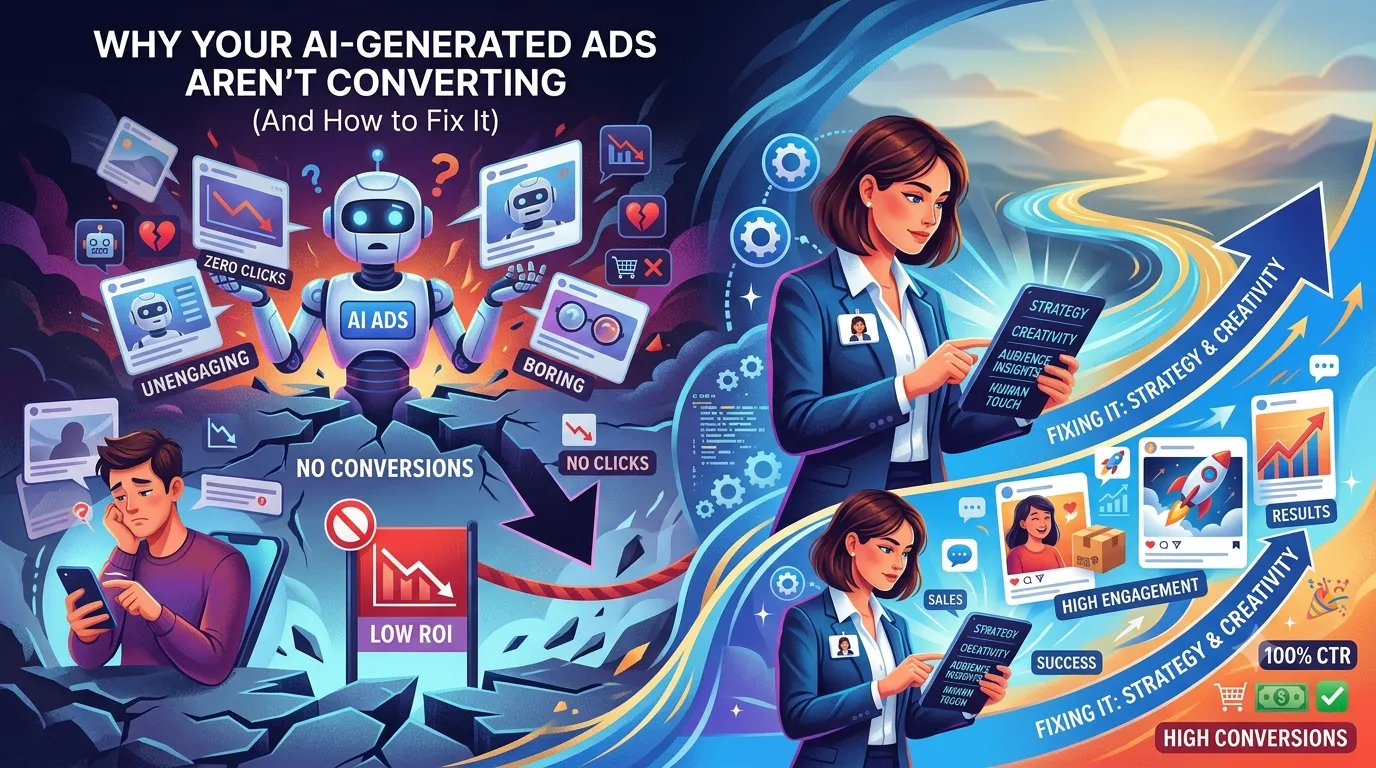
Here's the uncomfortable truth: AI-generated ads aren't converting because you're using them wrong. You're not alone — most marketers are making the same mistakes. But the good news is these mistakes are fixable. In this guide, I'll show you exactly why your AI ads are failing and how to turn them into conversion machines.
If you're serious about digital marketing, social media marketing, or getting the most out of AI tools, this is the playbook you need. Let's fix this.
1. The Promise vs. The Reality of AI Ads
The hype is powerful: "Just input your product, and AI will generate perfect ad copy and visuals that convert!" The reality is more complicated.
1.1 What AI Actually Does Well
AI is excellent at generating variations. It can quickly produce 50 ad headlines, multiple visual concepts, and different calls to action. It excels at analyzing past performance data and suggesting optimizations. It can identify patterns in customer behavior that humans might miss.
But here's the catch: AI is a tool, not a strategist. It doesn't understand your audience's psychology, your brand's unique position, or the emotional triggers that actually drive purchases.
1.2 The Gap Nobody Talks About
AI generates content based on patterns in its training data. That means your ads will look and feel like everyone else's ads. They'll be technically correct but emotionally hollow. They'll check the boxes but fail to connect.
Remember: people buy from people, not patterns. Your audience wants to feel understood, not just marketed to. And AI, no matter how advanced, doesn't truly understand.
2. The 7 Deadly Sins of AI-Generated Ads
Let's look at the specific mistakes that are killing your campaign performance.
2.1 Sin #1: Generic, Soulless Copy
AI-generated copy often reads like it was written by a committee — safe, sterile, and completely forgettable. "Unlock your potential." "The ultimate solution." "Revolutionize your workflow." Sound familiar? That's because AI has seen these phrases millions of times.
The Fix: Use AI to generate a first draft, then inject your brand voice. Add specific benefits, real-world examples, and genuine personality. If your copy could apply to any product, it's not working.
2.2 Sin #2: Missing Emotional Connection
AI doesn't feel, so it can't create content that makes people feel. It understands sentiment analysis but not genuine emotion. Your ads might be factually accurate but fail to move anyone.
The Fix: Layer emotional triggers into your AI-generated drafts. Use storytelling. Talk about pain points, aspirations, and transformations. If your audience doesn't feel something, they won't act.
2.3 Sin #3: Ignoring Audience Context
AI doesn't know your audience. It knows an audience — the average of all the data it was trained on. Your customers are not average. They have specific pain points, preferences, and cultural contexts.
The Fix: Feed AI detailed customer personas. Tell it exactly who you're targeting. Include demographics, psychographics, common objections, and even exact quotes from customer research. The more context you give, the better the output.
2.4 Sin #4: No Clear Value Proposition
AI generates lots of words but often misses the core question: What's in it for the customer? If your ad doesn't clearly communicate the specific benefit your product provides, it won't convert.
The Fix: Prompt AI specifically for value-driven copy. Ask it: "Write ad copy that clearly communicates [specific benefit] to [specific audience]." Make the value proposition impossible to miss.
2.5 Sin #5: Weak or Missing Call to Action
AI often generates generic CTAs like "Learn More" or "Get Started." These are weak. They don't create urgency, they don't overcome hesitation, and they don't tell people exactly what to do next.
The Fix: Use AI to generate multiple CTA options, then choose the strongest. Use action verbs, create urgency, and remove friction. "Claim Your Free Trial Before Friday" will outperform "Sign Up" every time.
2.6 Sin #6: Poor Visual-Text Alignment
Even when you use AI for both visuals and copy, they often don't work together. The image shows one thing, the headline says another, and the audience is confused.
The Fix: Design your ads holistically. Generate visuals and copy together, ensuring they tell a unified story. Every element should reinforce the same message.
2.7 Sin #7: Not Testing and Iterating
AI can generate 50 ad variations in minutes, but most people pick one and run with it. They don't test, they don't iterate, and they don't optimize based on results.
The Fix: Use AI to generate multiple versions of your ad. Run A/B tests. Let the data tell you what's working. Then feed that data back into the AI to create even better variations.
3. The "Human in the Loop" Framework
The most successful AI-powered marketers use a framework that combines AI efficiency with human wisdom.
3.1 Step 1: AI for Ideation and Volume
Use AI to generate a large volume of ideas — headlines, hooks, angles, visuals. Don't judge them too harshly at this stage. The goal is quantity.
3.2 Step 2: Human for Selection and Strategy
Review the AI outputs and select the ones that feel most aligned with your brand, audience, and goals. This is where your strategic thinking comes in. You know your audience better than any AI.
3.3 Step 3: Human-AI Collaboration for Refinement
Take the selected ideas and refine them with both human and AI input. Use AI to generate variations. Use human judgment to pick the best. Repeat until you have a winner.
3.4 Step 4: AI for Optimization
Once your ad is live, use AI to analyze performance data and suggest optimizations. Then apply those suggestions with human oversight. The loop continues indefinitely.
4. How to Fix Your AI Ads Right Now
Here's a step-by-step action plan to turn underperforming AI ads into conversion drivers.
4.1 Redefine Your Audience First
Before you generate anything, get crystal clear on who you're talking to. Create a detailed customer avatar with demographics, psychographics, pain points, desires, and objections. This is the foundation of everything.
4.2 Craft a Compelling Hook
Your headline or opening is the most important part of the ad. If it doesn't grab attention, nothing else matters. Use AI to generate dozens of hooks, then choose the strongest. Test different styles — curiosity, benefit, pain point, question.
4.3 Focus on One Key Benefit
Don't try to sell everything about your product. Pick one key benefit that matters most to your audience and build the entire ad around it. Everything should reinforce that single message.
4.4 Add Social Proof
AI doesn't know your customer testimonials. Add them manually. Include quotes, case studies, and social proof. This builds trust, which AI can't generate on its own.
4.5 Create Urgency and Scarcity
AI often misses this crucial conversion trigger. Add time limits, limited availability, or exclusive offers. If there's no reason to act now, people won't.
4.6 Test Multiple Variations
Let AI generate 10+ variations of your ad. Run them all (if your budget allows) and let the data decide. Then double down on what works and kill what doesn't.
5. Real-World Fixes That Worked
Let me share some examples of how companies turned failing AI ads into winners.
5.1 Example 1: The Generic SaaS Brand
A B2B SaaS company was using AI-generated ads that said "Streamline your workflow with our all-in-one solution." No conversions. We redefined the audience as "Marketing directors struggling with campaign attribution." We changed the ad to: "Stop guessing which channel drives sales. Get real attribution data in under 5 minutes." Conversions jumped 340%.
5.2 Example 2: The Ecommerce Store
An ecommerce store was using AI product descriptions that just listed features. We rewrote them with a single emotional benefit: "Finally, a bag that fits everything you need — and actually looks good carrying it." We added scarcity ("Only 47 left") and social proof ("4.8 stars from 2,300 reviews"). ROAS tripled.
5.3 Example 3: The Course Creator
A digital marketing course creator had AI ads saying "Learn digital marketing from experts." No one cared. We changed the hook: "Stop wasting money on ads that don't convert. Learn the 5-step framework that got us 10x ROI." Enrollments increased by 200%.
6. The AI + Human Performance Formula
Here's the formula that consistently delivers results:
- AI for: Ideation, variation generation, data analysis, optimization suggestions
- Humans for: Audience understanding, strategic direction, emotional connection, brand voice, final approval
In other words: AI does the heavy lifting; you do the strategic thinking. This combo is unbeatable.
7. Why This Matters for Your Digital Marketing Career
Here's what top marketers understand that others don't: AI is making strategic thinking more valuable, not less.
When everyone has access to the same AI tools, the differentiator is how well you use them. The marketers who understand audience psychology, emotional triggers, and strategic positioning will outperform those who just rely on AI to do everything.
That's why the best digital marketing course or SEO course doesn't just teach you how to use tools — it teaches you how to think. Because when you understand the "why" behind marketing, AI becomes a superpower, not a crutch.
8. Conclusion: AI Is a Tool, Not a Strategist
Your AI-generated ads aren't converting because AI doesn't understand people. It understands patterns. It doesn't feel emotions. It doesn't know your audience's secret fears and deepest desires. It can generate words but not meaning.
To fix this, you need to put humans back in the loop. Define your audience with precision. Inject emotional triggers. Create urgency. Test relentlessly. And always, always add your unique perspective.
When you combine AI's efficiency with human insight, you get ads that aren't just generated — they're crafted. And crafted ads convert.
If you're ready to master digital marketing, social media marketing, and the art of using AI tools to actually drive results, a structured digital marketing course can show you how to turn AI from a frustration into a growth engine.
Stop settling for generic ads. Start creating ads that truly connect.
Frequently Asked Questions (5 Unique FAQs)
❓ 1. Are AI-generated ads ever good enough to use without editing?
Rarely. AI outputs are best used as starting points, not final products. Even the best AI-generated ad needs human editing to add emotional resonance, brand voice, and strategic context. The "human in the loop" approach consistently outperforms fully automated ad generation.
❓ 2. How much should I rely on AI for ad creative?
Use AI for 70% of the heavy lifting — generating variations, drafting copy, suggesting visuals. Reserve 30% for human strategic input — audience definition, emotional layering, brand alignment, and final approval. This ratio consistently delivers the best results.
❓ 3. What's the biggest mistake people make with AI ads?
Assuming AI understands their audience. AI knows patterns, not people. Most failures happen because marketers skip the crucial step of defining their audience clearly before using AI. Context is everything — and only you can provide it.
❓ 4. How many ad variations should I test at once?
Test 5-10 variations at a time. This gives you enough data to find patterns without diluting your budget. Once you identify a winning approach, generate more variations using that winning angle and test again. Continuous iteration is key.
❓ 5. Can AI help me understand why my ads aren't converting?
Yes, AI is excellent at analyzing performance data and identifying patterns. It can tell you which headlines get more clicks, which visuals generate more engagement, and which audiences respond best. But it can't tell you why your audience isn't connecting emotionally. That's where human judgment is essential.