
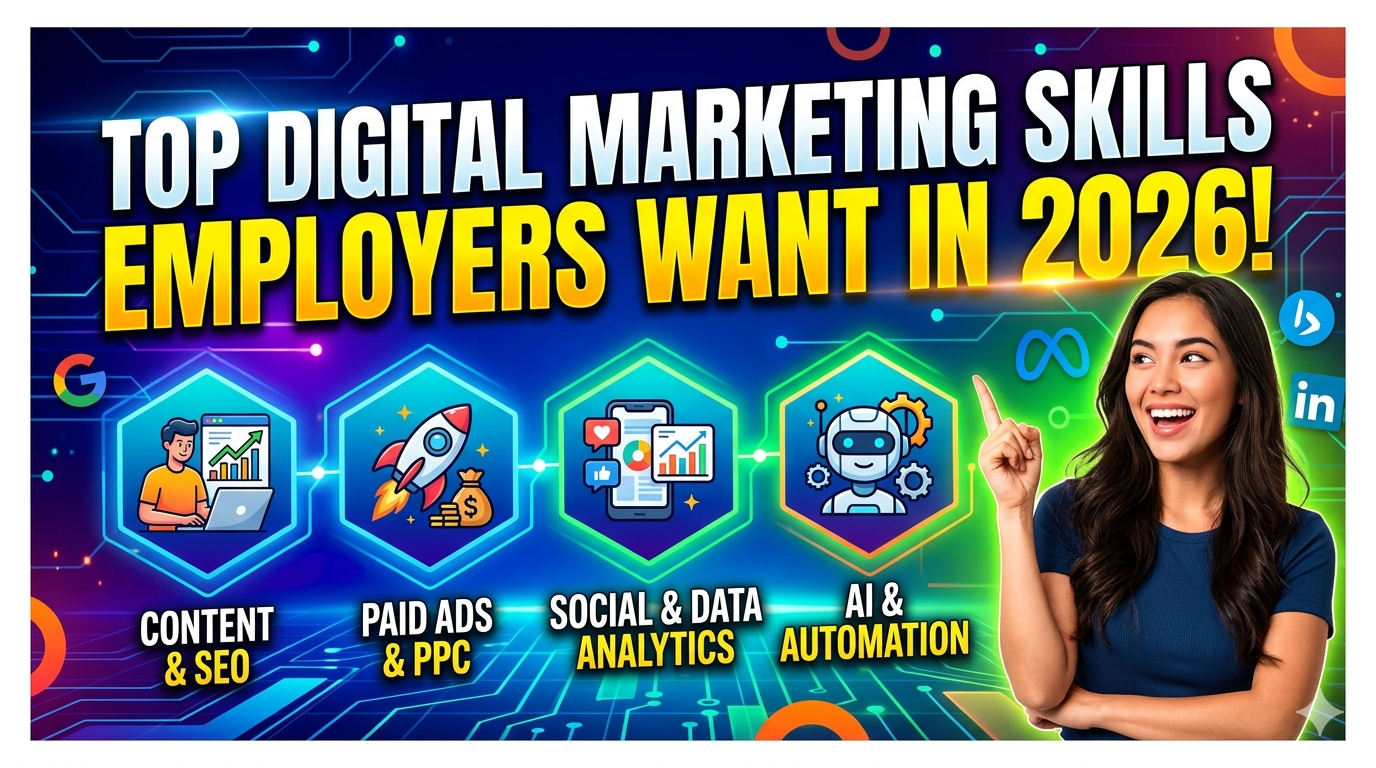
10 Apr Top Digital Marketing Skills Employers Want in 2026
You’ve seen the job posts. “Digital Marketing Manager Wanted.” “SEO Specialist Needed.” “Social Media Executive.”
You read the requirements. And your heart sinks. Every company wants something different. One wants SEO. Another wants content. A third wants ads, email, analytics, design, and “other duties as assigned.”
What do employers actually want? What skills should you learn if you want to get hired in 2026? What’s worth your time, and what’s just noise?
I’ve analyzed hundreds of job postings, talked to hiring managers, and looked at industry data. Here’s the honest answer about what skills matter most right now.
Let’s start with the most important one.
The #1 Skill: AI Literacy (Not Mastery)
Here’s what employers are not asking for: a PhD in machine learning.
Here’s what they are asking for: can you use AI tools to get work done faster and better?
In 2026, AI literacy is the baseline. It’s like knowing how to use email in 2010. Not special. Expected.
What this means in practice:
- You know how to write good prompts for ChatGPT, Claude, or Gemini
- You can use AI for research, drafting, and brainstorming
- You understand what AI does well and where it fails
- You can spot AI-generated content and improve it
- You’re familiar with AI tools for your specific role (SEO, ads, content, design)
How to demonstrate this skill: Mention specific AI tools you use daily. Show examples of work where AI helped you. Talk about your prompt engineering process. Employers aren’t looking for AI experts—they’re looking for marketers who aren’t afraid of AI.
Skill #2: Data Analytics and Interpretation
Everyone can pull a report. Few can tell you what it means.
Employers are drowning in data. Google Analytics, ad platforms, social insights, email metrics. They don’t need more reports. They need someone who can look at the numbers and answer: “What’s working? What’s not? What should we do next?”
What this means in practice:
- You understand key metrics (CTR, CPC, ROAS, CAC, LTV, conversion rate)
- You can use Google Analytics 4 to find insights, not just numbers
- You can connect data to business decisions
- You can create dashboards that tell a story
- You know the difference between correlation and causation
How to demonstrate this skill: In your portfolio or interview, show a specific example. “I looked at our Google Analytics data and noticed 70% of conversions came from mobile. We optimized our mobile experience and saw a 25% increase.” That’s what employers want—actionable insights, not just numbers.
Skill #3: Content Strategy and Creation
Content isn’t going anywhere. But the bar is higher.
Employers don’t need someone who can “write blog posts.” They need someone who can create content that actually helps the business. Content that ranks. Content that converts. Content that builds trust.
What this means in practice:
- You can research topics that your audience actually searches for
- You can write in different voices and formats (blogs, emails, social, video scripts)
- You understand SEO and how to optimize content without keyword stuffing
- You can repurpose one piece of content across multiple platforms
- You can measure content performance and improve based on data
How to demonstrate this skill: Build a portfolio. Not just links—show your process. “Here’s the keyword research I did. Here’s the brief. Here’s the final piece. Here’s how it performed.” Employers want to see that you think strategically about content, not just produce it.
Skill #4: SEO (Modern, Not 2015)
SEO is not dead. But old-school SEO is.
Employers don’t need keyword stuffers. They need people who understand search intent, user experience, and authority building. They need people who can adapt to AI overviews, zero-click searches, and changing algorithms.
What this means in practice:
- You understand search intent (informational, navigational, commercial, transactional)
- You can do keyword research that focuses on topics, not just individual keywords
- You understand E-E-A-T (Experience, Expertise, Authoritativeness, Trustworthiness)
- You know basic technical SEO (site speed, mobile, structured data)
- You understand how AI overviews are changing search and how to optimize for them
How to demonstrate this skill: Show a case study. “I optimized this page for X keyword. It moved from page 3 to position 2. Organic traffic increased 150%.” Even better: show how you adapted to a Google update or improved user experience, not just rankings.
Skill #5: Social Media Strategy (Not Just Posting)
Any intern can schedule posts. Employers need strategists.
They need someone who understands which platforms matter for their audience. Someone who knows when to post, what to post, and how to measure success. Someone who can build community, not just collect followers.
What this means in practice:
- You can develop a social media strategy aligned with business goals
- You understand platform algorithms and how to work with them
- You can create content calendars and manage workflows
- You know how to engage with communities, not just broadcast
- You can measure ROI from social media (not just likes and shares)
How to demonstrate this skill: Show a campaign you ran. “We wanted to increase website traffic from Instagram. We changed our content mix to 60% educational, 30% behind-the-scenes, 10% promotional. Traffic increased 80% in 3 months.” Employers want results, not activity.
Skill #6: Paid Advertising (PPC, Social Ads)
Organic reach is declining. Paid ads are growing. Employers need people who can spend money wisely.
They need someone who understands bidding, targeting, creative testing, and ROI. Someone who can manage budgets and optimize campaigns. Someone who knows when to scale and when to cut.
What this means in practice:
- You understand Google Ads (Search, Display, Shopping, Performance Max)
- You understand Meta Ads (Facebook, Instagram)
- You know how to set up conversion tracking and measure ROAS
- You can run A/B tests on creative, audience, and landing pages
- You understand campaign structures, bidding strategies, and optimization
How to demonstrate this skill: Show your numbers. “Managed ₹2L monthly ad spend. Achieved 4x ROAS. Lowered CPA by 30% through audience testing.” Certifications help (Google Ads, Meta Blueprint), but results matter more.
Skill #7: Email Marketing and CRM
Email is not dead. It’s one of the highest-ROI channels. Employers need people who understand it.
They need someone who can build lists, write emails that get opened, create automated sequences, and segment audiences. Someone who understands that email is about relationships, not blasts.
What this means in practice:
- You understand email platforms (Mailchimp, ConvertKit, HubSpot, Klaviyo)
- You can write subject lines that get opens and copy that gets clicks
- You know how to build automated sequences (welcome, abandoned cart, nurture, re-engagement)
- You understand segmentation and personalization
- You can track and improve email metrics (open rate, CTR, conversion rate)
How to demonstrate this skill: Share examples. “I built this welcome sequence. Open rate was 50%. 15% of recipients clicked through. 5% made a purchase within 30 days.” Show that you understand email as a relationship tool, not a spam tool.
Skill #8: Video Marketing
Video dominates. Employers need people who understand it—even if they’re not video editors.
They need someone who can plan video content, write scripts, understand platform differences (YouTube vs Reels vs Shorts vs TikTok), and measure video performance. Basic editing skills are a bonus.
What this means in practice:
- You understand different video formats (long-form, short-form, live)
- You can write video scripts that hook viewers in first 3 seconds
- You understand YouTube SEO (titles, descriptions, thumbnails)
- You know basic editing (CapCut, Canva, Descript)
- You can measure video performance (watch time, retention, engagement)
How to demonstrate this skill: Show a video you created or helped create. Explain your process: “We wanted to explain X to our audience. I wrote this script, storyboarded the shots, and edited in CapCut. The video got 50,000 views and drove 200 signups.”
Skill #9: Project Management and Adaptability
This is the soft skill that employers actually care about.
Marketing is chaotic. Deadlines change. Priorities shift. Tools break. Platforms update. Employers need people who can manage multiple projects, communicate clearly, and adapt when things go wrong.
What this means in practice:
- You can manage multiple campaigns and deadlines
- You communicate clearly with team members and stakeholders
- You can learn new tools quickly without hand-holding
- You stay calm when things go wrong and find solutions
- You can work independently without constant supervision
How to demonstrate this skill: In interviews, share examples. “I was managing three campaigns when one platform changed its algorithm. I researched the change, adjusted our strategy, and still hit our targets.” Stories of adaptability and problem-solving are gold.
Skill #10: Customer Empathy and Psychology
This is the most overlooked skill. And the most important.
All the tools, data, and tactics in the world don’t matter if you don’t understand the customer. Why do they buy? What do they fear? What do they dream? What stops them from buying?
What this means in practice:
- You can create customer personas and journey maps
- You understand what motivates your audience
- You can write copy that speaks to their problems and desires
- You can identify friction points in the customer journey
- You can translate customer insights into marketing strategy
How to demonstrate this skill: Show how customer research changed your approach. “We surveyed our customers and found that most were confused by our pricing. We simplified our pricing page and increased conversions by 40%.” Employers value marketers who listen to customers.
Skills That Are Less Important in 2026
Let’s be honest about what’s fading.
Pure execution skills. Scheduling posts. Basic copywriting. Pulling reports. AI handles these. Employers expect you to know them, but they won’t hire you just for them.
Platform-specific expertise (narrow). “I only know Instagram.” Employers want people who understand marketing fundamentals and can learn any platform. Platform-specific skills are valuable but not sufficient alone.
Old-school SEO tactics. Keyword stuffing. Link schemes. Low-quality content. These are not just useless—they’re harmful. Employers want modern SEO, not 2010 SEO.
Design skills (unless you’re a designer). Basic Canva is expected. Advanced design is a specialist role. Don’t spend months learning Photoshop if you want to be a marketer.
How to Build These Skills (Practical Path)
You don’t need to master all 10 skills tomorrow. Here’s a learning path.
Month 1-2: Foundation
Learn AI literacy (prompting, tools). Learn basic data analytics (GA4, key metrics). Learn content basics (writing, SEO fundamentals). These are the non-negotiables.
Month 3-4: Core Channels
Choose 2-3 channels based on your interest and job market. SEO + Content? Social + Ads? Email + CRM? Go deep on your chosen combination.
Month 5-6: Specialization
Pick one skill to become expert in. Maybe it’s SEO. Maybe it’s paid ads. Maybe it’s email. Specialists get hired faster than generalists.
Ongoing: Soft Skills
Project management, adaptability, customer empathy—these come from experience. Seek internships, freelance projects, or volunteer work. Practice explaining your process and results.
Certifications help but don’t substitute for real work. Build a portfolio. Get testimonials. Show results.
What Employers Are Actually Looking For (Behind the Job Description)
When you read a job description, translate it. Here’s what they really mean.
“2-3 years experience” = “We don’t want to train you from zero. Show us you’ve done real work, even if on your own projects or freelance.”
“Expert in XYZ tool” = “We use this tool. Show us you can learn it quickly, or better, already know it.”
“Self-starter” = “We don’t have time to micromanage. Can you work independently?”
“Growth mindset” = “Are you willing to learn and adapt? Marketing changes fast.”
“Detail-oriented” = “Will you catch mistakes before they go live?”
Employers want someone who can solve problems, not just execute tasks. Someone who thinks strategically, communicates clearly, and delivers results. Someone who is curious, adaptable, and hungry to learn.
The skills matter. But the person behind the skills matters more.
Conclusion: Learn Skills That Last
The platforms will change. The tools will evolve. The algorithms will update. But the fundamental skills—AI literacy, data, strategy, empathy—will always matter.
Don’t chase every new tool. Don’t panic about every update. Build a foundation of durable skills. Stay curious. Keep learning. Adapt as the industry changes.
The employers who are hiring in 2026 aren’t looking for someone who knows every platform. They’re looking for someone who can learn any platform. Someone who can think, analyze, and create. Someone who understands people.
That can be you. Start building these skills today.
Frequently Asked Questions (FAQs)
1. Which digital marketing skill pays the most in 2026?
Data analytics and paid advertising (PPC) specialists tend to command the highest salaries, followed by SEO and AI/martech roles. But skill alone isn’t enough—experience and results matter more. A content strategist with proven ROI can earn as much as a PPC specialist. Focus on what you’re good at, not just what pays most.
2. Do I need to know all these skills to get hired?
No. Entry-level roles expect foundational knowledge in 3-4 areas. Specialized roles expect deep expertise in 1-2 areas. Leadership roles expect broad understanding across many. Be honest about your level. Apply to roles that match your skills. You’ll grow into others over time.
3. Are certifications worth it for these skills?
Yes for some, no for others. Google Analytics, Google Ads, Meta Blueprint, HubSpot Academy—these are respected. Random “digital marketing certification” from unknown providers? Not worth it. Certifications help you learn structure and get past HR filters. But results (portfolio, case studies) matter more.
4. How do I demonstrate AI literacy without a technical background?
Show your process. “I use ChatGPT to draft blog outlines, then refine with my expertise. I use Perplexity for research. I use Canva AI for image generation.” Explain how AI makes you faster and better. You don’t need to build AI models. You need to use AI tools effectively.
5. What’s the fastest way to build these skills if I’m starting from zero?
Take a structured course that covers fundamentals. Then practice on real projects—even if unpaid. Help a friend’s business. Volunteer for a non-profit. Start your own blog or social channel. Build a portfolio. Get testimonials. The combination of learning + doing is faster than either alone.
No Comments