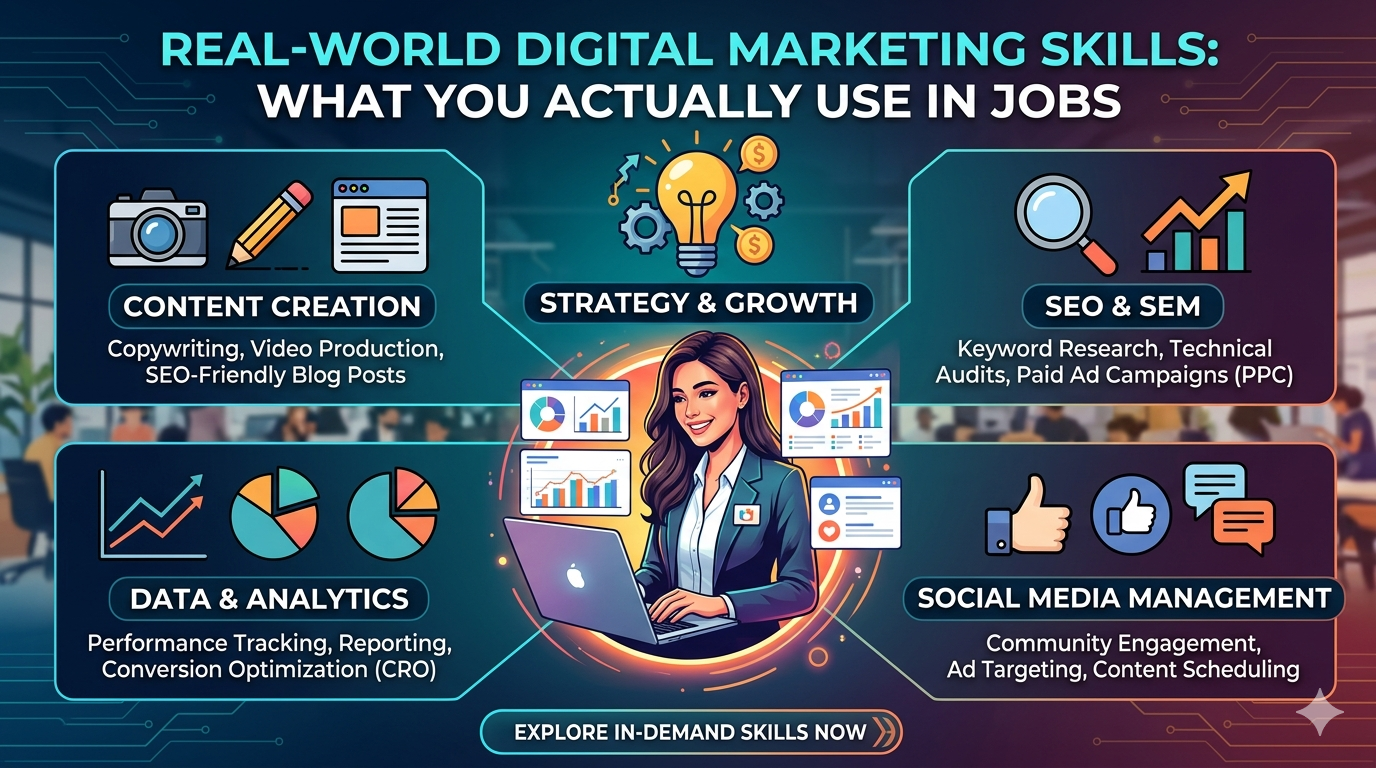
You’ve seen the job posts. They ask for everything. SEO, PPC, social media, email, content, analytics, design, video editing, coding, and “other duties as assigned.”
It’s overwhelming. It’s unrealistic. And frankly, it’s mostly nonsense.
No single person does all of that. The job descriptions are written by HR people who copy-pasted from five different templates. They’re not describing a real job. They’re describing a fantasy.
So what do real digital marketers actually do? What skills do you actually need to get hired and succeed? Not the laundry list. The real list.
I’ve looked at hundreds of real job postings. I’ve talked to hiring managers. I’ve seen what works and what doesn’t. Here’s the truth about what skills matter in real digital marketing jobs—by role, by company size, and by career stage.
The Hard Truth: Most Job Descriptions Are Lying
Before we talk about real skills, let’s expose the fake ones.
Most entry-level job descriptions ask for 3-5 years of experience, expertise in 8 different platforms, and proficiency in tools that cost thousands of dollars. Then they offer an intern-level salary.
Ignore most of that. Apply anyway.
Hiring managers know the job description is inflated. They’re looking for someone who has the core skills and is willing to learn the rest. Don’t let a scary job description stop you.
Now let’s talk about what actually matters.
The Core Skills Every Digital Marketer Needs (Regardless of Role)
These are the skills that appear in almost every real digital marketing job, regardless of specialty.
1. Writing (Clear, Concise, Persuasive)
Everything in digital marketing involves words. Emails. Ads. Social posts. Landing pages. Reports. Briefs. If you can’t write clearly, you will struggle. You don’t need to be a novelist. You need to be clear, concise, and persuasive.
What this looks like in a real job: Writing email subject lines that get opens. Writing ad copy that gets clicks. Writing report summaries that executives understand. Writing briefs that designers and developers can follow.
2. Data Comfort (Not Mastery, Just Comfort)
You don’t need to be a statistician. You need to not be afraid of numbers. You need to look at a spreadsheet and understand what it’s telling you. You need to know what a conversion rate means, what CTR means, what ROAS means.
What this looks like in a real job: Checking campaign performance daily. Spotting when something is underperforming. Knowing which metrics matter for your goal. Being able to say “this campaign is working” or “this campaign is not working” with confidence.
3. Project Management (Getting Stuff Done)
Marketing is chaos. Multiple campaigns. Multiple deadlines. Multiple stakeholders. Things change constantly. You need to manage your time, prioritize tasks, and communicate clearly.
What this looks like in a real job: Using Trello, Asana, or Monday.com. Keeping stakeholders updated without being asked. Meeting deadlines. Asking for help when stuck. Not dropping balls.
4. Curiosity and Learning Agility
Digital marketing changes constantly. Google updates its algorithm. New social platforms emerge. Old tactics stop working. The skill that matters most is the ability to learn new things quickly.
What this looks like in a real job: Reading industry blogs. Testing new features. Asking questions. Being able to say “I don’t know, but I’ll find out.”
5. Basic Analytics Tools (Google Analytics, Search Console)
Almost every marketing job requires you to look at data. Google Analytics 4 is the standard. You need to know how to find basic reports, understand what they mean, and use them to make decisions.
What this looks like in a real job: Logging into GA4 daily. Checking traffic sources. Identifying top-performing pages. Spotting drops or spikes. Exporting reports for your manager.
Master these five, and you can learn any specialty. These are the non-negotiables.
Skills by Role: What Different Jobs Actually Require
Now let’s break down real job titles and the skills they actually need.
SEO Specialist / Executive
Real skills needed: Keyword research (Ahrefs, Semrush, or free tools). On-page optimization (titles, headings, meta descriptions, content structure). Technical SEO basics (site speed, mobile, indexing, crawl errors). Content optimization (using tools like Surfer SEO or Frase). Basic link building (guest posts, outreach, broken link building). Google Search Console (submitting sitemaps, checking indexing, reviewing performance).
Skills NOT needed: Coding (beyond basic HTML). Advanced data science. Design. Video editing.
Typical day: Research keywords. Optimize existing pages. Write content briefs. Check rankings. Analyze competitor backlinks. Fix technical issues. Report on performance.
Content Marketing Specialist
Real skills needed: Writing (blogs, emails, social captions, landing pages). Content strategy (what to write, for whom, why). Basic SEO (keywords, internal linking, meta tags). CMS management (WordPress, Webflow, or similar). Content promotion (social, email, communities). Basic analytics (tracking performance, identifying winners).
Skills NOT needed: Advanced SEO. Paid ads. Design (basic Canva is enough). Coding.
Typical day: Write blog posts. Update existing content. Create content calendars. Interview subject matter experts. Promote content on social media. Analyze what’s performing well. Repurpose content into different formats.
Social Media Manager
Real skills needed: Content creation (writing captions, basic design in Canva, basic video in CapCut). Platform expertise (Instagram, LinkedIn, Facebook, TikTok—usually 2-3 main platforms). Community management (responding to comments and DMs). Scheduling tools (Buffer, Later, Hootsuite, or Meta Business Suite). Basic analytics (reach, engagement, clicks). Trend awareness (knowing what’s trending in your niche).
Skills NOT needed: Advanced design. Advanced video editing. Coding. SEO (beyond basics).
Typical day: Create social posts. Schedule content for the week. Engage with followers. Monitor trends. Create simple graphics and short videos. Report on weekly performance. Respond to customer questions.
Paid Ads Specialist (PPC)
Real skills needed: Platform expertise (Google Ads, Meta Ads Manager—usually one primary platform). Budget management (daily, monthly, campaign-level). Audience targeting (creating and testing audiences). Ad copywriting (short, punchy, persuasive). Basic analytics (CTR, CPC, CPA, ROAS). A/B testing (creative, audience, landing pages).
Skills NOT needed: SEO. Content writing (beyond ad copy). Design (you work with designers or use templates).
Typical day: Check campaign performance. Adjust bids and budgets. Pause underperformers. Create new ad variations. Analyze audience performance. Set up new campaigns. Report on ROI.
Email Marketing Specialist
Real skills needed: Email platform expertise (Mailchimp, Klaviyo, HubSpot, or similar). List management (segmentation, hygiene, growth). Copywriting (subject lines, preview text, body copy). Basic HTML (for formatting, not heavy coding). Automation (setting up welcome sequences, abandoned cart flows, re-engagement campaigns). Basic analytics (open rate, CTR, conversion rate).
Skills NOT needed: SEO. Paid ads. Design (templates do most of the work).
Typical day: Write email copy. Set up automated sequences. Segment lists for targeted campaigns. Test subject lines. Monitor deliverability. Report on email performance. Clean list of inactive subscribers.
Marketing Analyst / Analytics Specialist
Real skills needed: Google Analytics 4 (advanced proficiency, not just basic). Data visualization (Looker Studio, Tableau, or similar). Excel/Google Sheets (pivot tables, formulas, data cleaning). SQL (often required, not always). Understanding of marketing metrics (CAC, LTV, ROAS, attribution). Reporting (creating dashboards, explaining data to non-technical people).
Skills NOT needed: Content creation. Design. Social media management. Writing (beyond reports).
Typical day: Pull data from multiple sources. Build dashboards. Analyze campaign performance. Identify trends and anomalies. Present findings to marketing team. Set up tracking for new campaigns. Troubleshoot tracking issues.
Digital Marketing Generalist (Small Business / Startup)
Real skills needed: A bit of everything—writing, basic SEO, social media, email, basic analytics. Prioritization (knowing what matters most). Resourcefulness (doing more with less). Adaptability (wearing many hats).
Skills NOT needed: Deep expertise in any one area. You need breadth, not depth.
Typical day: Write a blog post. Schedule social media. Check email performance. Adjust Google Ads. Respond to customer comments. Plan next week’s content. Report to owner/founder.
Marketing Manager / Director
Real skills needed: Strategy (setting goals, choosing channels, allocating budget). Team management (hiring, training, delegating). Stakeholder communication (reporting to executives, managing expectations). Budget management (planning, forecasting, ROI analysis). Vendor management (agencies, freelancers, tools).
Skills NOT needed: Execution. You don’t write the posts. You don’t run the ads. You manage people who do.
Typical day: Review campaign performance. Meet with team. Meet with executives. Plan quarterly strategy. Review budget. Approve major campaigns. Hire and train. Solve problems.
Skills by Company Size (Important Nuance)
The skills you need depend heavily on company size.
Startups (1-20 employees)
Need: Generalists. You’ll do everything. Social, content, email, ads, analytics. You need breadth. You need to be resourceful. You need to learn fast.
Don’t need: Deep specialization. You won’t have time for deep SEO research. You’ll be doing whatever needs doing today.
Example: A startup marketing person writes blogs, schedules social, responds to comments, sets up email sequences, and runs small ad tests. All in one week.
Small to Medium Businesses (20-200 employees)
Need: Specialists with some breadth. You’ll own one channel (SEO, social, email, etc.) but may help with others. You need depth in your area plus basic understanding of others.
Don’t need: Extreme specialization (like being only a Google Ads Shopping specialist). You need to be able to collaborate across channels.
Example: An SEO specialist at a medium business does SEO full-time but understands enough about content and social to collaborate effectively.
Large Enterprises (200+ employees)
Need: Deep specialists. You’ll own a tiny slice of the marketing function. “SEO for the French market.” “Email for existing customers.” “LinkedIn ads for enterprise.” Extreme depth in your niche.
Don’t need: Breadth. You won’t touch other channels. You don’t need to know everything.
Example: An enterprise PPC specialist only runs Google Shopping ads. Nothing else. But they know Google Shopping inside and out.
Agencies
Need: Client management (meetings, reporting, expectation setting). Platform expertise (whatever your agency specializes in). Speed (multiple clients, multiple deadlines). Communication (explaining complex things simply).
Don’t need: Strategy depth (the client often provides strategy). Long-term planning (you’re execution-focused).
Example: An agency SEO person audits 10 client sites per week, implements fixes, and reports to clients. Fast-paced. Execution-heavy.
Skills by Career Stage (Junior to Senior)
What you need changes as you grow.
Entry-Level (0-2 years)
Need: Execution skills. You can write. You can schedule posts. You can pull reports. You can follow instructions. You can learn quickly. You’re reliable.
Don’t need: Strategy. You’re not setting direction yet. You’re executing the direction given.
How to demonstrate: Portfolio. Certifications. Internships. Freelance work. Side projects.
Mid-Level (2-5 years)
Need: Independent execution. You can run a channel without hand-holding. You can make decisions. You can identify problems and suggest solutions. You can manage small projects.
Don’t need: Team management. You might mentor interns, but you’re not managing a team yet.
How to demonstrate: Case studies. Results you drove. Projects you led. Problems you solved.
Senior / Lead (5-8 years)
Need: Strategy. You set direction for your channel. You train junior team members. You collaborate across teams. You manage budgets. You report to leadership.
Don’t need: Execution (though you still do some). You’re spending more time planning and mentoring.
How to demonstrate: Campaigns you strategized. Teams you trained. Revenue you influenced.
Manager / Director (8+ years)
Need: Leadership. You manage people. You set department strategy. You manage budgets across channels. You report to C-suite. You hire and fire. You manage agency relationships.
Don’t need: Execution. You shouldn’t be writing blog posts or scheduling social media.
How to demonstrate: Teams you’ve built. Budgets you’ve managed. Revenue growth you’ve driven. People you’ve promoted.
Tools That Actually Matter (By Role)
Not every tool listed in job descriptions matters. Here’s what real jobs actually use.
Universal (almost every role): Google Analytics (GA4), Google Search Console, Google Sheets/Excel, Slack, Zoom/Meet, project management tool (Asana, Trello, Monday, ClickUp).
SEO roles: Ahrefs or Semrush (at least one), Google Search Console, Google Keyword Planner, Screaming Frog (or similar crawler), Surfer SEO or Frase (often).
Content roles: WordPress or similar CMS, Grammarly, Canva, Google Docs, Surfer SEO or Frase (often).
Social roles: Meta Business Suite, Buffer/Later/Hootsuite (one scheduler), Canva, CapCut or similar video editor.
Paid roles: Google Ads, Meta Ads Manager, Google Analytics, Excel (for reporting).
Email roles: Mailchimp, Klaviyo, or HubSpot; Google Sheets (for segmentation).
Analytics roles: GA4 (advanced), Looker Studio, SQL (often), Excel/Sheets (advanced), BigQuery (sometimes).
You don’t need to know every tool. You need to know the core tools for your role and be able to learn others quickly.
What Hiring Managers Actually Look For (Behind the Job Description)
Here’s what hiring managers care about, even when they don’t say it.
Can you do the work? Portfolio beats resume. Show me a blog you wrote. Show me a campaign you ran. Show me a report you built. Proof matters more than claims.
Can you learn? Digital marketing changes fast. I need someone who can adapt, not someone who already knows everything.
Are you reliable? Can I trust you to meet deadlines? To communicate when stuck? To not need constant hand-holding?
Do you fit the team? Are you easy to work with? Do you take feedback well? Are you a positive presence?
Do you actually care? About the work? About the customer? About getting better?
These matter more than whether you know every feature of every tool.
What You Can Ignore (The Fake Requirements)
Don’t let these stop you from applying.
“5+ years experience” for an entry-level role. Ignore. Apply anyway. They’re describing a dream candidate who doesn’t exist.
“Mastery of 10+ tools.” No one masters that many tools. Pick 2-3 core tools. Be honest about others.
“Coding required” for a non-technical role. Often means “basic HTML understanding” or “we’d like it but don’t actually need it.”
“Rocket ship startup looking for ninja rockstar.” Translation: they have no idea what they need. Proceed with caution.
“Must have degree in marketing.” Many successful marketers don’t. Portfolio > degree.
Apply to jobs where you meet 60-70% of the listed requirements. That’s enough. The rest you can learn.
How to Build the Skills That Actually Matter
You don’t need to know everything before you apply. Here’s how to build real, hireable skills.
Start with the universal skills. Writing, data comfort, project management, learning agility, basic GA4. These help every role.
Pick one role that interests you. SEO? Content? Social? Email? Ads? Analytics? Choose one. Go deep.
Learn the core tools for that role. Not every tool. The 3-5 essential ones.
Build a portfolio with real projects. Your own blog. Volunteer work. Freelance projects. Proof beats certificates.
Apply to jobs where you meet 60-70% of requirements. Don’t wait until you meet 100%. You never will.
Keep learning on the job. Real experience teaches faster than any course. Get hired. Learn as you go.
Conclusion: Real Jobs Need Real Skills, Not Laundry Lists
The job descriptions are scary. They’re also unrealistic. Don’t let them intimidate you.
Real digital marketing jobs need real skills: writing, data comfort, project management, curiosity, and basic analytics. Everything else depends on the role.
You don’t need to know everything. You need to know enough to get started. You’ll learn the rest on the job. That’s how every marketer before you did it.
Pick one role. Learn the core skills. Build a portfolio. Apply to jobs. Learn as you go. That’s the path. It’s not glamorous. It works.
Your future in digital marketing starts with one step. Take it today.
Frequently Asked Questions (FAQs)
1. Do I need to know how to code to be a digital marketer?
For most roles, no. Basic HTML (like formatting text or adding links) is helpful but not required. For SEO and analytics roles, understanding basic HTML and maybe CSS is beneficial. For general marketing, content, social, and email roles, coding is not needed. Don’t let “coding” in a job description scare you—often they mean basic HTML.
2. What’s the one skill that will help me the most?
Writing. Clear, concise, persuasive writing is used in every marketing role. Emails, ads, social posts, landing pages, reports, briefs—all writing. Improve your writing, and you’ll improve every aspect of your marketing.
3. How do I know which role is right for me?
Ask yourself: Do you like analyzing data? (Analytics or SEO). Do you love writing? (Content). Are you creative and trend-aware? (Social). Do you enjoy numbers and optimization? (Paid ads). Are you strategic and organized? (Email). Try small projects in each area. See what you enjoy. That’s your role.
4. Can I get a digital marketing job without a portfolio?
It’s possible but much harder. A portfolio proves you can do the work. Without it, employers have to trust your claims. Build a portfolio. Your own blog counts. Volunteer work counts. Freelance projects count. Even spec work (samples you created for practice) counts. Show, don’t just tell.
5. Which role has the highest earning potential?
Paid ads (PPC) specialists and analytics roles often earn the highest salaries, followed by SEO and marketing managers. But earning potential depends more on your skill level, results, and location than on role choice. A great content marketer earns more than a mediocre PPC specialist. Focus on being excellent, not on choosing the “highest paying” role.
Leave a Reply