Introduction: Why Most Marketing Plans Fail by February
Every year in December, many business owners tell themselves, "Next year, I will do marketing properly." January starts with energy. A few posts go out, a couple of offers are shared, and by February everything slows down. The reason is rarely a lack of ideas. It is the lack of a simple plan.
A 12-month marketing plan feels heavy, so it never gets finished. A 90-day plan is different. It is short enough to follow and long enough to see real results. In this guide, I will show you how to build one in a single evening, step by step, and you can use the free template to fill it in as you read.
A 3-page printable template with every step from this guide. Fill it in one evening.
Why a 90-Day Plan Works Better Than a Yearly Plan
It is easy to finish. You can plan 3 months in 2 hours. A full year takes days, and nobody does it.
It stays realistic. Platforms, customer habits and AI search keep changing. A plan made in December can feel outdated by June.
It forces a review. Every 90 days you stop, look at the numbers and decide what to keep, change or stop.
It matches the Indian business year. January to March is the last quarter of the financial year (it ends on 31 March), when many customers and businesses are ready to spend.
The 90-Day Plan at a Glance
Month | Focus | What you do |
|---|---|---|
Month 1 | Foundation | Fix the basics: one clear offer, a complete Google Business Profile, and one place to track every lead. |
Month 2 | Visibility | Post on your three content pillars, collect reviews and answer your customers' common questions. |
Month 3 | Conversion | Push your best offer, follow up with every lead and review what worked. |
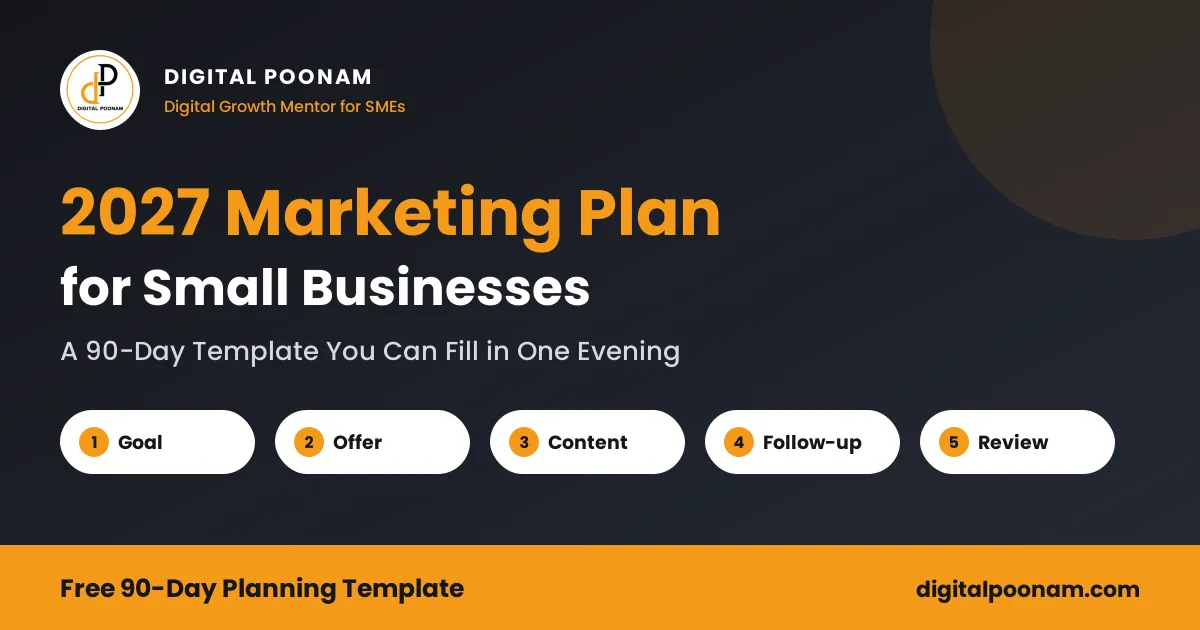
Every plan, whatever your business, has the same 5 parts: Goal, Offer, Content, Follow-up and Review. The steps below take you through each one. Together they take about 2 hours.
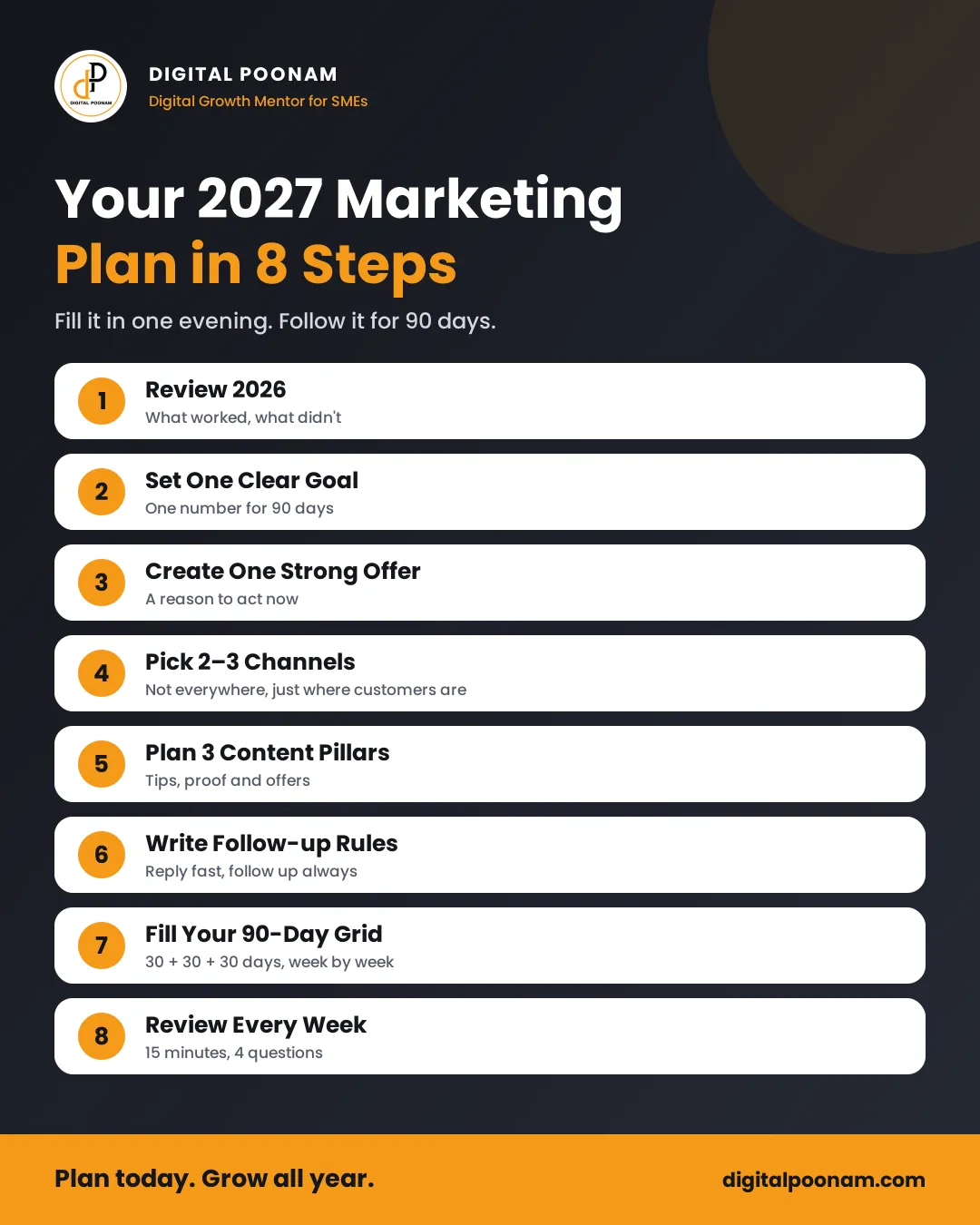
Step 1: Look Back at 2026 (15 minutes)
Before you plan ahead, look at what already worked. Open your WhatsApp, your Excel sheet, your CRM or even your notebook and answer these 5 questions:
Which 3 posts, offers or activities brought the most enquiries?
Which source brought your best customers: Instagram, Google, WhatsApp or referrals?
Which month was the slowest, and why?
What did you spend money on, and did it bring customers?
What will you stop doing in 2027?
Do not worry if you do not have exact numbers. Write what you remember. An honest guess is better than a blank page. And if you cannot answer question 2, that is your first lesson: start tracking where every lead comes from.
Step 2: Choose One Number (15 minutes)
The most common mistake in planning is having five goals. Pick one number that matters most for the next 90 days. For example:
New enquiries per month
New bookings or sales per month
New customers from Google or WhatsApp
Write it as a sentence: "I want 20 new enquiries every month." Choose a number that stretches you a little, but that you can honestly reach with your current time and team.
Step 3: Make One Clear Offer (15 minutes)
Marketing without an offer is like a shop without a price tag. Customers need a clear reason to contact you now. Answer 4 things:
What am I offering?
Who is it for?
Why now? Is there a benefit or a deadline?
What is the price or discount?
Example: "Free 15-minute demo for local shops, valid till 31 January." Keep one main offer for the quarter. You can refresh it every month, but do not run five different offers at once.
Step 4: Pick Your Channels (10 minutes)
You do not need to be everywhere. Choose a maximum of three channels, where your customers already spend time. Doing three well beats doing seven badly.
WhatsApp Business: best for follow-up and repeat customers. Read my guide on using WhatsApp for local marketing without spamming customers.
Google Business Profile: best for local businesses. Use this Google Business Profile checklist and learn how to get more Google reviews.
Instagram or Facebook: best for showing your work, products and customers.
YouTube or LinkedIn: best for expertise, trust and higher-value services.
Your website or blog: best for being found on Google and in AI answers. See my GEO guide for getting recommended by ChatGPT, Gemini and Perplexity.
Step 5: Set Your Three Content Pillars (20 minutes)
If you wake up every day asking "What should I post today?", you will run out of energy by February. Instead, decide on three content pillars, three types of content you will repeat:
Educate: tips, how-tos and answers to questions customers ask you again and again.
Prove: customer stories, before and after results, behind-the-scenes of your work.
Sell: your offer, new launches, limited slots and reminders.
A simple rhythm is 2 posts to educate, 1 post to prove and 1 post to sell each week. Then write down what you will do on each day of the week. For more help, read how to build a content calendar that actually works.
Tip for Q1: some dates are fixed and good for content ideas: New Year (1 January), Republic Day (26 January), Valentine's Day (14 February), Women's Day (8 March) and the financial year-end (31 March). Festivals like Makar Sankranti and Holi fall in this quarter too, but their dates change every year, so check the calendar.
Step 6: Set Your Follow-Up Rules (15 minutes)
This is the step most businesses skip, and it is where sales are won or lost. Many customers do not buy on the first message. They buy after the second or third follow-up. Write these rules down now:
I will reply to every new enquiry within ___ minutes.
If there is no reply, I will follow up on day ___, day ___ and day ___.
After sending a quotation, I will follow up after ___ days.
After a sale, I will ask for a review on day ___.
The person responsible for follow-ups is ___.
Rules only work if you do not have to remember them. Use phone reminders, or a CRM that reminds you automatically. If you are still tracking leads in a notebook, this is a good moment to switch. I built AIBizzPro, a CRM and AI platform for small businesses, for exactly this reason: so that no genuine enquiry is forgotten.
Step 7: Fill In Your 90-Day Grid (30 minutes)
Now bring everything together. For each month, write down 5 things: your focus, your goal number, your content, your offer and your follow-up action. Also add a small budget, even if it is just the cost of your tools and a little boost on social media.
Here is an example of how a filled-in plan could look for a small interior design studio. This is only an example. Your numbers will be different.
Month 1 | Month 2 | Month 3 | |
|---|---|---|---|
Focus | Foundation | Visibility | Conversion |
Goal | 10 enquiries | 15 enquiries | 20 enquiries |
Content | Introduce the studio, show 3 past projects | Weekly tips, 2 customer stories, FAQ posts | Offer posts, limited-slot reminders, results |
Offer | Free 15-minute design consultation | Same offer, with a customer story | Month-end offer with a deadline |
Follow-up | Reply in 10 minutes, follow up on day 2 and day 5 | Same, plus ask every happy customer for a review | Same, plus call every quotation after 3 days |
Notice how Month 1 is about building the base, Month 2 about being seen, and Month 3 about turning attention into customers. Do not rush to sell in week one. Build the foundation first.
Step 8: Review Every Week (15 minutes, every week)
A plan without a review is just a wish. Every week, set aside 15 minutes and answer 4 questions:
How many new leads came in this week?
How many did I follow up with?
Which post or offer worked best?
What is one thing to fix next week?
At the end of each month, ask one bigger question: "Did I reach my number? Should I keep it, change it or stop it?" Small corrections every week are far better than one big change after three months.
Common Planning Mistakes to Avoid
Too many goals. One number is enough for 90 days.
Too many channels. Three is the maximum.
No offer. Content without an offer gets likes, not customers.
No follow-up plan. Most lost sales are lost after the first message.
Never reviewing. If you do not look at the numbers, you cannot improve them.
Copying a big brand. Plan for your team size, your time and your budget.
Quick Checklist: Is Your 90-Day Plan Ready?
I have reviewed what worked in 2026
I have chosen one goal number
I have one clear offer with a reason to act now
I have picked a maximum of three channels
I have three content pillars and a weekly rhythm
I have written my follow-up rules
I have filled my 90-day grid
I have a 15-minute weekly review in my calendar
Final Thoughts
A good marketing plan does not need to be long or complicated. It needs one goal, one clear offer, a few channels you can manage, and a habit of following up and reviewing. If you can do that for 90 days, you will already be ahead of most small businesses.
Sit down this week, fill in the template in one evening, and start your first 30 days on schedule. If you get stuck or want help turning your plan into leads and follow-ups, get in touch with me or explore AIBizzPro, our CRM + AI platform built for small businesses.
A 3-page printable template with every step from this guide. Fill it in one evening.
FAQs
1. What is a 90-day marketing plan?
It is a simple plan that covers one goal, one offer, your content and your follow-up for the next three months, broken into three 30-day phases.
2. Why 90 days instead of a yearly plan?
A year is too long for a small business to predict. 90 days is short enough to stay focused and long enough to see real results, and you can adjust the plan every quarter.
3. How long does it take to fill in the template?
About 2 hours, which is why we call it a one-evening plan.
4. How many marketing channels should I use?
Two or three at most. It is better to do two channels consistently than six channels occasionally.
5. How much marketing budget do I need?
You can start with a very small budget. Most of this plan runs on your time, your content and your follow-up. Add paid ads only after your offer and follow-up are working.
6. Can I start the plan in a different month?
Yes. Any 90-day period works. Start on the 1st of next month or even next Monday, whichever is sooner.