Introduction: Your Customers Have Changed How They Search
A few years ago, if someone wanted a CA in Bhopal, a digital marketing mentor, or a good CRM for their shop, they typed it into Google and clicked on a few links.
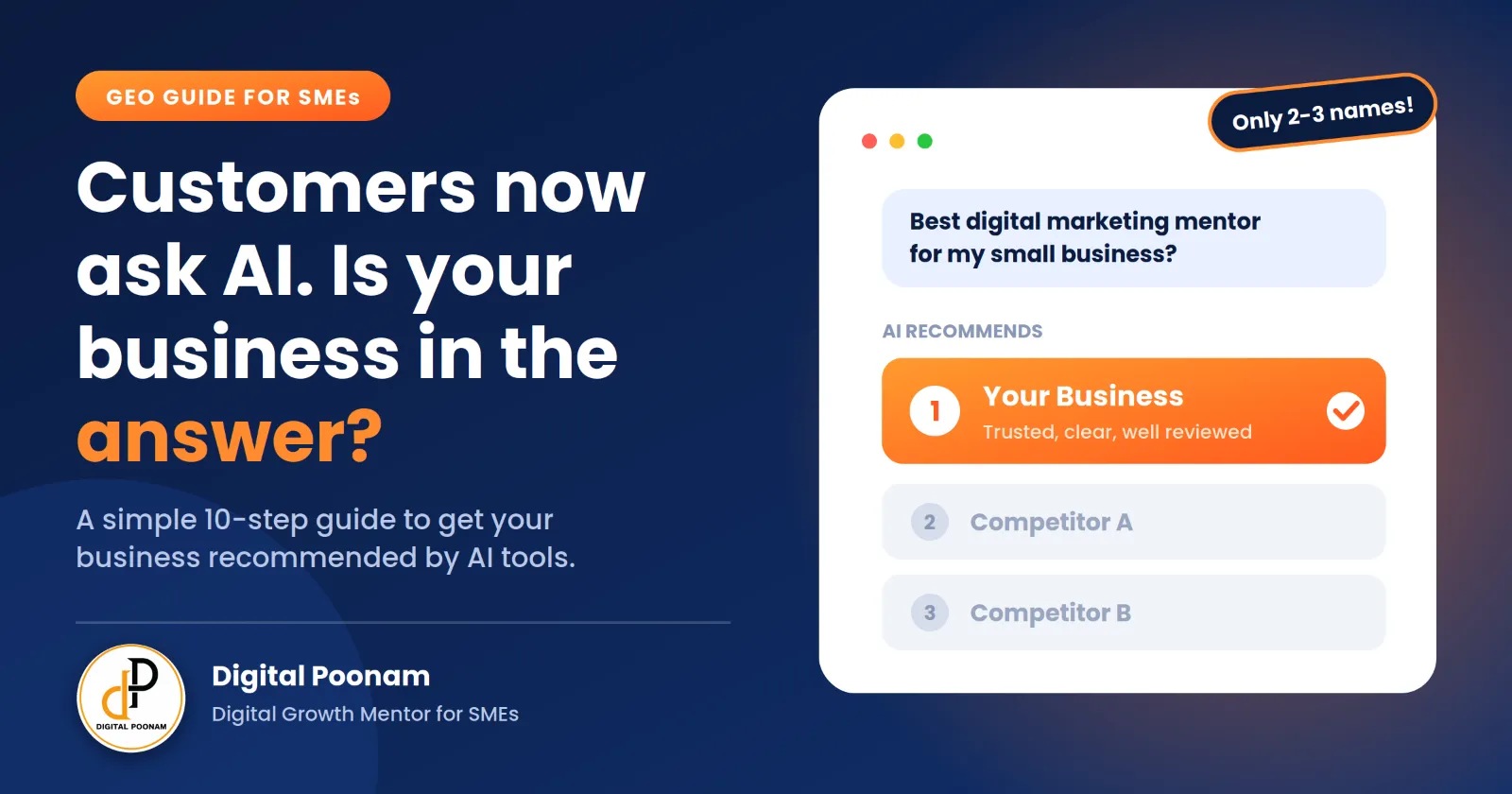
Today, many people simply ask an AI tool: "Which is the best CRM for a small business in India?" or "Who can help me grow my business with digital marketing?" The AI gives one direct answer, often with just two or three names.
If your business is not one of those names, you are invisible to that customer. You never even got a chance to compete.
This is where GEO (Generative Engine Optimization) comes in. In this guide, I will explain what GEO is, why it matters for small and medium businesses, and give you a step-by-step process you can start using this week.
What is GEO (Generative Engine Optimization)?
SEO helps your website rank on Google. GEO helps your business get mentioned, quoted and recommended inside AI-generated answers on tools like ChatGPT, Google Gemini, Perplexity and Google's AI Overviews.
The key difference:
- SEO goal: Get a click to your website.
- GEO goal: Get your brand named in the answer itself.
GEO does not replace SEO. It builds on it. Good SEO is still the foundation, but GEO adds a new layer: making your content easy for AI to understand, trust and quote.

Why SMEs Should Care About GEO Right Now
- Less competition. Most small businesses are not optimizing for AI yet. Starting early gives you a real advantage.
- Higher-intent customers. People who ask AI a detailed question are usually close to making a decision.
- Trust transfer. When an AI recommends you, the customer treats it like a suggestion from a knowledgeable friend.
- It rewards real expertise. Small businesses with genuine knowledge and clear content can beat bigger brands with generic content.
How AI Tools Decide Who to Recommend
AI tools do not have a secret ranking button you can press. In simple terms, they look for businesses that are:
- Clearly described: It is obvious what you do, for whom and where.
- Consistently mentioned: Your name and details match across your website, social profiles, directories and other websites.
- Backed by trust signals: Reviews, case studies, media mentions, speaking engagements, testimonials.
- Helpful: Your content answers real questions in a clear, direct way.
Everything in the steps below is built around these four points.
Step-by-Step Process to Get Your Business Into AI Answers
Step 1: Find Out Where You Stand Today
Before changing anything, test yourself. Open ChatGPT, Gemini and Perplexity and ask 10 to 15 questions your customers would ask, such as:
- "Best [your service] in [your city]?"
- "Who can help me with [your customer's problem]?"
- "Which [your product] is good for small businesses in India?"
Note down: Is your business mentioned? Who else is mentioned? What do those competitors have that you do not? Save this as your baseline and repeat the test every month.
Step 2: Write a Clear "Who We Are" Statement
AI needs one simple, consistent description of your business. Write a 2 to 3 line statement:
"[Business name] is a [what you are] based in [city] that helps [target customer] with [main problem/solution]."
Use this exact statement on your homepage, About page, LinkedIn, Google Business Profile, Instagram bio and every directory listing. Consistency is what builds AI's confidence in you.
Step 3: Build Strong About and Service Pages
Most SME websites have vague pages. Fix this:
- State your services in plain language, not buzzwords.
- Mention your city, industry and the kind of customers you serve.
- Add real numbers and facts: years of experience, number of clients served, results achieved.
- Add a short bio of the founder with credentials, since people and expertise build trust.
Step 4: Create FAQ-Style Content
AI tools love content that directly answers questions. For every main service or product, create a page or blog section with:
- The exact question customers ask, as a heading.
- A direct answer in the first 2 to 3 lines.
- Then a more detailed explanation below.
Example: "How much does a CRM cost for a small business in India?" followed by a clear, honest answer. Answer-first writing is more likely to be picked up and quoted.
Step 5: Add Structure With Schema Markup
Schema markup is a small piece of code that tells search engines and AI exactly what your page is about: your business, FAQs, reviews, articles, author and so on. If your website runs on WordPress, plugins like Rank Math or Yoast can add Organization, FAQ and Article schema without writing code. If you are not technical, ask your web developer to add it.
Step 6: Strengthen Your Presence Beyond Your Website
AI tools learn from the wider web, not only your own site. Make sure your business is present and consistent on:
- Google Business Profile (fully filled, with photos and regular updates)
- LinkedIn company page and founder profile
- Industry directories and local listings
- YouTube, with videos that explain your services
- Guest posts, podcasts, interviews and event pages where you are mentioned
The more trusted places that mention your business the same way, the more likely AI is to recommend you.
Step 7: Collect and Showcase Reviews and Case Studies
Trust signals matter. Ask happy customers for Google reviews and short testimonials. Publish 2 to 3 detailed case studies in this format: problem, what you did, result. Real stories with real outcomes make your business stand out from generic competitors.
Step 8: Publish Original Insights
AI tools prefer content that offers something unique. Instead of repeating what everyone says, share:
- Lessons from your own work with clients
- Simple data or observations from your experience
- Your own frameworks and step-by-step methods
Original, experience-based content is much more likely to be cited than copied content.
Step 9: Keep Content Fresh and Technically Healthy
- Update your key pages at least every few months.
- Make sure your website loads fast and works well on mobile.
- Do not block AI crawlers by mistake in your robots.txt file. Ask your developer to check this.
Step 10: Track, Test and Improve Monthly
Repeat the test from Step 1 every month. Track whether your brand is being mentioned more often, and watch for new traffic from AI tools in your website analytics. Improve the pages that are not performing and double down on what works.
Common GEO Mistakes SMEs Make
- Writing vague, buzzword-heavy content with no clear answers.
- Using different business descriptions on different platforms.
- Ignoring reviews and case studies.
- Publishing only once and never updating.
- Expecting overnight results. GEO is a steady, long-term game.
Quick GEO Checklist
- ☐ Tested my business on ChatGPT, Gemini and Perplexity
- ☐ Written one clear "Who We Are" statement
- ☐ Updated About and Service pages with facts and numbers
- ☐ Created FAQ-style, answer-first content
- ☐ Added schema markup
- ☐ Made my profiles consistent across the web
- ☐ Collected reviews and published case studies
- ☐ Shared original insights and experience
- ☐ Checked website speed and crawler access
- ☐ Set a monthly tracking reminder
Final Thoughts
The way customers find businesses is changing fast. The good news is that GEO rewards exactly what good small businesses already have: real expertise, real customers and real results. You just need to present them clearly, consistently and in a way AI can understand.
Start with Step 1 today. Spend 30 minutes testing where your business stands, and you will already know what to fix first.
If you want help building a digital growth system for your business, including lead capture and follow-up automation, get in touch with me or explore AIBizzPro.
FAQs
What is the difference between SEO and GEO?
SEO helps your website rank in search engine results. GEO helps your brand get mentioned and recommended inside AI-generated answers.
Do I need GEO if I already do SEO?
Yes. SEO is the foundation, but GEO adds the extra layer that makes your content easy for AI tools to understand and quote.
How long does GEO take to show results?
It usually takes a few months of consistent work. Early improvements often show up as more mentions in AI answers and better engagement on your key pages.
Can a small business really compete with big brands in AI answers?
Yes. AI tools value clarity, expertise and trust, and small businesses with focused, experience-based content can win in their niche and city.

