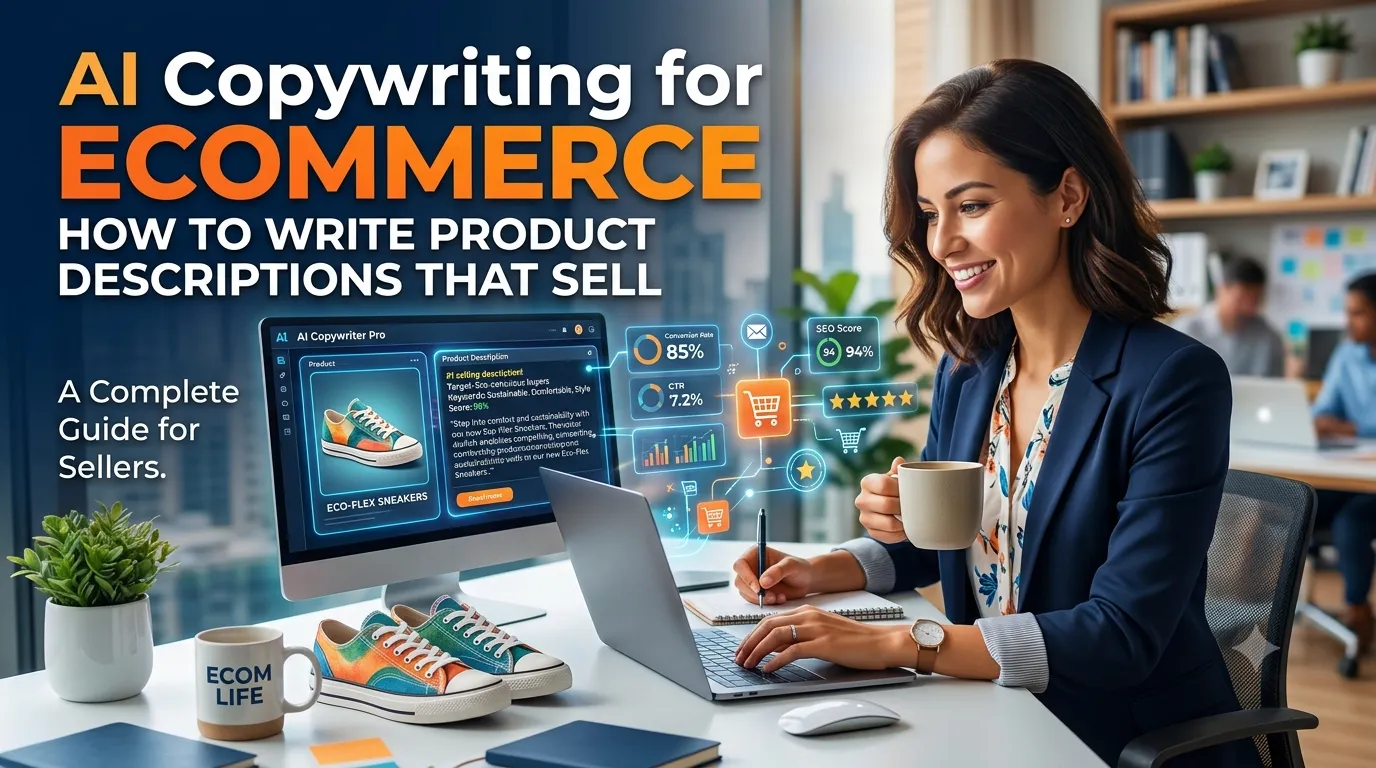
AI Copywriting for Ecommerce: How to Write Product Descriptions That Sell
Let me ask you something. How much time do you spend writing product descriptions for your ecommerce store? And more importantly—do those descriptions actually sell?
If you're like most ecommerce owners, the answer is: "Too much time, and the results are inconsistent." You know product descriptions matter. They help customers understand your products, build trust, and drive purchases. But writing them manually is slow, and the quality varies.
Here's the good news: AI can help you write product descriptions that sell—faster and better than ever. In this guide, I'll show you exactly how to use AI copywriting for ecommerce to create descriptions that convert. Whether you're a digital marketing professional, an ecommerce business owner, or a student taking a digital marketing course, this is your blueprint for ecommerce success.
Let's dive in.
1. Why Product Descriptions Matter
Product descriptions are one of the most important parts of your ecommerce store. Here's why.
1.1 They Sell the Product
Customers can't touch, feel, or try your products online. Your description is what convinces them to buy. It explains what the product is, what it does, and why they need it.

1.2 They Build Trust
A well-written description builds trust. It shows customers you understand their needs and that your product will deliver. A poor description erodes trust and drives customers away.
1.3 They Improve SEO
Product descriptions are indexed by search engines. They help your products rank for relevant keywords. The better your descriptions, the more organic traffic you'll get.
1.4 They Reduce Returns
Clear, accurate descriptions set proper expectations. This reduces returns and increases customer satisfaction. Customers know exactly what they're getting.
2. Why Manual Product Descriptions Fail
Writing product descriptions manually is challenging. Here's why.
2.1 Time-Consuming
If you have hundreds or thousands of products, writing unique descriptions for each one is a massive time investment. Most businesses cut corners, leading to low-quality descriptions.
2.2 Inconsistent Quality
Different writers produce different results. Some descriptions are great; others are bland. This inconsistency hurts your brand.
2.3 Missing Emotional Connection
Great product descriptions connect emotionally. They don't just list features—they show how the product makes the customer's life better. Manual writers often focus on features instead of benefits.
2.4 Lack of SEO Knowledge
Many writers don't understand SEO. They don't know how to weave keywords naturally into descriptions. As a result, product pages don't rank well in search results.
3. How AI Transforms Product Descriptions
AI solves the problems of manual writing by automating the process and improving quality.
3.1 Speed and Scale
AI can generate hundreds of product descriptions in minutes. What used to take weeks now takes hours. This lets you focus on other areas of your business.
3.2 Consistency
AI ensures every description follows the same structure, tone, and style. Your brand voice stays consistent across all products.
3.3 SEO Optimization
AI tools can optimize descriptions for keywords. They naturally include relevant terms and phrases, helping your products rank higher in search results.
3.4 Personalization
AI can tailor descriptions to different customer segments. It can address specific pain points, highlight relevant benefits, and use language that resonates with each audience.
4. The Best AI Tools for Ecommerce Product Descriptions
Here are the top AI tools for writing product descriptions.
- ChatGPT: Versatile AI writing assistant. Best for general product descriptions.
- Jasper: AI copywriting with brand voice customization. Best for ecommerce brands.
- Copy.ai: Structured content workflows. Best for bulk product descriptions.
- Describely: AI product description generator. Best for large product catalogs.
- Hypotenuse AI: AI-powered product descriptions with SEO. Best for SEO optimization.
5. How to Write Product Descriptions That Sell
Here's a step-by-step process for writing AI-powered product descriptions that convert.
Step 1: Start with Product Research
- Understand your product's features and benefits
- Identify your target customer and their pain points
- Research competitors' descriptions for inspiration
Step 2: Focus on Benefits, Not Just Features
- Features tell; benefits sell
- Instead of "waterproof," say "keeps your feet dry in any weather"
- Instead of "100% cotton," say "soft, breathable comfort all day long"
Step 3: Use AI to Draft Descriptions
- Provide AI with product details, features, and benefits
- Specify the tone, style, and length
- Ask for multiple variations
Step 4: Add Emotional Triggers
- Connect the product to a feeling or outcome
- Use sensory language (soft, smooth, vibrant)
- Create a sense of urgency (limited stock, special offer)
Step 5: Optimize for SEO
- Include relevant keywords naturally
- Use semantic variations
- Write meta descriptions and title tags
Step 6: Edit and Personalize
- Review every AI-generated description
- Add unique insights and brand voice
- Ensure accuracy and quality
6. The Anatomy of a High-Converting Product Description
Here's the structure that sells.
6.1 Headline
A compelling headline that grabs attention. It should include the main benefit and a keyword.
6.2 Emotional Hook
An opening sentence that connects with the customer's pain point or desire. Make them feel understood.
6.3 Benefit-Driven Features
List features, but translate them into benefits. Explain how each feature improves the customer's life.
6.4 Social Proof
Include testimonials, reviews, or ratings. Social proof builds trust and reduces hesitation.
6.5 Call to Action
A clear, urgent call to action. Tell customers exactly what to do next.
6.6 SEO Elements
Naturally include keywords, use semantic variations, and optimize for search engines.
7. Real-World Example: The AI Product Description Transformation
Here's how an ecommerce brand used AI to transform their product descriptions:
- Challenge: They had 500+ products with generic descriptions. Conversion rates were low.
- Solution: They used Jasper and Describely to generate new descriptions that focused on benefits, emotions, and SEO.
- Result: Conversion rates increased by 40%. Organic traffic grew by 60%. Returns decreased by 20%.
8. Conclusion: Write Product Descriptions That Sell
Product descriptions are essential for ecommerce success. They sell your products, build trust, improve SEO, and reduce returns. AI makes it possible to write better descriptions faster—without sacrificing quality.
But here's the good news: You can start today. Choose one AI tool, upload your product details, and generate descriptions. Review, personalize, and publish. The results will speak for themselves.
The choice is yours. Keep writing descriptions manually, or start using AI to write descriptions that sell.
Join the best Digital Marketing Course to master AI-powered ecommerce marketing and digital strategy in 2026.
Frequently Asked Questions (5 Unique FAQs)
❓ 1. Can AI write product descriptions that actually convert?
Yes. AI can write product descriptions that convert—if they're optimized for benefits, emotions, and SEO. The key is to use AI as a starting point, then add your unique brand voice and insights.
❓ 2. How long should a product description be?
It depends on the product. For simple products, 50-100 words is sufficient. For complex products, 200-300 words may be needed. Focus on being clear, concise, and benefit-driven.
❓ 3. Should I use the same description for all my products?
No. Every product should have a unique description. Duplicate descriptions hurt SEO and fail to differentiate your products. AI makes it easy to generate unique descriptions at scale.
❓ 4. How do I make AI product descriptions sound authentic?
Review and edit every AI-generated description. Add your brand voice, unique insights, and emotional triggers. Use conversational language and avoid generic phrases.
❓ 5. Can AI help with product description SEO?
Yes. AI tools like Hypotenuse AI and Jasper optimize descriptions for SEO. They include relevant keywords naturally, improving your product pages' search rankings.