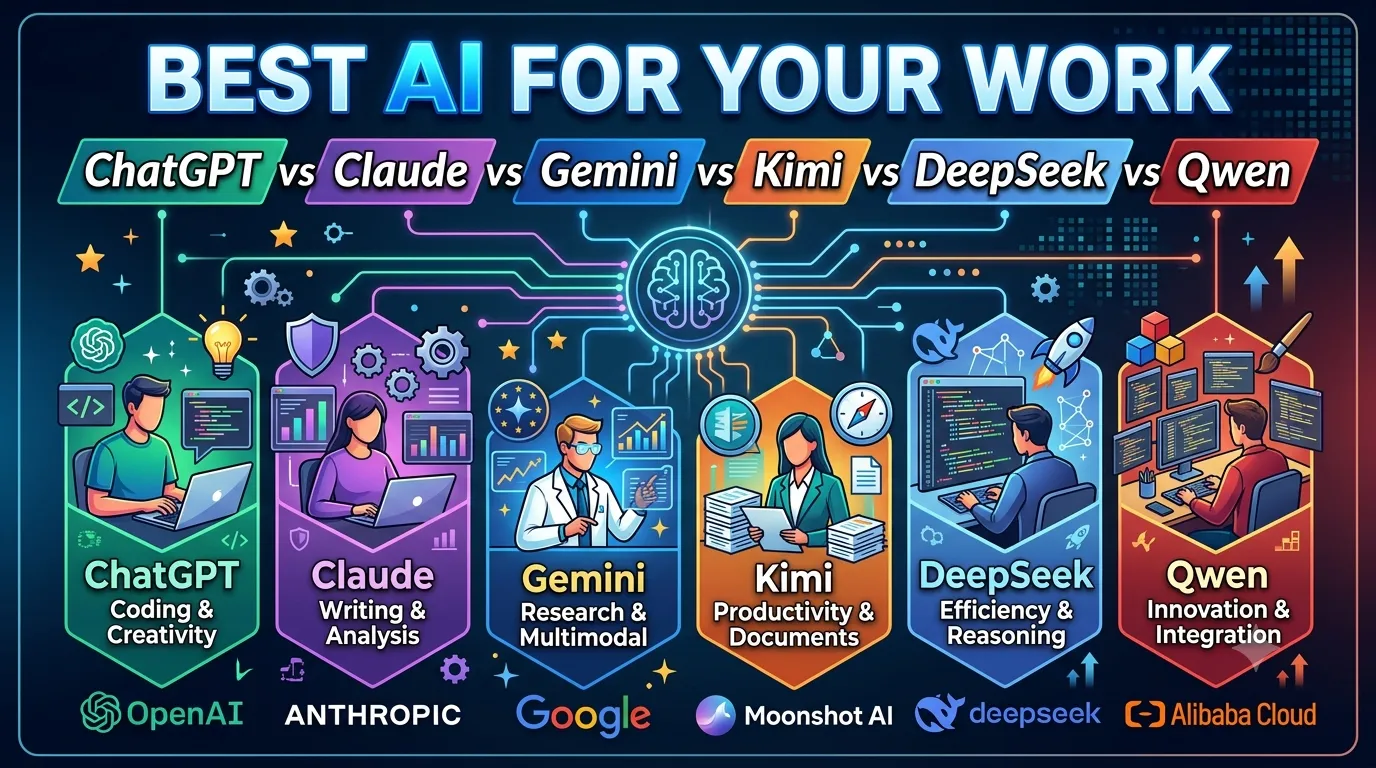
You open six tabs. ChatGPT. Claude. Gemini. Kimi. DeepSeek. Qwen Coder. You type the same prompt into each. Six different responses come back.
Which one wins? It depends entirely on what you're trying to do.
In 2026, there's no single "best AI." There's the best AI for emails. The best for coding. The best for long documents. The best for spreadsheets. The best for building apps.
Let me break down exactly which AI tool you should use for which task—no fanboy bias, just practical recommendations.
The Quick Comparison (One-Line Summary)
ChatGPT: Best for general writing—emails, messages, blogs, social posts.
Claude: Best for high-level coding and complex technical tasks.
Gemini: Best for image generation (via Imagen 3) and Google Workspace integration.
Kimi: Best for spreadsheets, documents, websites, and AI agents.
DeepSeek: Best for extremely long-context writing (up to 1 million tokens).
Qwen Coder: Best for app development and specialized coding tasks.
ChatGPT: Best for General Writing
What it's best at: Emails, messages, blog posts, social media captions, ad copy, brainstorming, and day-to-day writing tasks.
ChatGPT is the Swiss Army knife of AI tools. It's not the best at any single thing, but it's good at almost everything. For most people's daily writing needs, ChatGPT is the right choice .
What it does well:
- Generates content FAST (50 headlines in 10 seconds)
- Understands complex, multi-step instructions
- Huge user community (templates, prompts, tutorials everywhere)
- Integrates with countless tools via API
- Free tier is generous and usable
What it struggles with: Long-form content can feel repetitive. Sometimes sounds like a textbook. Hallucinates facts more than Claude.
Best for: Daily writing. Email drafts. Social media captions. Blog outlines. Ad copy variations. Brainstorming. Quick research summaries.
Pricing: Free tier. Plus: $20/month. Pro: $200/month.
Claude: Best for High-Level Coding
What it's best at: Complex coding tasks, debugging, code generation, technical architecture, and following intricate instructions.
Claude consistently outperforms competitors on coding benchmarks. In 2026, Claude Opus 4 scores highest on SWE-bench (software engineering benchmark) and handles 200,000+ token contexts—enough to process entire codebases in one conversation .
What it does well:
- Follows complex, multi-step instructions accurately
- Produces the most natural, human-sounding prose among AI tools
- Excellent at maintaining consistency across long documents
- Rarely hallucinates facts
- Claude Code (terminal-based coding agent) included in Pro plan .
What it struggles with: Cannot generate images. Smaller user community than ChatGPT. Less integration with third-party tools .
Best for: Coding complex features. Debugging. Code reviews. Technical architecture planning. Following precise, multi-step instructions.
Pricing: Free tier. Pro: $20/month. Team: $30/user/month. Max: $100-200/month.
Gemini: Best for Image Generation
What it's best at: Generating and editing images (via Imagen 3), plus deep integration with Google Workspace (Docs, Sheets, Gmail, Slides).
Gemini's image generation has quietly become the best option for marketers who need realistic product shots, lifestyle images, and branded visuals. Unlike Midjourney's artistic flair, Gemini produces images that look like real photographs .
What it does well:
- High-quality, photorealistic image generation (Imagen 3)
- Direct integration with Google Docs, Sheets, Gmail, Slides
- Excellent at summarizing YouTube videos and long articles
- Real-time data via Google Search (less hallucination)
- 1 million+ token context window
What it struggles with: Writing feels more robotic than Claude. Less creative than ChatGPT for brainstorming. User interface less intuitive .
Best for: Generating product photography, social media visuals, blog featured images. Working inside Google Workspace. Summarizing long videos or documents.
Pricing: Free tier. Gemini Advanced: $20/month (included with Google One AI Premium).
Kimi: Best for Sheets, Docs, Websites, and Agents
What it's best at: Working with spreadsheets, long documents, website content, and building AI agents that execute tasks.
Kimi (developed by Moonshot AI) has emerged as a specialist for productivity workflows. It excels at reading and analyzing massive documents, manipulating spreadsheet data, and understanding website structures. Its agent capabilities allow it to execute multi-step tasks autonomously .
What it does well:
- Processes extremely long documents (up to 500,000+ tokens)
- Analyzes spreadsheet data and finds patterns
- Understands website structures and can navigate them
- Can be configured as autonomous agents for recurring tasks
- Strong at Chinese and English bilingual tasks
What it struggles with: Less known in Western markets. Smaller community. Fewer integrations.
Best for: Analyzing large datasets in spreadsheets. Processing long contracts or reports. Building AI agents that automate recurring workflows. Website content analysis and scraping.
Pricing: Free tier. Paid plans start around $10-20/month.
DeepSeek: Best for Long Context Writing
What it's best at: Processing and writing within extremely long contexts—up to 1 million tokens .
DeepSeek-V3 (by DeepSeek AI) has pushed the boundary of context length. It can process entire book series, massive codebases, or years of chat logs in one conversation. For anyone working with extremely long documents, DeepSeek is unmatched .
What it does well:
- 1 million token context window (can process entire novels)
- Strong reasoning capabilities, especially for technical and mathematical tasks
- Extremely cost-effective (priced significantly lower than competitors)
- Open-source weights available
What it struggles with: Less polished user interface. Smaller ecosystem of integrations. Newer to the market .
Best for: Processing entire book manuscripts. Analyzing years of customer support logs. Working with massive codebases. Research requiring cross-referencing many documents.
Pricing: Free tier. API pricing: extremely competitive (approx 90% cheaper than GPT-4).
Qwen Coder: Best for App Development
What it's best at: Specialized coding for app development, frontend and backend, and generating complete application structures .
Qwen Coder (by Alibaba Cloud) is purpose-built for developers building applications. It understands framework-specific patterns, generates complete component structures, and can scaffold entire projects from descriptions .
What it does well:
- Specialized training on code (not just general text)
- Understands framework-specific patterns (React, Vue, Django, Spring, etc.)
- Can generate complete app structures from high-level descriptions
- Strong performance on code generation benchmarks
- Free tier available
What it struggles with: Narrow focus (only coding). General writing tasks are not its strength. Less suitable for non-developers.
Best for: Building web applications. Generating frontend components. Creating backend APIs. Scaffolding project structures. Code refactoring and optimization.
Pricing: Free tier. API pricing competitive with other Chinese models.
Quick Reference Table
| AI Tool | Best For | Context Window | Pricing (Starting) | |----------|----------|----------------|--------------------| | ChatGPT | General writing, emails, social | 128K-1M tokens | Free / $20/mo | | Claude | High-level coding, complex instructions | 200K tokens | Free / $20/mo | | Gemini | Image generation, Google Workspace | 1M+ tokens | Free / $20/mo | | Kimi | Sheets, docs, websites, agents | 500K+ tokens | Free / $10-20/mo | | DeepSeek | Long context writing (1M tokens) | 1M tokens | Free / Very cheap API | | Qwen Coder | App development, specialized coding | 128K-1M tokens | Free / Competitive API |
How to Choose: A Decision Guide
Choose ChatGPT if: You need an all-purpose writing assistant for emails, social media, blogs, and quick tasks. You want something that works well enough for everything without switching tools .
Choose Claude if: You're a developer working on complex coding tasks. You need to follow precise, multi-step instructions. You write long-form content and care deeply about natural prose .
Choose Gemini if: You need high-quality image generation. Your team lives in Google Workspace (Docs, Sheets, Gmail). You want a single tool for research, writing, and visuals .
Choose Kimi if: You work extensively with spreadsheets, long documents, or websites. You want to build AI agents for recurring workflows. You need bilingual (English/Chinese) support .
Choose DeepSeek if: You work with extremely long documents (book-length manuscripts, years of logs, massive codebases). You need cost-effective API access. Context length is your primary constraint .
Choose Qwen Coder if: You're building applications full-time. You need framework-specific code generation. You want a specialized coding assistant, not a general-purpose AI .
The Smart Marketer's Toolkit
You don't need to pick one. Use multiple.
Use ChatGPT for daily writing—emails, captions, quick drafts .
Use Claude for coding tasks and complex multi-step instructions .
Use Gemini for generating images and working inside Google Docs/Sheets .
Use Kimi for spreadsheet analysis and building autonomous agents .
Use DeepSeek when you need to process extremely long documents .
Use Qwen Coder when you're building applications and need framework-specific code .
Six tools. Six purposes. Use each where it wins.
Frequently Asked Questions (FAQs)
1. Which AI is completely free?
All six have free tiers. ChatGPT, Claude, Gemini, DeepSeek, Kimi, and Qwen Coder all offer free access with usage limits. For most individuals, the free tiers are sufficient for daily use. Upgrade only if you hit limits or need advanced features .
2. Can I use these AIs for commercial work?
Yes. All have commercial licenses. However, review each tool's terms regarding data usage and output ownership. Generally, you own the outputs. But if you're generating sensitive business content, consider enterprise plans with data protection guarantees.
3. Which AI writes the most human-like content?
Claude. Its prose is consistently rated most natural and least "AI-sounding." For emails, newsletters, and anything that needs to sound like a real person, Claude wins. ChatGPT is faster but more robotic. Gemini is improving but still behind both .
4. Which AI is best for non-English content?
Gemini (Google) and Kimi (Chinese) both excel at non-English languages. ChatGPT supports many languages but quality varies. Claude is English-optimized. For Indian languages (Hindi, Tamil, Telugu, etc.), Gemini and ChatGPT are your best options .
5. Do I need to pay for any of these?
For basic use, no. Free tiers are generous. For heavy use, consider ChatGPT Plus ($20/mo), Claude Pro ($20/mo), or Gemini Advanced ($20/mo). Kimi, DeepSeek, and Qwen Coder have affordable API pricing. Start free. Upgrade when you need more volume or advanced features .