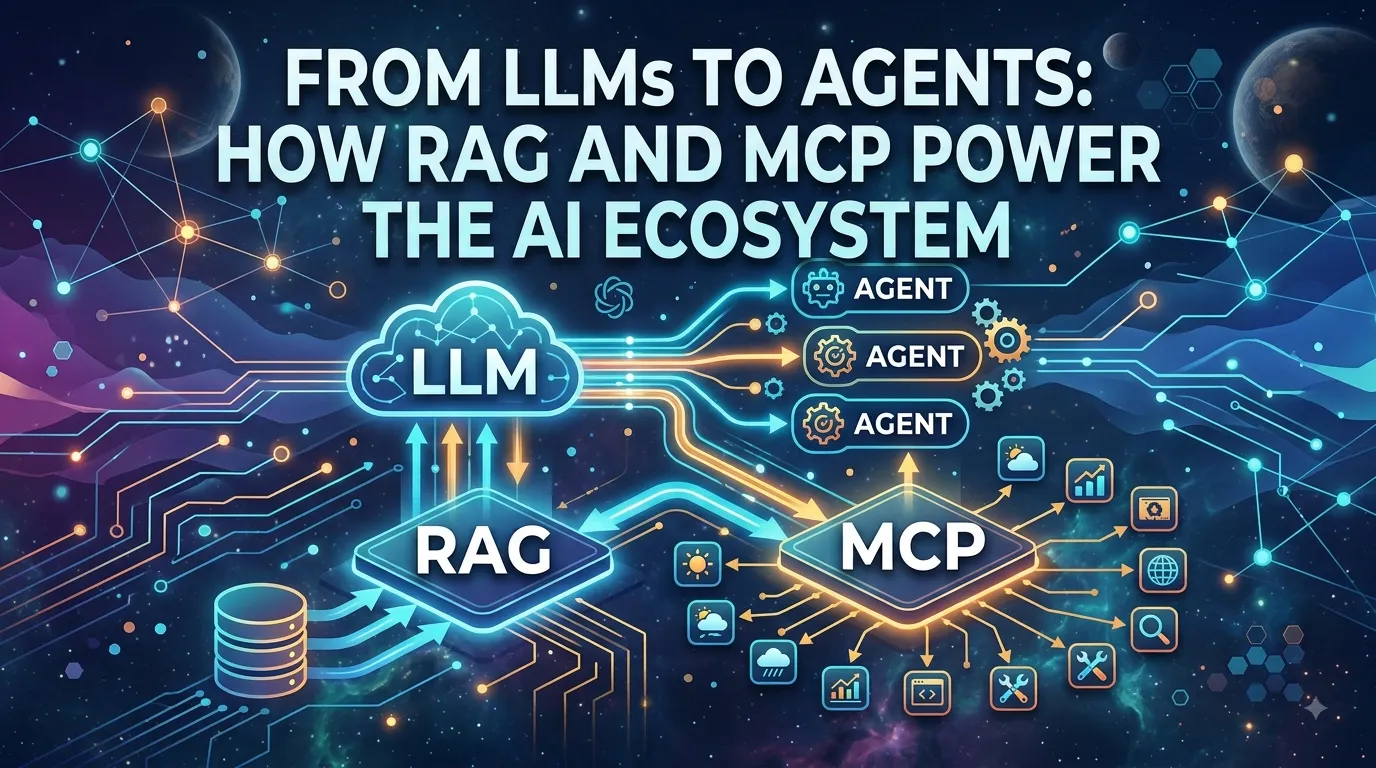
Let me ask you something. Have you ever wondered how AI actually works? You've heard terms like LLMs, RAG, MCP, and Agents thrown around. But what do they actually mean? And more importantly — how do they all fit together?
If you're like most digital marketing professionals, the answer is: "I know some of them, but I'm not sure how they connect." You're not alone. The AI ecosystem is complex, and the terminology can be confusing.
In this guide, I'll break down LLMs, RAG, MCP, and Agents — what they are, how they differ, and how they work together to power the AI revolution. Whether you're a digital marketing professional, a business owner, or a student taking a digital marketing course, this is your complete breakdown of the AI ecosystem.
Let's dive in.
1. LLMs: The Foundation of the AI Ecosystem
Let's start at the beginning. LLM stands for Large Language Model. It's the brain of the AI ecosystem — the foundational technology that powers everything else.
1.1 What Is an LLM?
An LLM is a type of artificial intelligence that processes and generates human-like text. It's trained on massive amounts of data — books, articles, websites, and more — to understand patterns in language.
Think of an LLM as a highly advanced autocomplete. It predicts what word comes next based on the words before it. But because it's trained on so much data, it can generate coherent, contextually relevant text on almost any topic.
1.2 Examples of LLMs
- GPT-4 (OpenAI) — The most widely known LLM, powering ChatGPT
- Claude (Anthropic) — Known for reasoning and long-form content
- Gemini (Google) — Google's multimodal LLM
- Llama (Meta) — Open-source LLM
- Qwen (Alibaba) — Multimodal LLM with video and image capabilities
1.3 What LLMs Can and Can't Do
Can: Generate text, answer questions, summarize, translate, brainstorm ideas.
Can't: Access real-time information, take actions, remember conversations long-term (without help), or know when it's wrong.
This is where RAG, MCP, and Agents come in. They extend LLMs beyond their basic capabilities.
2. RAG: Making LLMs Accurate and Up-to-Date
RAG stands for Retrieval-Augmented Generation. It's a technique that makes LLMs more accurate and reliable by giving them access to external knowledge.
2.1 What Is RAG?
Imagine you're taking a test. You could try to answer everything from memory. Or you could look up information in a textbook and then answer. That's what RAG does for LLMs.
Instead of relying only on what it learned during training, the LLM retrieves information from a specific knowledge base (like your company documents) and generates answers based on that information.
2.2 How RAG Works
- Step 1: You ask a question
- Step 2: The system retrieves relevant information from a knowledge base
- Step 3: The LLM generates an answer based on that information
- Step 4: The answer is accurate, up-to-date, and grounded in real data
2.3 Why RAG Matters
- Reduces hallucinations: LLMs make things up less often
- Provides current information: Training data has a cutoff date; RAG accesses real-time info
- Customizes responses: You can use your own documents, making the AI specific to your business
- Builds trust: You can see where the information came from
2.4 Example of RAG in Action
When you upload a document to ChatGPT and ask questions about it, that's RAG in action. The AI retrieves information from your document and generates answers based on it.
3. MCP: The Universal Translator for AI
MCP stands for Model Context Protocol. It's a newer term that's becoming increasingly important as AI systems become more complex.
3.1 What Is MCP?
Think of MCP as a universal translator for AI systems. Different AI models speak different "languages." MCP is a standard that helps them communicate and share context with each other.
When you have a conversation with an AI, it needs to remember what you said earlier. That's context. MCP helps AI models manage that context more effectively, especially when multiple models are working together.
3.2 How MCP Works
- Manages context: MCP helps AI models remember and reference earlier parts of a conversation.
- Facilitates communication: Different AI models can share context with each other, enabling seamless collaboration.
- Standardizes interactions: MCP creates a common language for AI systems to interact, reducing complexity.
3.3 Why MCP Matters
- Interoperability: Different AI tools can work together effectively.
- Better context: AI can remember more of what you said, leading to more coherent and personalized conversations.
- Standardization: Makes it easier to build and scale AI systems.
- Efficiency: Reduces the complexity of AI integration.
4. Agents: The Autonomous Workforce
AI Agents are autonomous systems that can perceive, reason, and act to achieve goals. They're the executives of the AI world.
4.1 What Is an AI Agent?
Think of an AI agent as a self-driving car. You give it a destination, and it figures out the best route, navigates traffic, avoids obstacles, and gets you there — all without you telling it every step.
A regular LLM is like a GPS that gives you directions. An AI agent is like the self-driving car that actually takes you there.
4.2 How Agents Work
- Perceive: The agent gathers information from its environment
- Reason: The agent processes information and makes decisions
- Act: The agent executes actions to achieve goals
- Learn: The agent adapts and improves based on feedback
4.3 Why Agents Matter
- Autonomy: Agents work without constant supervision
- Multi-step tasks: They can handle complex workflows
- Adaptability: They adjust based on feedback
- Learning: They improve over time
4.4 Example of Agents in Action
An AI agent could handle your entire customer support process — identifying the issue, retrieving relevant information, generating a response, and escalating complex cases to humans. All without you telling it every step.
5. How They All Work Together
Now for the important part: how do these four technologies work together?
5.1 The AI Ecosystem Stack
- LLM: The brain — generates language and understands text
- RAG: The memory — retrieves external information for accuracy
- MCP: The translator — enables communication between systems
- Agents: The workforce — takes action and executes tasks
5.2 A Working Example
Here's how they work together in practice:
- RAG retrieves customer history from your database
- LLM analyzes the customer's situation and generates a response
- MCP manages the context of the entire conversation
- Agent sends the response to your email system and schedules a follow-up
5.3 The Synergy
Each component makes the others more powerful. RAG makes LLMs more accurate. MCP makes agents more coordinated. Agents make the entire system more useful. Together, they create an ecosystem that's far more powerful than any individual part.
6. Why This Matters for Your Career
Understanding these concepts isn't just academic — it's essential for your career.
6.1 Better Communication
When you understand these terms, you can communicate with developers, stakeholders, and clients more effectively. You'll understand what they're talking about and can contribute meaningfully.
6.2 Smarter Decisions
When you understand the AI landscape, you can make better decisions about which tools to use, how to implement them, and what's possible. This makes you a more effective decision-maker.
6.3 Career Growth
AI literacy is becoming essential in digital marketing and many other fields. Understanding these concepts positions you as a leader, not a follower.
6.4 Strategic Advantage
By understanding how LLMs, RAG, MCP, and Agents work together, you can design AI-powered systems that give your business a strategic advantage over competitors who are still trying to figure out the basics.
7. Conclusion: The AI Ecosystem Explained
LLMs, RAG, MCP, and Agents are the building blocks of the AI ecosystem. LLMs are the brain. RAG is the memory. MCP is the translator. Agents are the workforce. Together, they create systems that are powerful, accurate, and autonomous.
But here's the good news: You don't need to be a developer to understand these concepts. They're accessible to anyone who's willing to learn. And now, you've taken the first step.
The choice is yours. Stay confused by AI jargon, or start understanding the ecosystem that's reshaping the world.
Join the best Digital Marketing Course to master AI-powered marketing and digital strategy in 2026.
Frequently Asked Questions (5 Unique FAQs)
❓ 1. What's the difference between an LLM and an AI Agent?
An LLM generates language — it's reactive. An AI Agent perceives, reasons, acts, and learns — it's proactive and autonomous. Think of an LLM as a brain, and an AI Agent as a worker that uses that brain to get things done.
❓ 2. Do I need RAG for every AI application?
No. RAG is most useful when you need accurate, up-to-date information from specific sources. For general-purpose tasks, a well-trained LLM is sufficient. For business-specific applications, RAG is essential for reliability and trust.
❓ 3. Can MCP help different AI models work together?
Yes. MCP is designed to standardize how AI models communicate and share context. This enables different models to collaborate seamlessly, making complex workflows more reliable.
❓ 4. Is RAG the same as fine-tuning?
No. RAG retrieves information from a knowledge base at the time of the query. Fine-tuning changes the LLM itself by training it on specific data. RAG is faster, cheaper, and easier to update. Fine-tuning creates a permanent change to the model.
❓ 5. Can a single AI system have multiple agents?
Yes. Many modern AI systems use multiple agents that work together. For example, one agent might handle research, another handles content creation, and a third handles quality control. They coordinate through a central system — often with MCP managing the context.


