You're here because you want to become a digital marketing professional. Maybe you're starting from absolute zero. Maybe you're switching careers. Maybe you've been in marketing for years but feel like the AI wave is leaving you behind. Whatever your starting point, this guide is your roadmap.
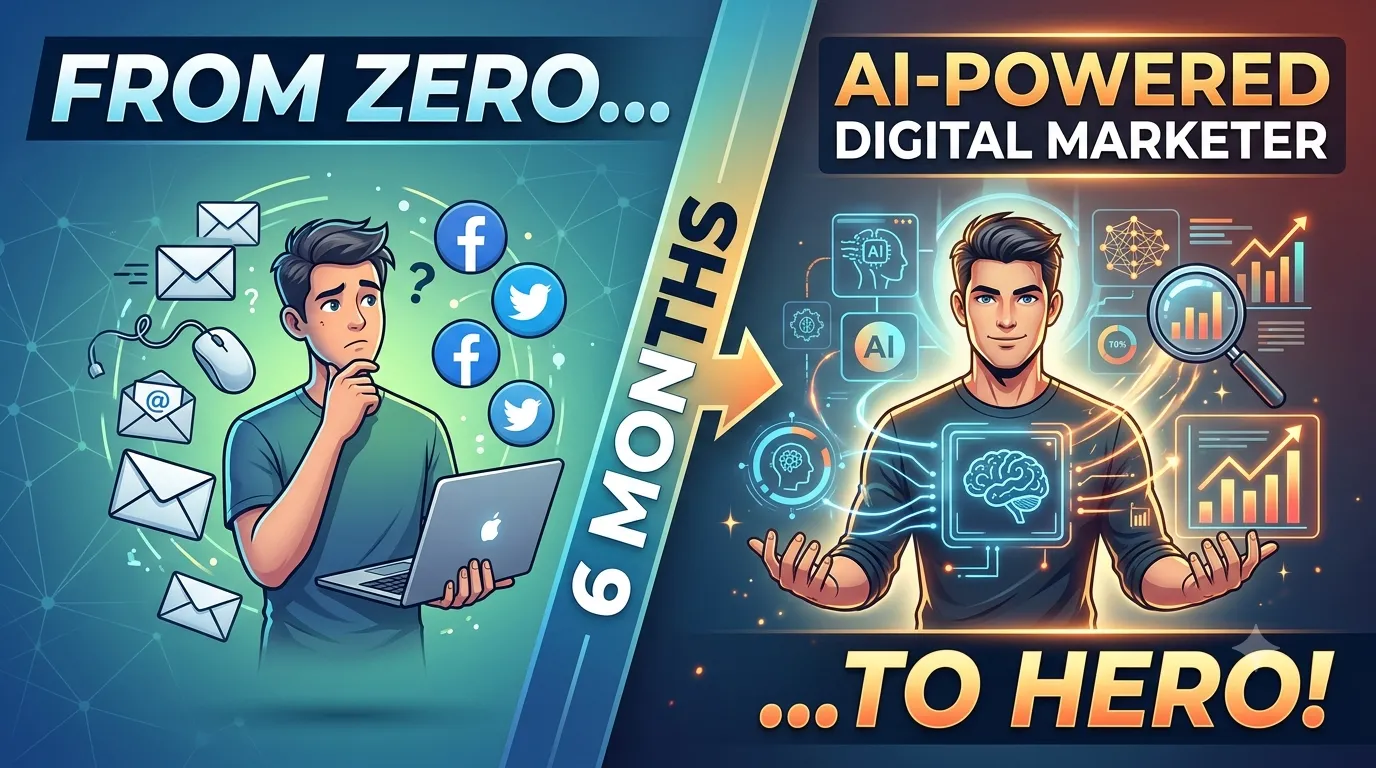
Here's the truth: You can go from complete beginner to AI-powered digital marketing expert in just six months. Not "learn a few tools." Not "get a certificate." I mean actually build the skills, create a portfolio, and start landing clients or jobs.
In this guide, I'll give you a month-by-month plan to master digital marketing, SEO, social media marketing, and the AI tools that will make you unstoppable. Let's get started.
1. The Big Question: Can You Really Do This in 6 Months?
I know what you're thinking. "Six months? That's it?" Yes. Here's why: you don't need to be a genius or have a decade of experience. You just need focus, the right resources, and a structured approach. The days of needing years to break into digital marketing are over. AI has changed the game.
The key is to compress the learning curve. Instead of spending years figuring things out through trial and error, you'll learn from experts and use AI tools to accelerate your progress.
Let's be honest about the commitment, though. This won't be easy. It will take dedication, practice, and the willingness to get uncomfortable. But if you stick with this plan, you'll be unrecognizable in six months. Sound good?
2. Before You Start: The Foundation
Before we dive into the monthly plan, let's get clear on a few things.
2.1 What You'll Actually Learn
By the end of this six-month journey, you'll be proficient in:
- Digital Marketing Fundamentals: The core principles that never change
- SEO: How to rank content on Google and drive organic traffic
- Social Media Marketing: Strategies for Facebook, Instagram, LinkedIn, and more
- AI Tools: How to use ChatGPT, Claude, Canva AI, and other essential tools
- Content Creation: Writing, visuals, and video at scale
- Advertising: Running AI-powered ad campaigns that convert
- Analytics: Measuring and optimizing performance
- Personal Branding: Building your own online presence
2.2 What You'll Need
- A computer and internet connection
- 2-3 hours of focused time per day
- A notebook or digital note-taking system
- Willingness to practice and make mistakes
- Optional but recommended: a digital marketing course or SEO course to accelerate your progress
2.3 The Mindset Shift
This is the most important part. You need to embrace the idea that you are not a student; you are a practitioner. From day one, you're not just learning theory — you're building practical skills that you can apply immediately. Think of this as an apprenticeship, not a classroom.
3. Month 1: Build Your Foundation
In the first month, your goal is to understand the digital marketing landscape and build your fundamental knowledge.
Week 1: The Big Picture
- What to Learn: Understand what digital marketing actually is. Learn the core channels — SEO, social media, email marketing, content marketing, paid ads, and analytics.
- Action: Subscribe to 3 marketing newsletters (e.g., HubSpot, Moz, Neil Patel). Listen to 2 marketing podcasts per week.
- AI Tool: Start using ChatGPT daily for learning. Ask it to explain concepts you don't understand.
Week 2: SEO Basics
- What to Learn: What is SEO? How does Google work? The difference between on-page, off-page, and technical SEO.
- Action: Set up a free blog on WordPress or Medium. Write your first SEO-optimized blog post (500+ words).
- AI Tool: Use ChatGPT to generate 10 blog topic ideas. Use Google Keyword Planner (free) to find keywords.
Week 3: Social Media Marketing
- What to Learn: How to create content for Facebook, Instagram, LinkedIn, and TikTok. What works on each platform.
- Action: Create a business page on LinkedIn and Instagram. Post 3 times per week.
- AI Tool: Use Canva AI to design your first 5 social graphics.
Week 4: Analytics and Measurement
- What to Learn: What are KPIs? How to use Google Analytics and social media insights.
- Action: Set up Google Analytics on your blog. Track your first 50 visitors.
- AI Tool: Use Google Analytics AI insights to understand your early traffic.
Month 1 Checkpoint: You've built a foundation. You understand the core channels, have a blog with 4 posts, and are posting on social media. You're ready for Month 2.
4. Month 2: Deep Dive into AI Tools
This month is all about becoming proficient with the AI tools that will power your marketing.
Week 1: Mastering ChatGPT and Claude
- What to Learn: Prompt engineering, content creation, research, and analysis.
- Action: Write 10 blog posts with ChatGPT (draft + heavy editing). Use Claude for long-form content.
- AI Tool: ChatGPT and Claude (free tiers). Learn to write effective prompts.
Week 2: AI for Visuals and Video
- What to Learn: How to create visuals and video with AI tools.
- Action: Create 20 social media graphics with Canva AI. Generate a 30-second video with an AI video tool.
- AI Tool: Canva Magic Studio, Photoroom.
Week 3: AI for SEO and Research
- What to Learn: How to use AI for keyword research, competitor analysis, and content optimization.
- Action: Audit your blog's SEO using AI. Identify 10 new keywords to target.
- AI Tool: ChatGPT, Google Search Console, Ubersuggest (free tier).
Week 4: Automation Workflows
- What to Learn: How to connect tools and automate repetitive tasks.
- Action: Set up a Zapier automation that posts your blog to social media automatically.
- AI Tool: Zapier (free tier).
Month 2 Checkpoint: You're now proficient with AI tools. You can create content, visuals, and automations. You're no longer a beginner. You're an AI-powered marketer in the making.
5. Month 3: Content Creation at Scale
Now that you have the tools, it's time to produce content at scale. This is where you build your portfolio.
Week 1: Content Strategy
- What to Learn: How to plan and execute a content strategy that attracts and converts.
- Action: Create a 30-day content calendar for your blog and social media.
- AI Tool: ChatGPT for content idea generation and calendar planning.
Week 2-3: Content Production
- What to Learn: How to create high-quality content efficiently.
- Action: Write 5 blog posts. Create 30 social media posts. Produce 2 videos.
- AI Tool: ChatGPT, Claude, Canva AI, AI video tools.
Week 4: Content Repurposing
- What to Learn: How to turn one piece of content into many.
- Action: Take one long blog post and repurpose it into 5 social posts, an email newsletter, and a LinkedIn article.
- AI Tool: ChatGPT for repurposing content variations.
Month 3 Checkpoint: You have a content machine. You're producing at scale, repurposing effectively, and building a portfolio that demonstrates your skills.
6. Month 4: Advertising and Automation
This month, you learn how to drive traffic through paid ads and scale with automation.
Week 1: Google Ads Mastery
- What to Learn: How to set up, run, and optimize Google Ads campaigns.
- Action: Set up your first Google Ads campaign with a small budget ($10/day).
- AI Tool: Google Ads AI suggestions.
Week 2: Social Media Advertising
- What to Learn: How to run ads on Facebook, Instagram, and LinkedIn.
- Action: Create a Facebook Ads campaign targeting your ideal audience.
- AI Tool: Facebook Ads AI, Canva AI for ad creatives.
Week 3: Marketing Automation
- What to Learn: How to automate email sequences, follow-ups, and lead nurturing.
- Action: Set up an email welcome sequence with a free tool like Mailchimp.
- AI Tool: Mailchimp AI features.
Week 4: Analytics and Optimization
- What to Learn: How to analyze campaign performance and optimize for better results.
- Action: Audit your Google Ads and social campaigns. Make data-driven adjustments.
- AI Tool: Google Analytics AI insights, Supermetrics.
Month 4 Checkpoint: You can now drive traffic through paid ads and nurture leads with automation. You understand the full marketing funnel from awareness to conversion.
7. Month 5: Strategy and Brand Building
You've built the skills. Now it's time to think strategically and build your own brand.
Week 1: Personal Branding Foundation
- What to Learn: Why personal branding matters and how to build yours.
- Action: Define your personal brand statement. Create a "single source of truth" on a personal website.
- AI Tool: ChatGPT for personal branding copy.
Week 2: Strategic Thinking
- What to Learn: How to think like a strategist, not just a specialist.
- Action: Analyze 3 real-world marketing campaigns. Write a strategic breakdown of what worked and why.
- AI Tool: ChatGPT for campaign analysis assistance.
Week 3: Thought Leadership
- What to Learn: How to position yourself as an expert in your niche.
- Action: Publish a thought leadership article on LinkedIn. Share your unique perspective.
- AI Tool: ChatGPT for drafting thought leadership content.
Week 4: Portfolio and Case Studies
- What to Learn: How to build a portfolio that showcases your work and results.
- Action: Create a portfolio page with case studies of your best work (blog posts, campaigns, projects).
- AI Tool: Canva AI for portfolio design.
Month 5 Checkpoint: You're now a strategic thinker with a personal brand. You have a portfolio that demonstrates your skills and results.
8. Month 6: Client Acquisition and Landing Your First Role
You've built the skills, the brand, and the portfolio. Now it's time to monetize.
Week 1: Identify Your Target Market
- What to Learn: Who you're going to serve and how to reach them.
- Action: Create an ideal client profile. List 20 potential clients or employers.
- AI Tool: ChatGPT for lead research and outreach ideas.
Week 2: Outreach and Networking
- What to Learn: How to reach out to potential clients or employers effectively.
- Action: Send 10 personalized outreach messages on LinkedIn.
- AI Tool: ChatGPT for drafting outreach messages.
Week 3: Pitching and Proposals
- What to Learn: How to create winning proposals that close deals.
- Action: Write a proposal for one of your target clients.
- AI Tool: ChatGPT for proposal drafting.
Week 4: Land Your First Client or Role
- What to Learn: How to close the deal and deliver results.
- Action: Finalize your first client agreement or accept your first job offer.
- AI Tool: ChatGPT for contract drafting and onboarding.
Month 6 Checkpoint: Congratulations. You've gone from zero to hero. You have the skills, portfolio, personal brand, and first client or job. You're now an AI-powered digital marketer.
9. What to Do After 6 Months
Congratulations! You've completed the six-month journey. But digital marketing is constantly evolving. Here's how to keep growing.
9.1 Keep Learning
Continue learning through a structured digital marketing course or SEO course. Deepen your knowledge in areas that interest you most.
9.2 Stay Updated
Follow industry blogs, podcasts, and newsletters. AI tools evolve fast. Stay ahead of the curve.
9.3 Build Your Network
Connect with other professionals. Collaborate, share insights, and support each other.
9.4 Specialize
Consider specializing in one area of digital marketing where you can become a true expert — SEO, social media, paid ads, or AI strategy.
10. Conclusion: Your Journey Starts Today
Six months may seem long. But ask yourself: where will you be in six months if you start now? Where will you be in six months if you don't?
This plan works because it's structured, practical, and focused on real-world skills. It combines the fundamentals of digital marketing with the power of AI tools. It builds your foundation, then helps you specialize and monetize.
The only thing standing between you and becoming an AI-powered digital marketer is taking the first step. Start today. Week 1, Day 1. You've got this.
If you want to accelerate this journey, consider a comprehensive digital marketing course that offers structured training, mentorship, and community. It can compress your learning even further and give you a support system along the way.
Don't wait. The future of marketing is already here. And it's powered by people like you who are ready to embrace the change.
Frequently Asked Questions (5 Unique FAQs)
❓ 1. Can I really become a digital marketer in 6 months if I have no experience?
Absolutely. This plan is designed for beginners. The key is consistent effort (2-3 hours per day) and a willingness to practice. Many people have transitioned into digital marketing even faster than 6 months by following this type of structured approach.
❓ 2. Do I need to be good at writing or design to succeed?
No. You'll use AI tools to help with writing and design. What you need is a willingness to learn, practice, and iterate. Creativity helps, but it's not required. The skills can be developed.
❓ 3. What's the single most important skill I should focus on?
Strategic thinking and understanding your audience. AI can handle the execution, but only you can understand what motivates your customers, what they care about, and what will truly drive them to take action. That's the skill that will always be in demand.
❓ 4. Should I take a course or just follow free resources for this plan?
A well-structured digital marketing course or SEO course can accelerate your learning significantly. It provides guidance, community, and accountability that free resources often lack. If you can afford it, it's a worthwhile investment. If not, you can still follow this plan with free resources, but it may take longer.
❓ 5. Will AI make digital marketing skills obsolete by the time I finish?
No. AI is augmenting digital marketing, not replacing it. The skills you're developing — strategic thinking, audience understanding, creativity, and AI tool proficiency — are becoming more valuable, not less. The future belongs to marketers who can combine human insight with AI efficiency.