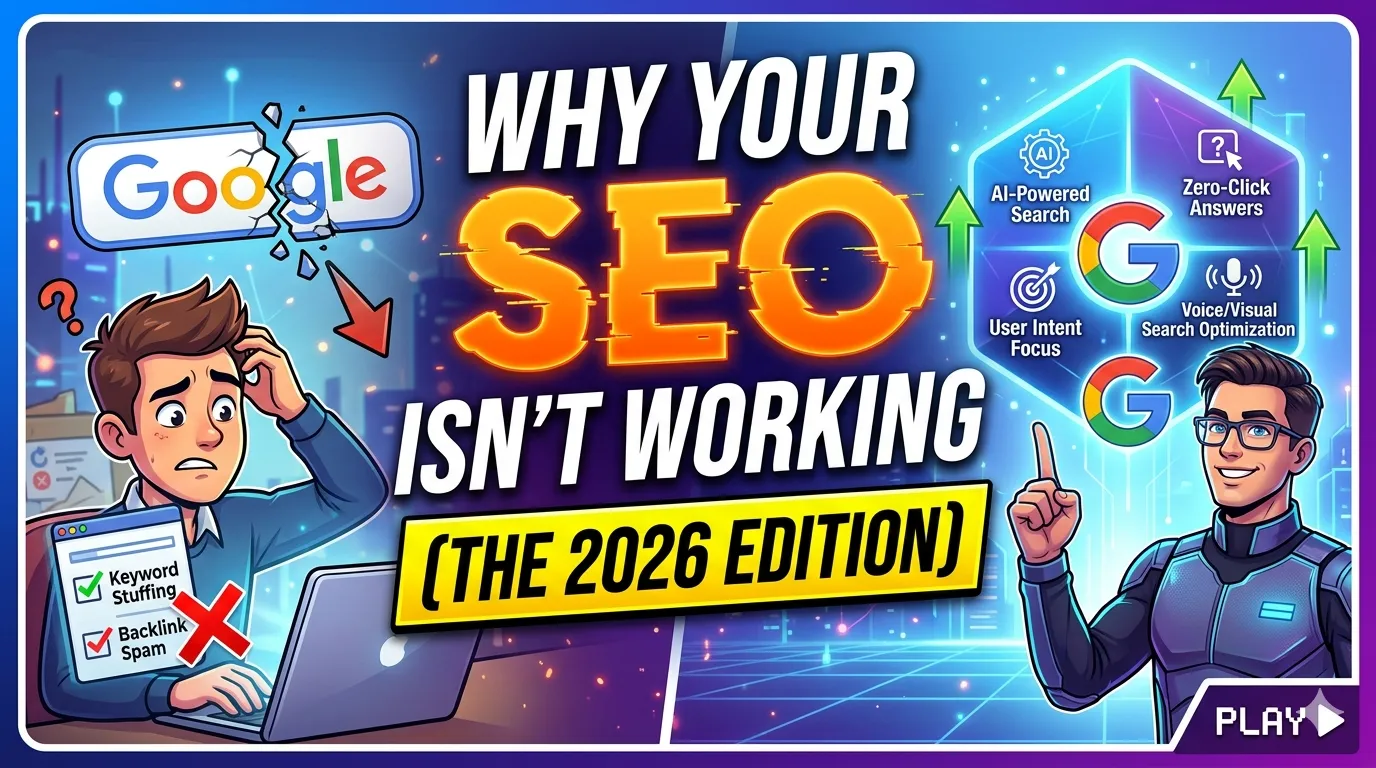
You're doing everything right. Or so you think.
You write blog posts. You add keywords. You build backlinks. You optimize meta tags. You check all the boxes. And still, your website sits on page 4. Page 5. Page "no one will ever find you."
Frustrating, isn't it?
The problem isn't that SEO doesn't work. It's that SEO has changed. And most people are still using 2020 tactics in 2026.
Let me show you the 7 reasons your SEO isn't working—and exactly how to fix each one.
Reason #1: You're Still Writing for Keywords, Not People
Remember when you could stuff "best pizza in Delhi" into your page 50 times and rank #1? Those days are long gone.
In 2026, Google understands context. It understands synonyms. It understands what people actually mean when they search. Keyword stuffing now hurts you—it doesn't help.
The fix: Write for humans first. Answer the question completely. Use natural language. If your keyword appears naturally, great. If not, don't force it. Google is smart enough to figure it out.
Ask yourself: Would a real person enjoy reading this? If yes, you're on the right track. If no, rewrite it.
Reason #2: Your Content Is Too Shallow
500-word blog posts don't rank anymore. Not for competitive keywords. Google wants depth. It wants authority. It wants the best answer to the question—not a quick overview.
The fix: Go deep. Write 1500-3000 words for important pages. Cover related questions. Add examples, data, images, and case studies. Become the resource, not just a mention.
Look at the top 3 results for your keyword. How long are their pages? What do they cover that you don't? Match their depth. Then exceed it.
Reason #3: Google Doesn't Trust You (E-E-A-T Matters)
E-E-A-T stands for Experience, Expertise, Authoritativeness, and Trustworthiness. It's what Google uses to decide if your content is credible.
If your site looks like it was built by a spammer, Google won't rank it—no matter how good your keywords are.
The fix: Show who you are. Add author bios with real names and photos. Link to your LinkedIn. Publish your phone number and address. Get reviewed on Google. Add case studies and real client results. Be transparent. Be real.
Would you trust your site if you landed on it randomly? If not, fix it.
Reason #4: Your Site Is Painfully Slow
Google measures page speed. Users hate waiting. If your site takes more than 3 seconds to load, people leave. Google notices. Your rankings drop.
The fix: Test your site on Google's PageSpeed Insights. It will tell you exactly what's wrong. Common fixes: compress images, remove unused plugins, upgrade hosting, enable caching.
Speed isn't just about ranking. It's about keeping people on your site. A faster site = happier visitors = more conversions.
Reason #5: Your Google Business Profile Is Incomplete
If you're a local business and not ranking in the map pack, your Google Business Profile is the problem. 76% of local searches click the top 3 results. If you're not there, you're invisible.
The fix: Complete every field on your GBP. Add 20+ photos. Add all your services. Post weekly. Respond to every review. Enable messaging. Add products if you sell them.
Businesses with complete GBP profiles get 7x more clicks than those with incomplete ones.
Reason #6: You're Ignoring Search Intent
Why is someone searching for your keyword? Are they looking to buy? To learn? To compare? To find a location?
If your content doesn't match their intent, they'll bounce. Google sees that bounce. And it stops sending people to you.
The fix: Check the top 3 results for your keyword. What format are they? Blog posts? Product pages? Location pages? Videos? Match the format. If everyone else is writing "how-to" guides and you're selling a product, you won't rank.
Give searchers what they actually want—not what you want to give them.
Reason #7: You Gave Up Too Soon
SEO takes time. Months. Sometimes 6-12 months. Most people quit after 6-8 weeks when they don't see results. They declare "SEO doesn't work" and move on to the next shiny tactic.
The fix: Be patient. Keep creating great content. Keep optimizing. Keep building relationships (backlinks will follow). SEO compounds. The work you do today pays off 6 months from now.
Don't judge SEO by weekly results. Judge it by 6-month trends.
Quick Diagnostic Checklist
Run through this checklist to diagnose why your SEO isn't working:
✅ Are you writing for humans or robots?
✅ Is your content at least 1500 words for competitive topics?
✅ Does your site have author bios and trust signals?
✅ Does your site load in under 3 seconds?
✅ Is your Google Business Profile 100% complete?
✅ Does your content match search intent?
✅ Have you been consistent for at least 6 months?
If you answered "no" to any of these, you've found your problem. Fix it. Then wait. Results will follow.
The 2026 SEO Reality Check
SEO isn't dead. It's just harder. And that's good. Because most people won't do the work. They'll write thin content, ignore user experience, and give up after 2 months.
You can be different. You can go deep. You can build trust. You can be patient.
And when you do, you'll rank—while everyone else complains that SEO doesn't work.
Frequently Asked Questions (FAQs)
1. How long does SEO really take in 2026?
For new websites: 4-8 months to see meaningful results. For established websites: 2-4 months for improvements. For competitive keywords: 6-12 months. SEO is not fast. But it's the only channel that keeps paying long after you stop working. Patience pays.
2. Is SEO still worth it in 2026?
Yes. Organic search still drives more traffic than any other channel. Paid ads stop when you stop paying. SEO keeps working. It's a long-term investment. Worth it if you're patient. Not worth it if you want results next week.
3. Do backlinks still matter in 2026?
Yes. But quality matters more than quantity. One link from a trusted, relevant site is worth 100 from spammy directories. Focus on earning links through great content, not buying them. Bought links can get you penalized.
4. Can I do SEO myself or do I need an expert?
You can do basic SEO yourself. On-page optimization, content creation, and Google Business Profile management are doable. Technical SEO, backlink building, and competitive analysis are harder. Start yourself. Hire help when you scale or get stuck.
5. What's the #1 ranking factor in 2026?
Content relevance + user satisfaction. Does your content answer the question completely? Do people stay on your page and read it? Do they click back to search and try another result? Google measures all of this. Create the best answer. Give people what they want. Rankings follow.


