Remember when you searched Google and clicked a result? That's changing.
Today, billions of searches end without a single click. Google answers the question directly on the search results page. The user reads the answer. They close the tab. Your website? Never visited. Your content? Never read. Your business? Never discovered.
This is the era of zero-click searches. And Google's AI Overviews (formerly SGE) are the engine driving it.
In 2026, over 60% of Google searches now end without a click . For informational queries—"how to," "what is," "why does"—that number is even higher. Users want answers, not links. Google gives them answers directly.
So how do you win when no one clicks? You optimize for the overview itself. You become the source Google trusts. You get cited, even if not clicked. And you build relationships that bring users back directly.
Let me show you exactly how.
What Are Google's AI Overviews? (2026 Update)
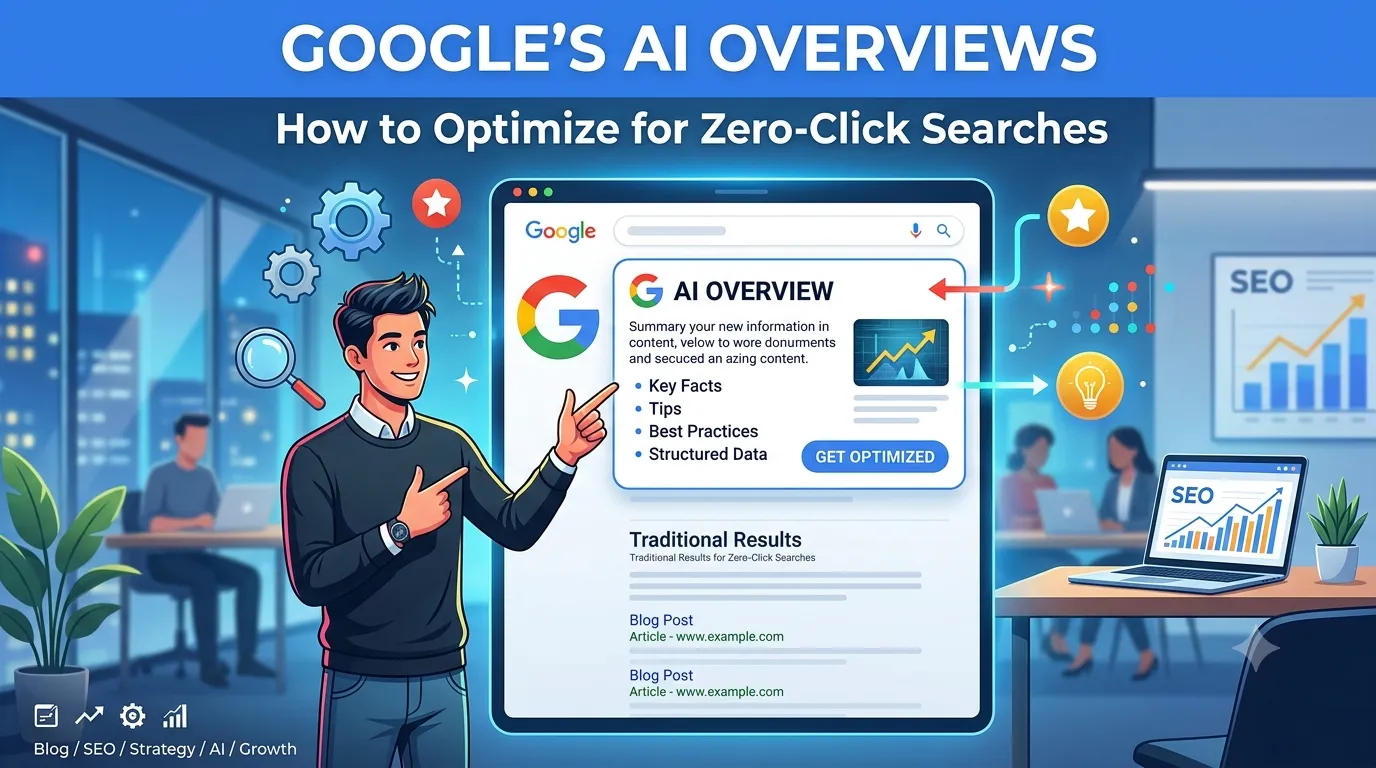
AI Overviews are AI-generated summaries that appear at the top of Google search results. They synthesize information from multiple sources to answer the user's question directly .
Example: You search "how to clean a laptop screen." Google's AI generates a step-by-step guide right there. You never leave Google. You never click a website.
AI Overviews appear for complex, multi-faceted questions—not simple fact lookups. They pull from high-authority sources that Google trusts .
For businesses, this is both a threat and an opportunity. Threat: fewer clicks to your site. Opportunity: be the source Google cites, and build brand authority.
Why Zero-Click Searches Are Growing (The Data)
In 2020, about 50% of Google searches ended without a click . By 2024, that number exceeded 60% for mobile searches . In 2026, it's even higher—especially for informational queries.
Why? Two reasons.
First, Google wants to keep users on Google. Every click leaving Google is a potential loss of ad revenue. Answering questions directly keeps users on the platform .
Second, users actually like it. For quick answers, they don't want to read a full article. They want the answer now. Google gives it to them now .
The trend is clear: zero-click is the new normal for informational searches.
How Google Chooses Which Sources to Cite
Google's AI doesn't pull from random websites. It has criteria .
Authority and trustworthiness (E-E-A-T): Google prioritizes sources with demonstrated Experience, Expertise, Authoritativeness, and Trustworthiness. Well-established brands. Authors with credentials. Sites with positive reputations .
Content comprehensiveness: The source must answer the question thoroughly. A 200-word blog post won't be cited. A 2000-word guide that covers every angle might be .
Freshness (when relevant): For time-sensitive topics, Google favors recent content. For evergreen topics, freshness matters less .
First-party data and unique insights: Google increasingly values original research, case studies, and proprietary data. These signals prove authority .
Page speed and user experience: Slow, hard-to-navigate sites are less likely to be cited. Google prefers fast, user-friendly sources .
How to Optimize for AI Overviews (7 Strategies)
Strategy 1: Answer Questions Directly and Clearly
Google's AI pulls answers from content that directly addresses user questions. Use clear headings: "How to clean a laptop screen" (H2). Follow immediately with a direct answer. Don't bury the answer in fluff .
Format answers as clear steps (numbered lists), bullet points, or concise paragraphs. The easier your answer is to extract, the more likely Google uses it .
Example format:
## How to clean a laptop screen

Step 1: Power down your laptop and unplug it.
Step 2: Gently wipe the screen with a dry microfiber cloth.
Step 3: If needed, dampen the cloth with distilled water (never spray directly).
Step 4: Wipe in gentle circles, then dry with a clean cloth.
Strategy 2: Use Structured Data (Schema Markup)
Schema markup helps Google understand your content's structure. For AI Overviews, FAQ schema, HowTo schema, and QAPage schema are particularly valuable .
These schemas tell Google: "This content answers a question" or "This content is a step-by-step guide." Google can directly extract and display this information .
Strategy 3: Build Authority (E-E-A-T Signals)
Google only cites sources it trusts. Build trust by:
- Adding author bios with credentials and links to LinkedIn/Google Scholar
- Publishing case studies and original research (first-party data is powerful)
- Getting cited by other reputable sites (earned backlinks)
- Maintaining a consistent publishing history (Google favors active sites)
- Displaying contact information, privacy policy, and trust signals (HTTPS, secure payment, etc.)
Strategy 4: Target "How-To" and "What Is" Queries
Not all queries trigger AI Overviews. They most commonly appear for complex, informational, multi-faceted questions. How-to queries are prime territory .
Focus your content on:
- How to [do something]
- What is [concept] and how does it work
- Why does [something happen] and how to fix it
- [Problem] vs [solution]: which is better?
Use these phrases in your headings and opening paragraphs.
Strategy 5: Create "10x" Content (Comprehensive, Not Minimal)
Shallow content won't be cited. Google's AI favors comprehensive resources that answer the question fully. Aim for 1500+ words for topic clusters, but focus on quality and completeness over word count .
Cover related questions. Add examples, case studies, and data. Include visuals (images, charts, videos) that enhance understanding. Become the definitive resource, not just another mention.
Strategy 6: Monitor Your Performance in AI Overviews
Third-party SEO tools (Semrush, Ahrefs, Surfer) now track when your content appears in AI Overviews .
Monitor:
- Which queries trigger an AI Overview for your content
- Whether you're cited as a source (and how prominently)
- Which competitors are cited more often
Use this data to refine your strategy. If competitors are cited for certain topics, analyze what they're doing differently.
Strategy 7: Accept That Clicks Will Drop—But Brand Visibility Won't
Zero-click searches aren't going away. Fighting them is futile. Instead, adapt .
Even if users don't click, being cited in an AI Overview builds brand authority. They see your business name. They associate you with expertise. Later, when they're ready to buy, they search for you directly .
Focus on building brand recognition and direct traffic (direct URL entries, branded searches) rather than relying solely on organic clicks.
Real Example: Before and After Optimization
Before optimization (won't be cited):
A generic 500-word blog post. Heading: "How to fix a leaking tap." No clear steps. No schema. Author name generic ("admin"). No supporting visuals. No internal links to related content.
Result: Google ignores this. No AI Overview citation. Few clicks.
After optimization (likely to be cited):
A comprehensive 2000-word guide. Clear H2: "How to Fix a Leaking Tap in 5 Steps." Numbered list with clear instructions. Video embed showing the process. HowTo schema markup. Author bio: "John Smith, Licensed Plumber with 15 years experience." Internal links to "How to fix a dripping shower head" and "Tools every homeowner needs." External links to manufacturer specifications (authoritative sources).
Result: Google cites this as a source in AI Overviews. Users see the answer (maybe don't click). But they remember "John Smith Plumbing" as the authority.
What About Product and Commercial Queries?
Zero-click searches are most common for informational queries. Commercial queries—"best laptop under ₹50,000," "buy running shoes online"—still generate clicks .
Google has less incentive to answer commercial queries directly. They want users to click through to make purchases (and generate ad revenue).
For e-commerce and local businesses, focus on traditional SEO for transactional keywords. Use AI Overview optimization for top-of-funnel awareness content .
Common Mistakes (And How to Avoid Them)
Mistake 1: Creating thin content. 300-word blog posts won't be cited. AI needs depth to synthesize answers. Expand your content. Cover related questions. Add examples and data.
Mistake 2: No clear structure. Walls of text without headings can't be parsed by AI. Use clear H2 and H3 headings. Use lists, tables, and step-by-step formatting.
Mistake 3: Ignoring schema markup. FAQ, HowTo, and QAPage schema are direct signals to Google. Implement them. They're not optional for AI Overview optimization.
Mistake 4: Forgetting E-E-A-T. Anonymous content won't be cited. Show your expertise. Author bios. Case studies. Original research. Build trust.
The Future of Zero-Click Search
Google's AI Overviews will only expand. More queries, more languages, more depth. Competing with Google for clicks is a losing battle .
Instead, compete for authority. Become the source Google trusts. Build direct relationships with your audience (email, communities, direct traffic). Zero-click searches won't kill your business—ignoring them will .
Conclusion: Don't Fear Zero-Click. Adapt to It.
The rules of SEO have changed. Clicks are no longer the only metric that matters. Authority, citations, and brand visibility matter more.
Google's AI Overviews are here to stay. Optimize for them. Structure your content clearly. Answer questions directly. Build authority. Use schema.
And measure success differently—not just clicks, but citations, brand searches, and direct traffic.
Frequently Asked Questions (FAQs)
1. What's the difference between AI Overviews and featured snippets?
Featured snippets extract a block of text from a single source. AI Overviews synthesize information from multiple sources to generate a unique answer .
2. Do AI Overviews reduce website traffic?
For informational queries, yes. Users get their answer without clicking. For commercial and transactional queries, less so. The key is to build brand authority so users search for you directly later .
3. Can I opt out of being cited in AI Overviews?
Technically, you can block Google's crawlers. But that also prevents you from ranking in traditional search results. Not recommended .
4. How do I know if my content is being cited?
Use third-party SEO tools (Semrush, Ahrefs, Surfer). They now track AI Overview mentions. Also monitor your brand search volume and direct traffic .
5. Will zero-click searches kill SEO?
No. But SEO will change. The emphasis shifts from earning clicks to earning citations and building brand authority. Adapt, and you'll survive. Ignore the trend, and you'll struggle .