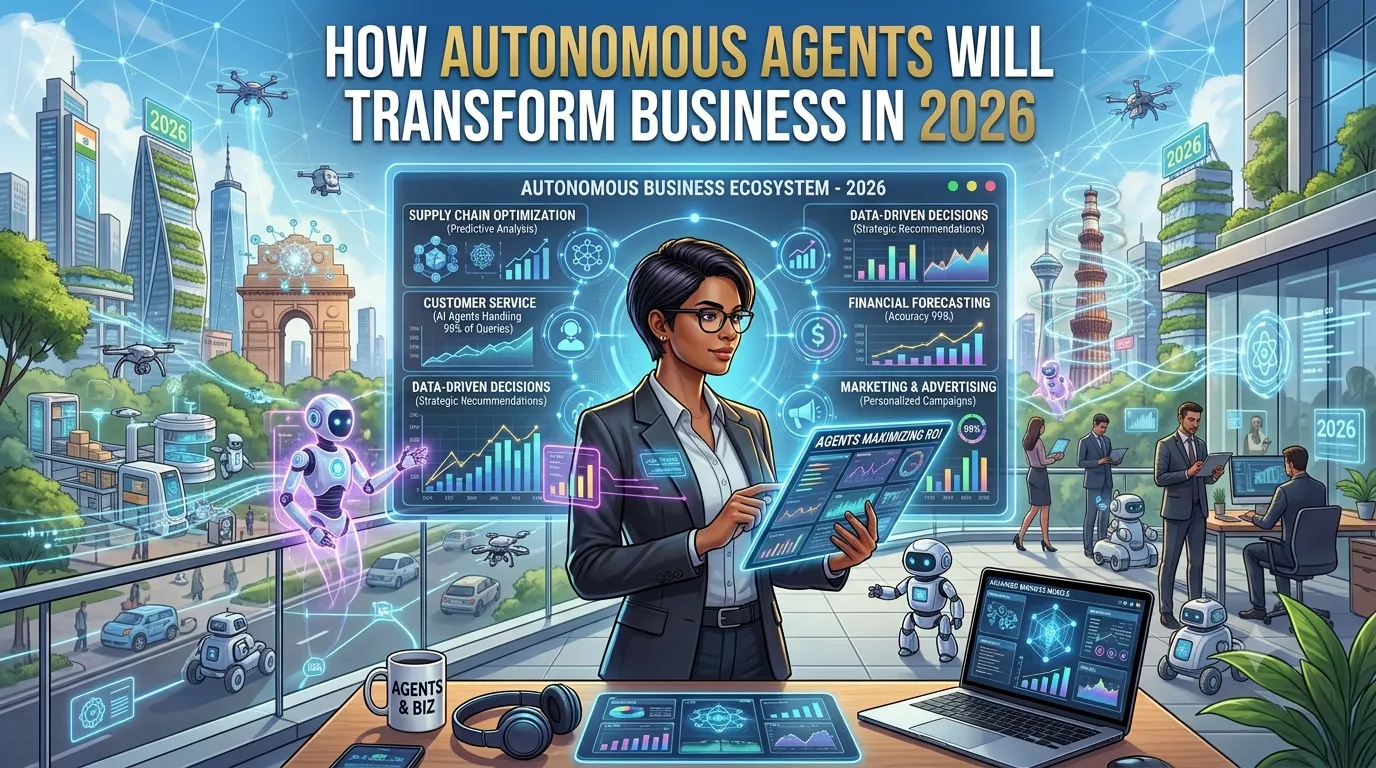
The AI Agent Economy: How Autonomous Agents Will Transform Business in 2026
Let me ask you something. What if you could hire a team of workers who never sleep, never take breaks, and never ask for a raise? Workers who handle customer support, generate leads, manage social media, and run entire workflows—all without supervision.
If you're like most business owners and digital marketing professionals, the answer is: "That sounds too good to be true." But here's the reality: AI agents are making this possible right now. And they're creating an entirely new economic model—the AI agent economy.
In this guide, I'll explain what the AI agent economy is, how autonomous agents will transform business in 2026, and how you can prepare. Whether you're a digital marketing professional, a business owner, or a student taking a digital marketing course, this is your introduction to the next economic revolution.

Let's dive in.
1. What Is the AI Agent Economy?
The AI agent economy is the emerging economic system where autonomous AI agents perform work, create value, and transact with each other and with humans.
1.1 The Definition
An AI agent is a system that perceives its environment, reasons about it, and takes action to achieve goals—without constant human supervision. The AI agent economy is what happens when these agents become economically productive.
1.2 The Shift from Tools to Workers
- Traditional AI: A tool you use for specific tasks
- Agentic AI: A worker that operates autonomously
- The difference: Tools wait for instructions; agents take initiative
1.3 Why This Matters
The AI agent economy represents a fundamental shift in how businesses operate. Instead of hiring humans for every task, businesses can deploy AI agents that work 24/7, scale instantly, and cost a fraction of human labor.
2. How Autonomous Agents Are Transforming Business
AI agents are already transforming every function of business. Here's how.
2.1 Marketing and Advertising
- Campaign management: Agents plan, execute, and optimize campaigns
- Content creation: Agents generate and publish content across platforms
- Lead generation: Agents find, qualify, and nurture leads
- Ad optimization: Agents test and optimize ad creatives in real-time
2.2 Customer Service
- 24/7 support: Agents answer questions and resolve issues anytime
- Personalization: Agents tailor responses to each customer
- Escalation: Agents route complex issues to humans
- Learning: Agents improve based on every interaction
2.3 Operations and Admin
- Scheduling: Agents manage calendars and appointments
- Data entry: Agents process and organize information
- Reporting: Agents generate reports and insights
- Workflows: Agents coordinate tasks across teams and systems
2.4 Sales
- Prospecting: Agents find and qualify potential customers
- Outreach: Agents personalize and send messages at scale
- Follow-up: Agents nurture leads until they're ready to buy
- Closing: Agents assist with proposals and negotiations
3. The Business Models of the AI Agent Economy
The AI agent economy is creating new business models. Here are the most important ones.
3.1 Agent-as-a-Service (AaaS)
Businesses subscribe to AI agents that perform specific functions—like marketing, customer service, or sales. Instead of hiring employees, they "hire" agents.
3.2 Agent Orchestration
Businesses manage teams of AI agents, coordinating their work to achieve complex goals. This requires new skills in agent orchestration and workflow design.
3.3 Agent Marketplaces
Marketplaces where businesses can buy, sell, and trade AI agents. Think of it like an app store—but for autonomous workers.
3.4 Agent-to-Agent Commerce
AI agents transacting with each other. For example, a marketing agent might hire a design agent to create visuals for a campaign. This creates entirely new economic activity.
4. How to Prepare Your Business for the AI Agent Economy
Here's how to prepare for the agentic revolution.
4.1 Identify Tasks for Agents
- Which tasks are repetitive and time-consuming?
- Which tasks follow clear rules and processes?
- Which tasks can be automated without sacrificing quality?
4.2 Start with One Agent
- Don't try to automate everything at once
- Choose one function—customer service or lead generation
- Start small and learn
4.3 Build Your Data Foundation
- Agents need clean, organized data to work effectively
- Invest in data quality and integration
- Ensure your systems can communicate with agents

4.4 Develop Agent Orchestration Skills
- Learn how to design agent workflows
- Learn how to monitor and optimize agent performance
- Learn how to handle exceptions and escalations
4.5 Shift Your Team's Focus
- Move humans from execution to strategy
- Focus on relationship building and creativity
- Develop skills that AI can't replicate
5. The Jobs and Skills That Will Thrive
The AI agent economy will create new opportunities. Here's what will thrive.
5.1 Jobs That Will Thrive
- AI Agent Orchestrators: Manage teams of AI agents
- AI Ethics Officers: Ensure responsible agent behavior
- AI Trainers: Teach agents to perform specific tasks
- Human-AI Collaboration Specialists: Design workflows that combine human and agent strengths
- Relationship Builders: Focus on human connection and trust
5.2 Skills That Will Thrive
- Strategic thinking: Setting direction for agent teams
- Emotional intelligence: Building relationships and trust
- Creativity: Generating original ideas and solutions
- Agent orchestration: Designing and managing agent workflows
- Ethical judgment: Making decisions about agent behavior
6. Real-World Example: The AI Agent-Powered Business
Here's how a digital marketing agency used AI agents to transform their business:
- Challenge: They were spending 40+ hours per week on client reporting, content creation, and lead generation.
- Solution: They deployed AI agents for reporting, content creation, and lead generation. Humans focused on strategy and client relationships.
- Result: They cut operational time by 70%, increased client capacity by 3x, and grew revenue by 150%.
7. Conclusion: Prepare for the Agentic Revolution
The AI agent economy is coming. Autonomous agents are already transforming marketing, customer service, operations, and sales. The businesses that embrace this shift will thrive. Those that don't will be left behind.
But here's the good news: You can prepare today. Identify tasks for agents. Start with one agent. Build your data foundation. Develop orchestration skills. Shift your team's focus to strategy. Small steps lead to big results.
The choice is yours. Ignore the agentic revolution, or start preparing for it now.
Join the best Digital Marketing Course to master AI agents, automation, and digital marketing in 2026.
Frequently Asked Questions (5 Unique FAQs)
❓ 1. What's the difference between an AI agent and a chatbot?
A chatbot responds to messages. An AI agent perceives, reasons, acts, and learns—it can operate autonomously to achieve goals. Agents are proactive; chatbots are reactive.
❓ 2. Will AI agents replace human workers?
AI agents will replace some tasks, but not entire jobs. They'll handle routine, repetitive work so humans can focus on strategy, creativity, and relationships. The key is to adapt and develop skills that AI can't replicate.
❓ 3. How do I get started with AI agents?
Start small. Choose one function—like customer service or lead generation. Deploy an AI agent for that function. Learn from the experience and expand. Build your data foundation and develop orchestration skills.
❓ 4. What skills do I need to succeed in the AI agent economy?
Strategic thinking, emotional intelligence, creativity, agent orchestration, and ethical judgment. These are the skills that will make you valuable as AI agents handle more execution.
❓ 5. How long until the AI agent economy is mainstream?
It's already happening. Major platforms are rolling out agentic AI capabilities. Within the next 2-3 years, AI agents will be standard in most businesses. The time to prepare is now.