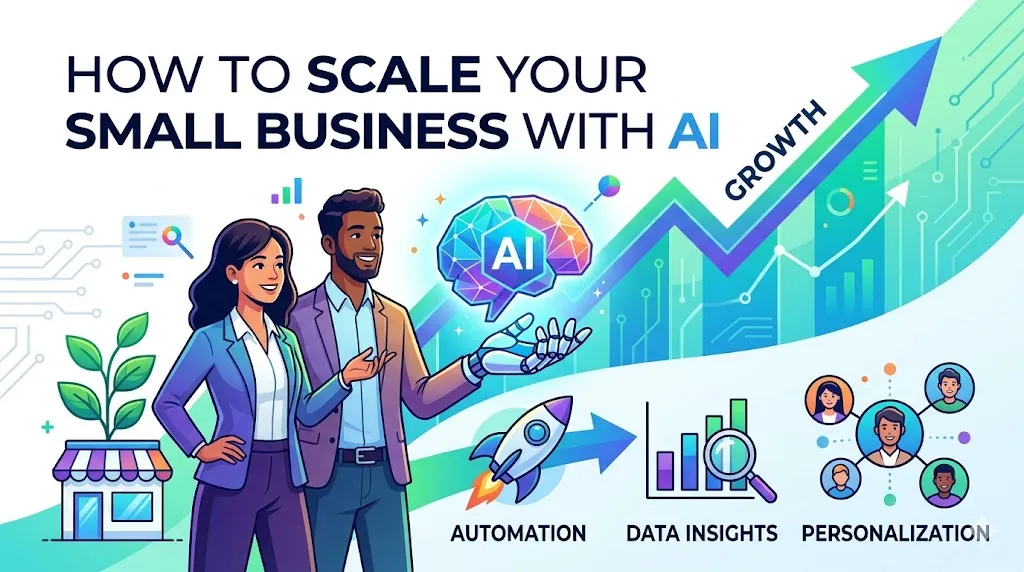
Let's be real for a moment. You're running a small business, juggling a dozen roles, and somehow expected to compete with corporations that have entire departments for marketing, data analysis, and customer support. Sound exhausting? It is. But here's the good news: artificial intelligence is leveling the playing field.
Between 2023 and 2024, AI adoption among small businesses grew by a staggering 72% across OECD countries[citation:1]. And for good reason — 91% of small businesses using generative AI report efficiency gains, 76% cite increased innovation, and over 60% note reduced staffing needs or access to new revenue streams[citation:1]. The numbers don't lie. If you're not using ai tools to scale your business, you're leaving money on the table.
In this guide, I'll show you exactly how to use AI to automate, optimize, and grow your small business — whether you're a solopreneur or managing a lean team. Let's dive in.
1. Why AI Is the Ultimate Growth Lever for Small Businesses
Here's the thing: small businesses have always had to do more with less. What's changed is that AI is starting to make that possible at scale. AI-powered tools that once required technical expertise and enterprise budgets are now accessible to businesses of all sizes.
AI works best as a multiplier of human effort, not a replacement for it. It handles the repetitive, time-consuming tasks so you can focus on what actually builds your business — strategy, creativity, and customer relationships.
1.1 The Numbers That Matter
Still skeptical? Consider this: a Salesforce survey found that 91% of small and medium businesses using AI reported revenue growth[citation:8]. And according to the US Chamber of Commerce, 82% of small businesses using AI were able to grow their workforce[citation:6]. AI doesn't replace people — it enables growth.
2. Automate Repetitive Tasks: The Fastest ROI
If you're spending hours on data entry, scheduling, responding to emails, or generating reports, you're wasting your most valuable resource — time. These are the exact tasks AI can handle instantly.
2.1 Administrative Automation
AI can automatically categorize invoices, track project deadlines, organize client records, and pull reports in seconds[citation:6]. Tools like Zapier and Make.com connect your apps and automate workflows without any coding — Zapier's free tier handles 100 tasks per month.
Imagine your AI digital assistant autonomously managing inventory, generating invoices, updating financial records, and preparing compliance reports. That's not science fiction; it's happening right now.
2.2 Financial Management with AI
AI-powered financial tools like Futrli and Fluidly connect to your accounting software, create visual forecasts, and flag potential cash flow crunches weeks before they hit. For small business owners, this means making informed decisions without being a finance expert.
3. Win More Customers with AI-Powered Marketing
Digital marketing is one of the most powerful applications of AI for small businesses. It helps you reach the right audience, personalize your messaging, and convert more customers — all without a massive marketing budget.
3.1 Audience Segmentation and Targeting
In the past, building customer segments and analyzing audiences could take days or even weeks. With AI, you can build segments using plain language prompts — just describe the audience you want to reach, and AI creates the segment for you.
3.2 AI-Generated Content for Marketing
Creating content for social media posts, blogs, and marketing emails can be incredibly time-consuming. Tools like ChatGPT, Jasper AI, and Copy.ai generate professional content in seconds[citation:8]. A HubSpot study found a 50% increase in engagement rates when companies leverage AI in their content marketing efforts.
For design work, platforms like Canva use AI for writing and design suggestions on both free and Pro plans. Tools such as DALL-E 3 and Google Gemini's Veo help small businesses create professional visuals with minimal cost or effort.
3.3 Personalization at Scale
Seventy-four percent of consumers expect more personalized experiences from brands. AI makes it possible to personalize every email, product recommendation, and message without doing it manually. AI can determine the best send time for each customer, figure out which channel they engage with most, and even run smart A/B tests where AI chooses the variation most likely to resonate.
This is where AI helps small businesses punch significantly above their weight — delivering personalized experiences that larger companies spend millions trying to achieve.
4. Customer Service That Never Sleeps
Providing 24/7 customer support is expensive, and many startups can't afford a large customer service team. AI chatbots can handle up to 50% of routine queries instantly, freeing your team for complex, high-value conversations.
4.1 AI Chatbots for Small Businesses
Platforms like Tidio, Intercom, and Zendesk AI are easy to implement and can handle FAQs, basic troubleshooting, and common customer questions. AI chatbots reportedly resolve 80% of customer inquiries without human assistance.
Quick wins: automate your five most common questions (shipping status, returns policy, opening hours, product availability, password resets), feed your chatbot existing FAQs, and set it to escalate to humans when it detects frustration.
5. Make Smarter Decisions with AI Analytics
Most small businesses are sitting on more useful data than they realize — customer interactions, sales patterns, purchase history, and email engagement. The challenge is that processing this data manually is impractical for a small team.
5.1 Predictive Analytics for Retention
With predictive analytics, you can anticipate your customers' next moves and get ahead of their needs. AI can identify customers likely to churn (like a lower number of recent orders) so you can be proactive instead of reactive — sending win-back flows or curated offers before they leave.
Companies that implement AI for decision-making processes are 23 times more likely to outperform competitors in revenue growth.
5.2 Market Research and Competitor Intelligence
AI tools analyze thousands of customer reviews, social media conversations, and competitor activity in minutes — surfacing trends you'd never spot manually[citation:2]. You can use ChatGPT to analyze competitor reviews, identify content gaps, and set up monthly competitor tracking for pricing changes and new launches.
This level of market intelligence was once only available to large corporations with dedicated research teams. Now, any small business can access it.
6. Real-World Success Stories
AI isn't theory — it's delivering real results for small businesses right now.
6.1 Aretto: AI-Powered Product Design
Aretto, a Pune-based footwear brand, uses AI to scan global design, material, and lifestyle trends to inform product direction. AI allows their design team to build mood boards and render base silhouettes much faster, compressing the time between idea and visualization. The result? They can test more ideas, prototype quicker, and design products better tuned to customer needs.
6.2 Every Man Jack: Predictive Analytics in Action
Men's personal care brand Every Man Jack uses predictive analytics to send reorder flows on or before each customer's unique predicted next order date. In 90 days, they generated over 12% of their attributed revenue with predictive analytics segments.
6.3 Saranoni: AI-Powered Segmentation
Luxury blanket brand Saranoni uses AI to generate zip code-based segments for location-specific messaging. They save 10-30 minutes per segment compared to manually entering parameters.
7. How to Start Your AI Journey: A 30-Day Plan
Don't try to implement everything at once. The businesses that win with AI won't be the ones with the fanciest technology — they'll be the ones who use it to work smarter, move faster, and serve customers better.
7.1 Week 1: Choose One Problem
Select one painful process and fix it. Could be customer support, content creation, or data entry. Pick one tool and start with a free trial.
7.2 Week 2: Set It Up
Feed the tool your existing data. Don't aim for perfection — aim for progress. Most AI tools learn and improve over time.
7.3 Week 3: Use It Daily
Monitor results, refine settings, and track time saved. The goal is to build the habit of using AI in your daily workflow.
7.4 Week 4: Measure the Impact
Is it saving time? Improving decisions? If yes, keep it. If no, try something else. The key is to focus on ROI, not novelty.
8. What AI Can't Do for Your Business
Honest framing matters. AI for small business growth is a genuine opportunity, but it isn't a substitute for the things that actually build a business.
- Human intelligence remains the core of success. AI can help you prepare better for a client conversation — it can't have it for you.
- AI can't replace your product or service. It can help you market it more efficiently, but it can't make people want something they don't need.
- AI can't build trust. Virtual assistants can handle questions, but they can't build the kind of trust that turns a customer into a long-term advocate.
Use AI as a multiplier of human effort, not a replacement for it. The most successful small businesses treat it that way.
9. The Bottom Line: AI Isn't Optional Anymore
The small business owners who get meaningful growth from AI are the ones who identify one or two specific problems and find AI tools that solve them directly[citation:5]. They don't try to implement everything at once. They start small, scale what works, and keep humans in the loop.
AI is no longer a distant ambition — it's becoming a real enabler for small businesses. It's helping businesses streamline operations, personalize customer experiences, and make smarter decisions at speed and scale[citation:8]. The question isn't whether you can afford to adopt AI; it's whether you can afford not to.
Those who keep their heads in the sand about AI will get left behind, while those who embrace it will flourish. The choice is yours.
Frequently Asked Questions (5 Unique FAQs)
❓ 1. What's the first AI tool I should implement in my small business?
Start with a tool that solves your biggest pain point. If customer support is overwhelming, try a chatbot like Tidio. If marketing is your challenge, start with ChatGPT or Canva AI. The key is to choose one problem and solve it, rather than trying to implement everything at once.
❓ 2. Is AI too expensive for a small business?
Not at all. Many powerful AI tools offer free tiers or affordable plans starting under $20/month. ChatGPT is free for general use, Zapier has a free tier, and Canva's AI features are available on both free and Pro plans. You don't need a six-figure budget to benefit from AI.
❓ 3. Will AI replace my employees?
Unlikely. The World Economic Forum estimates that AI could displace 85 million jobs by 2025 but also create 97 million new ones. AI is transforming how people work, not completely displacing them. It enables employees to focus on higher-value areas like innovation, problem-solving, and customer relationships.
❓ 4. How long does it take to see results from AI adoption?
Many small businesses see results within weeks — faster response times, more efficient workflows, and improved customer satisfaction. However, the best results come from consistent use and refinement over 2-3 months. Start with a 30-day trial period to measure the impact.
❓ 5. What industries benefit most from AI for small businesses?
AI benefits virtually every industry. Retailers use it for inventory forecasting and personalized marketing. Service providers use it for customer support automation and scheduling. Manufacturers use it for predictive maintenance and quality control. Even local restaurants and salons use AI for appointment booking and personalized promotions.