Let me ask you something. What are people saying about your brand right now? What are your competitors doing? What trends are emerging in your industry?
If you're like most digital marketing professionals, the answer is: "I'm not sure. I check sometimes, but I can't keep up with everything." Social media moves fast. It's impossible to monitor everything manually.
Here's the good news: AI can monitor, analyze, and surface insights from millions of social media conversations automatically. In this guide, I'll show you exactly how to build an AI-powered social media listening system. Whether you're a digital marketing professional, a business owner, or a student taking a digital marketing course, this is your blueprint for staying ahead.
Let's dive in.
1. What Is Social Media Listening?
Before we get into the AI part, let's define social media listening.
1.1 Listening vs. Monitoring
- Monitoring: Tracking mentions, hashtags, and keywords
- Listening: Analyzing conversations to understand sentiment, trends, and opportunities
Monitoring tells you what people are saying. Listening tells you why and what to do about it.
1.2 Why Social Media Listening Matters
- Understand your audience: What they care about, what they need, what frustrates them
- Track your brand health: Are people talking about you positively or negatively?
- Monitor competitors: What are they doing? What's working for them?
- Identify trends: What's emerging in your industry?
- Find opportunities: What are people asking for that isn't being provided?
2. How AI Powers Social Media Listening
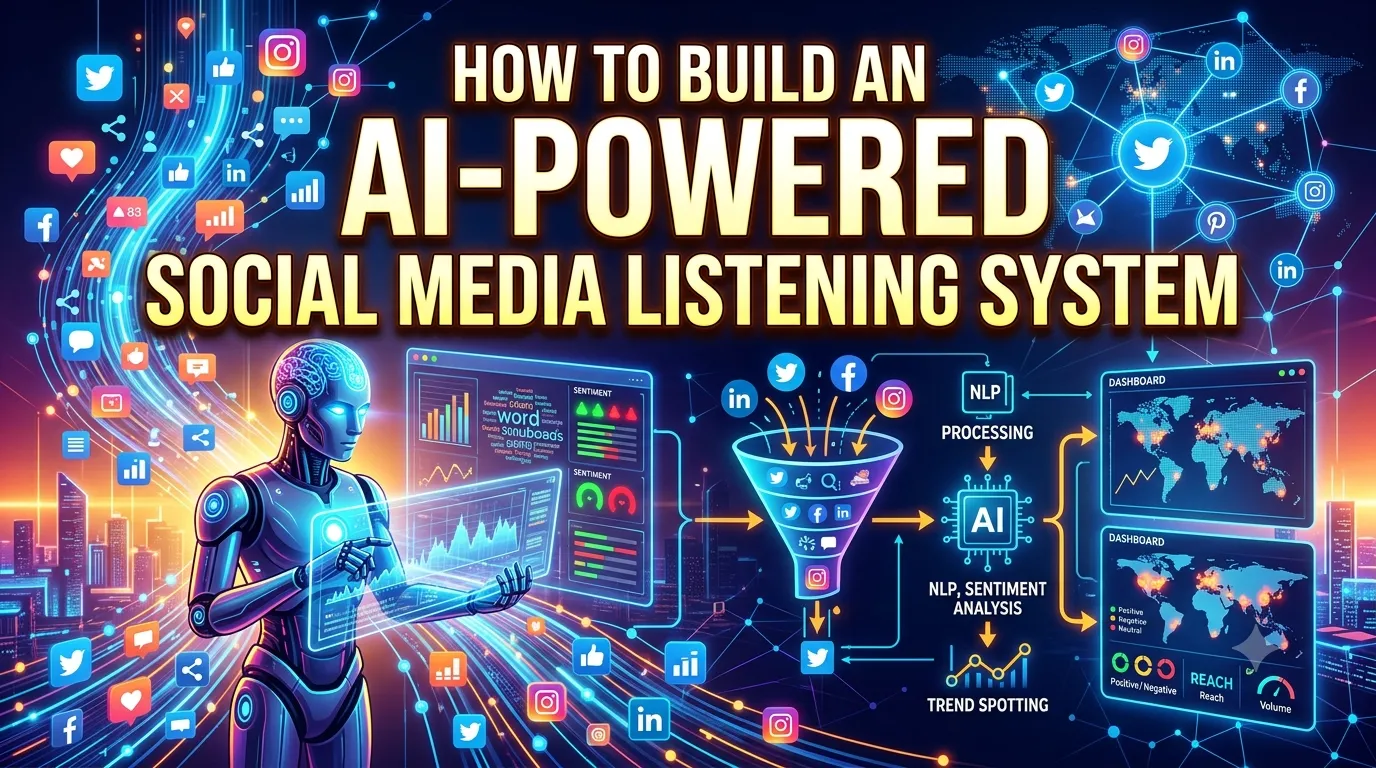
AI transforms social media listening from a manual chore to an automated intelligence system.
2.1 What AI Does
- Scans millions of posts: AI monitors conversations across platforms at scale
- Analyzes sentiment: Determines whether conversations are positive, negative, or neutral
- Identifies patterns: Spots trends before they become obvious
- Extracts insights: Surfaces actionable information from noisy data
- Predicts trends: Forecasts what's coming based on current signals
2.2 The AI Advantage
AI can process more data than any human team. It's faster, more consistent, and never sleeps. It turns social media noise into actionable intelligence.
3. The Essential AI Listening Tools
Here are the top AI tools for building a social media listening system.
3.1 Brandwatch
Brandwatch is one of the most powerful social listening platforms. It uses AI to analyze sentiment, identify trends, and surface insights.
- Key features: AI-powered sentiment analysis, trend detection, competitor tracking
- Best for: Enterprise businesses and large marketing teams
3.2 Sprout Social
Sprout Social combines social media management with AI-powered listening.
- Key features: AI-powered sentiment analysis, keyword tracking, competitor insights
- Best for: Small to medium businesses
3.3 Mention
Mention is a more accessible listening tool with AI-powered analytics.
- Key features: Real-time monitoring, AI sentiment analysis, competitor tracking
- Best for: Small businesses and startups
3.4 Talkwalker
Talkwalker offers AI-powered social listening with advanced analytics.
- Key features: AI sentiment analysis, visual listening, trend detection
- Best for: Enterprise businesses
3.5 ChatGPT + Google Alerts (The Free Option)
If you're on a budget, combine Google Alerts (free monitoring) with ChatGPT (free analysis).
- Key features: Basic monitoring (Google Alerts), AI analysis (ChatGPT)
- Best for: Startups and small businesses on a tight budget
4. How to Build Your AI Listening System
Here's a step-by-step process for building your AI-powered social media listening system.
Step 1: Define Your Goals
What do you want to learn? Brand health? Competitor strategy? Industry trends? Your goals determine what you track.
Step 2: Identify Your Keywords
What should you track? Include:
- Your brand name: Including common misspellings
- Your products/services: Specific product names
- Your competitors: Competitor brand names
- Industry keywords: Topics relevant to your industry
- Hashtags: Relevant hashtags
Step 3: Choose Your Tools
Select the right tools based on your budget and needs.
Step 4: Set Up Your Monitoring
Configure your tools to track your keywords across relevant platforms. Set up alerts for important mentions.
Step 5: Analyze and Act
Review insights regularly. Use them to:
- Adjust your marketing strategy
- Improve your products or services
- Engage with your audience
- Identify new opportunities
5. Real-World Example: AI Listening in Action
Here's how a digital marketing agency used AI social media listening:
- Challenge: They needed to understand their clients' audiences quickly.
- Solution: They built an AI-powered listening system using Brandwatch and ChatGPT.
- Result: They identified emerging trends two months before competitors. They created content that resonated instantly with audiences. Client engagement increased by 150%.
6. Conclusion: Listen to Your Audience—Without the Manual Work
Social media moves fast. You can't monitor everything manually. AI-powered social media listening gives you the insights you need without the manual work. It scans millions of posts, analyzes sentiment, identifies trends, and surfaces insights—automatically.
But here's the good news: You can start today. Choose one tool, set up your keywords, and start listening. The insights will transform your social media marketing and digital marketing strategy.
The choice is yours. Keep guessing about your audience, or start listening with AI.
Join the best Digital Marketing Course to master AI-powered marketing and digital strategy in 2026.
Frequently Asked Questions (5 Unique FAQs)
❓ 1. What's the difference between social listening and social monitoring?
Monitoring tracks mentions and keywords. Listening analyzes conversations to understand sentiment, trends, and opportunities. Monitoring tells you what's happening. Listening tells you what it means and what to do about it.
❓ 2. How long does it take to see results from social listening?
You'll start seeing data immediately. But meaningful insights usually take 1-2 months to identify patterns, trends, and significant opportunities. Be patient and consistently review your findings.
❓ 3. Can I do social listening for free?
Yes—to some extent. Combine Google Alerts (free monitoring) with ChatGPT (free analysis). But the best results come from dedicated listening tools that offer paid plans with more capabilities.
❓ 4. What platforms should I monitor?
Focus on where your audience spends time. For most businesses, this includes Twitter, LinkedIn, Instagram, Facebook, and TikTok. If you're B2B, prioritize LinkedIn. B2C, prioritize Instagram and TikTok.
❓ 5. How do I turn social listening insights into action?
Review insights weekly. Look for patterns, trends, and opportunities. Use them to adjust your content strategy, improve your products, engage with your audience, and identify new opportunities.