Let's cut through the fear-mongering for a moment. Open any news site, and you'll see headlines screaming about AI taking our jobs. "AI will replace 300 million workers!" "Your career is obsolete!" "The robots are coming!" And honestly? It's exhausting.
Yes, AI is transforming the workplace. Yes, some jobs are changing dramatically. And yes, some roles will disappear. But here's the truth nobody's telling you: AI is also creating new opportunities, new roles, and new ways for humans to thrive.
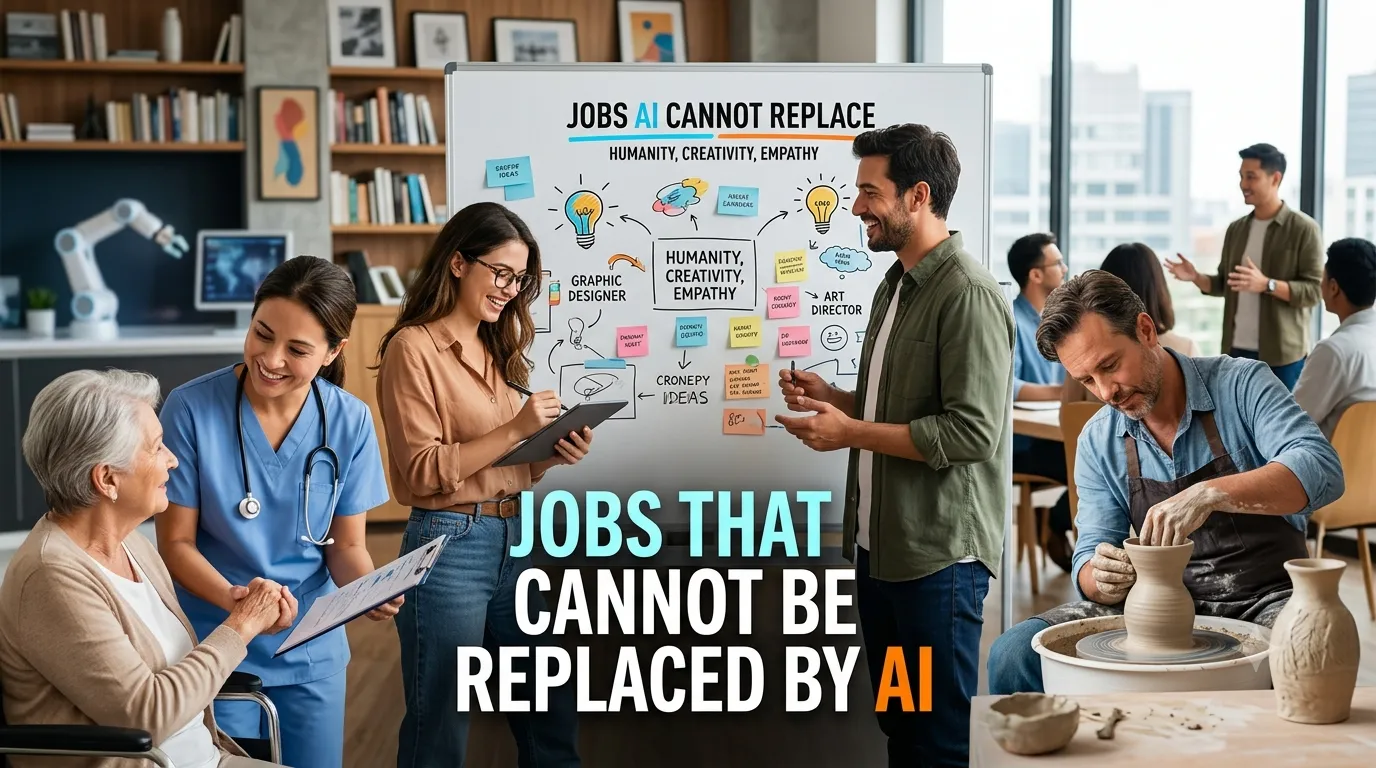
In this guide, I'll show you the jobs that cannot be replaced by AI — roles where human skills, emotional intelligence, and uniquely human capabilities are not just valuable but essential. Whether you're choosing a career path, upskilling, or just trying to future-proof your professional life, this is the guide you need.
Let's explore what makes us irreplaceable.
1. Why Some Jobs Are Safe from AI
Before we get into specific roles, let's understand the framework. Jobs that are safe from AI share certain characteristics:
- Emotional intelligence: They require empathy, understanding, and human connection
- Complex decision-making: They involve ethical judgment, nuance, and context
- Physical dexterity: They require fine motor skills in unpredictable environments
- Creativity and innovation: They involve original thinking, not just pattern recognition
- Social interaction: They require building trust and navigating complex human dynamics
- Unpredictable problem-solving: They involve novel situations with no clear precedents
AI excels at pattern recognition, data processing, and routine tasks. It struggles with ambiguity, emotion, and genuine human connection. The jobs that are safest combine elements AI can't replicate.
2. Jobs That AI Simply Cannot Replicate
Let's dive into specific career categories that are fundamentally human-centric.
2.1 Mental Health Professionals
Therapists, psychologists, counselors, and social workers. Why are these safe? Because healing requires genuine human connection. A client in crisis needs someone who can truly listen, interpret body language, sense unspoken emotions, and provide comfort in a way no algorithm can replicate.
AI chatbots can be helpful for basic screenings, but they cannot build the trust, provide the nuanced understanding, or navigate the complex emotional landscape that human therapists do. The therapeutic relationship itself is the healing agent.
2.2 Healthcare Providers (Physicians, Surgeons, Nurses)
Yes, AI can analyze medical images and assist with diagnostics. But healthcare is about people, not just data. Physicians make judgment calls that involve ethics, empathy, and understanding the whole person. Nurses provide comfort, advocate for patients, and notice subtle changes that machines miss.
Surgery, particularly in emergency situations, requires adaptability and decision-making that AI simply cannot manage. The human touch in healthcare — a hand on a patient's shoulder, a reassuring word, the ability to read fear in someone's eyes — is irreplaceable.
2.3 Teachers and Educators
Teaching is not just information transfer. It's inspiration, mentorship, and relationship building. A good teacher notices when a student is struggling, adapts their approach in real-time, and creates a safe environment for growth. They motivate, encourage, and sometimes push students to believe in themselves.
AI can provide tutoring and personalized learning pathways, but it cannot replicate the transformative impact of a passionate, dedicated teacher. The human connection in education is what changes lives.

2.4 Creative Professionals
We're talking about writers, artists, musicians, filmmakers, designers, and other creative roles. Yes, AI can generate content. It can write blog posts, create images, and compose music. But AI is a remixer, not a creator.
AI can mimic patterns, but it cannot produce the originality that comes from human experience, emotion, and vision. It cannot create work that challenges norms, provokes thought, or changes culture. True creativity is about expressing something new and deeply human.
2.5 Leadership and Management Roles
CEOs, executives, managers, and team leaders. Why are these safe? Because leadership is about people — inspiring, motivating, resolving conflicts, building culture, and making tough decisions that involve ethics and values.
AI can provide data and recommendations, but it cannot lead a team through a crisis, inspire loyalty, or make the kind of judgment calls that require moral and ethical reasoning. Leadership is fundamentally about human relationships and vision.
2.6 Skilled Trades and Craftspeople
Electricians, plumbers, carpenters, welders, mechanics, and other skilled trades. Why are these safe? Because they require physical dexterity, problem-solving in unpredictable environments, and a level of adaptability that robots simply cannot achieve.
Every building is different. Every repair job presents unique challenges. These roles require spatial reasoning, practical judgment, and the ability to improvise. Not to mention the years of hands-on experience that no AI can replicate.
2.7 Emergency Responders and First Responders
Police officers, firefighters, paramedics, and emergency medical technicians. These roles require split-second decision-making in unpredictable, high-stakes situations. They involve physical agility, emotional resilience, and human judgment.
When lives are on the line, you need someone who can adapt, make quick decisions, and respond to dynamic situations. AI might assist, but it cannot replace the human response in an emergency.
2.8 Legal Professionals with a Human Touch
While AI can review documents and assist with legal research, lawyers do much more than that. They counsel clients, negotiate deals, provide strategic advice, and navigate the complexities of human relationships and legal systems.
Family law, criminal defense, and other areas that involve human suffering and difficult choices require empathy, judgment, and ethical reasoning that AI cannot replicate.

2.9 Sales Professionals and Relationship Managers
Sales is about trust, relationship-building, and understanding human needs. While AI can assist with lead scoring and basic outreach, closing complex deals requires understanding, empathy, and the ability to navigate human dynamics.
The best sales professionals are trusted advisors. They ask the right questions, understand unspoken needs, and build genuine relationships over time.
2.10 Human Resources and Recruiting
HR professionals do more than screen resumes. They build company culture, mediate conflicts, manage sensitive situations, and help people grow. These roles require emotional intelligence, confidentiality, and the ability to navigate complex human dynamics.
AI can help with initial screening, but it cannot conduct a meaningful interview, assess cultural fit, or provide the kind of support employees need during difficult times.
3. The "AI-Proof" Skills You Need to Develop
If you're worried about AI taking your job, stop worrying and start developing these uniquely human skills.
3.1 Emotional Intelligence (EQ)
This is the ability to understand and manage your own emotions — and those of others. It's about empathy, self-awareness, social skills, and relationship management. These are deeply human capabilities that AI cannot replicate.
3.2 Complex Problem Solving
AI is good at solving structured problems with clear parameters. It struggles with ambiguous, ill-defined problems that require intuition, creativity, and judgment. Focus on developing your ability to tackle complex, multi-faceted challenges.
3.3 Creativity and Innovation
AI generates variations on existing patterns. It doesn't produce breakthroughs. Focus on developing original thinking, connecting disparate ideas, and creating something genuinely new.
3.4 Critical Thinking and Judgment
AI can provide data and suggestions. It cannot evaluate the quality of that data, make ethical judgments, or weigh competing priorities. These are skills you must develop.
3.5 Adaptability and Continuous Learning
The ability to learn, unlearn, and relearn is more valuable than any specific skill. The world changes fast. Your ability to adapt and evolve is what will keep you relevant.
3.6 Communication and Persuasion
AI can generate text. It cannot truly persuade, inspire, or move people. These are uniquely human capabilities that become more valuable in an AI-driven world.
4. Hybrid Roles: The Future of Work
Here's where things get interesting. The future isn't humans vs. AI. It's humans + AI. The most valuable professionals will be those who combine human skills with AI capabilities.
4.1 The AI-Human Collaborator
This is someone who uses AI tools to enhance their work while adding the uniquely human elements — strategy, emotion, judgment, creativity. Examples include:
- AI-Powered Marketers: Using AI for data analysis and content creation while providing strategic direction and emotional connection
- AI-Assisted Doctors: Using AI diagnostics while providing empathy, communication, and patient care
- AI-Enhanced Teachers: Using AI for personalized learning while providing mentorship and inspiration
4.2 The AI Translator
Someone who bridges the gap between AI capabilities and business needs. They understand both the technology and the human context. They can translate complex AI outputs into actionable strategies.
4.3 The AI Ethicist
As AI becomes more powerful, the need for ethical oversight grows. Someone who can evaluate the ethical implications of AI systems, ensure fairness, and navigate the complex moral landscape.
5. Why Digital Marketing Professionals Are Safe
Let's talk specifically about your field. Many people worry that digital marketing and social media marketing will be automated out of existence. They're wrong.
AI can execute tactics. It cannot develop strategy. Marketing is about understanding human psychology, building trust, telling stories that connect, and creating emotional resonance. These are deeply human activities.
A digital marketing course or SEO course that focuses on developing strategic thinking, audience understanding, and creative skills will always be valuable. AI is a tool you use, not a replacement for your judgment.
6. What to Do If You're in a Job That Could Be Automated
If you're worried about your current role, here's a practical action plan.
6.1 Upskill Immediately
Identify the human skills you need and start developing them. Take courses. Read books. Practice. Focus on skills that AI can't replicate.
6.2 Learn AI Tools
Don't fear AI — learn to use it. The AI tools that exist today are powerful. Learning how to leverage them makes you more valuable, not less.
6.3 Shift Your Focus
If your role involves routine tasks, find ways to take on work that requires judgment, creativity, or human interaction. Move from execution to strategy.
6.4 Build Your Personal Brand
People trust people, not algorithms. Build a personal brand that showcases your unique perspective, experience, and personality. This makes you harder to replace.
7. Conclusion: Your Humanity Is Your Superpower
AI is powerful. It's changing the world. But it's not replacing you — not if you understand what makes you human.
The jobs that remain will be the ones that require empathy, creativity, judgment, and human connection. These are not just safe — they're the most fulfilling, meaningful roles there are.
If you're worried about your future, shift your focus. Stop trying to compete with machines on their turf. Double down on your humanity. Develop skills that AI can't replicate. Build relationships that matter. Create work that only you can create.
If you're in digital marketing, SEO, or social media marketing, you're already in a field that values human insight. A comprehensive digital marketing course or SEO course can help you develop both the technical AI tools skills and the uniquely human capabilities that will define the future.
You are not replaceable. You are irreplaceable. Act like it.
Frequently Asked Questions (5 Unique FAQs)
❓ 1. Are there really jobs that AI can never replace?
Yes. Any job that requires genuine emotional connection, complex ethical judgment, adaptability to unpredictable situations, or original creativity is fundamentally human-centric. AI can assist, but it cannot replace the human element.
❓ 2. Should I avoid choosing a career that involves AI tools?
No. Learning to use AI tools makes you more valuable, not less. The future belongs to people who can combine AI capabilities with uniquely human skills. Embrace the tools while developing your humanity.
❓ 3. How can I make my digital marketing career AI-proof?
Focus on strategy, not just execution. Develop your strategic thinking, audience understanding, creative skills, and ability to build emotional connections. AI can handle tactics; humans handle strategy.
❓ 4. What's the single most important skill to develop for the future?
Emotional intelligence. The ability to understand, connect with, and influence people will be more valuable than ever. EQ is the skill that AI cannot replicate.
❓ 5. Will AI eliminate more jobs than it creates?
History suggests otherwise. The Industrial Revolution eliminated some jobs but created many more. The Information Age did the same. The AI age will transform work, but it will also create new opportunities we can't yet imagine.