Let me ask you something. How many browser tabs do you have open right now with "free" learning resources? Blog posts, YouTube tutorials, LinkedIn articles, PDFs, podcasts — all promising to teach you digital marketing, SEO, or social media marketing without spending a dime. Sound familiar?
Here's the thing: free resources are everywhere. And they're not all bad — far from it. But there's a massive difference between consuming information and building a career. And that difference is what separates people who dabble from people who dominate.
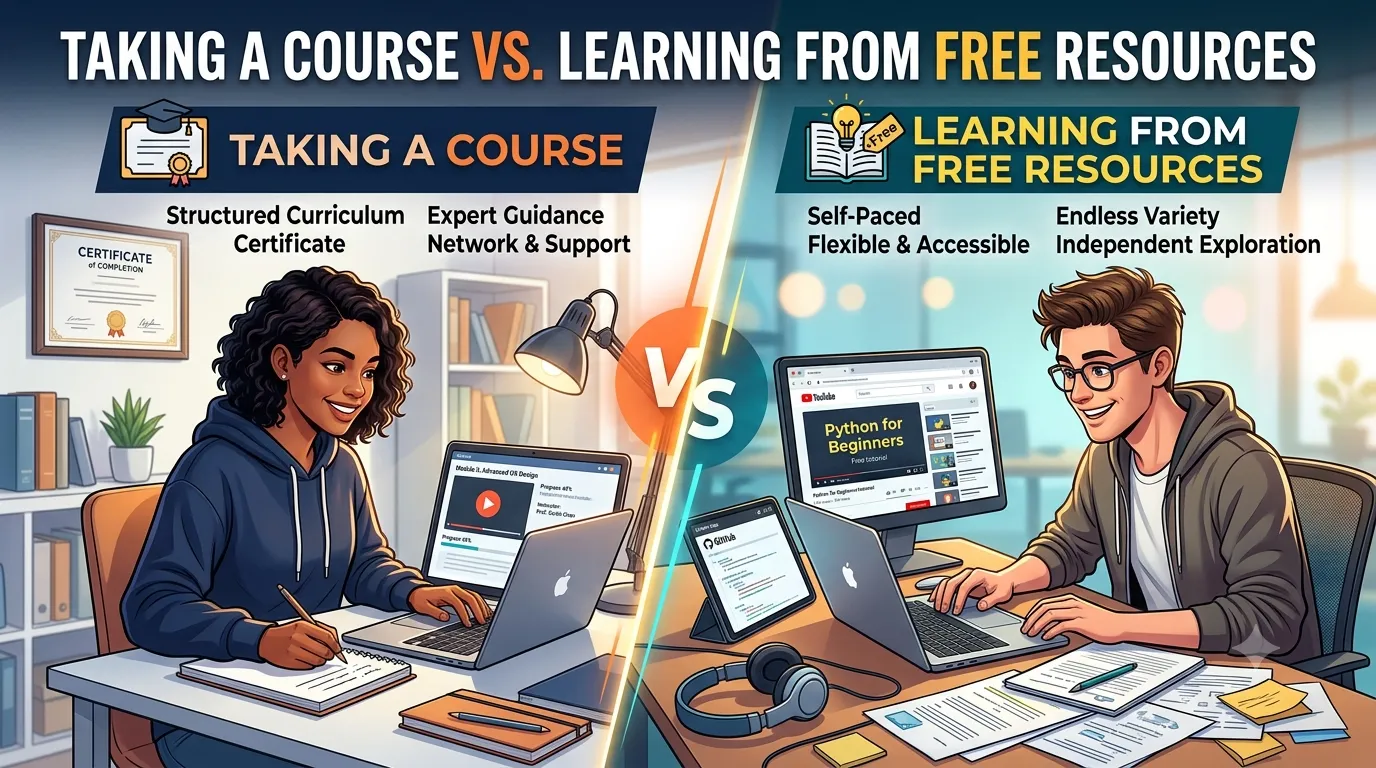
In this guide, I'll break down the real pros and cons of taking a course versus learning from free resources. I'll tell you what works, what doesn't, and how to decide which path is right for you. Whether you're just starting out, switching careers, or leveling up, this will help you stop wasting time and start making real progress.
1. The Illusion of "Free" Learning
Let's start with the obvious: free resources are free. No upfront cost, no commitment, no risk. Sounds perfect, right? But here's what nobody tells you about free learning.
1.1 The Hidden Cost of Free
Free isn't really free. It costs you time — lots of it. It costs you clarity — because information is scattered across a hundred sources. It costs you momentum — because every time you get stuck, you're on your own.
Think about it. How many half-finished YouTube playlists do you have saved? How many "must-read" blog posts have you bookmarked and never touched? Free resources often lead to analysis paralysis — you consume endlessly but never apply.
1.2 The Quality Problem
Anyone can publish content. And I mean anyone. There's no quality filter, no fact-checking, no accountability. For every amazing free tutorial, there are ten that are outdated, misleading, or just plain wrong.
In digital marketing and SEO, things change fast. An article written six months ago might already be irrelevant. A YouTube tutorial might teach you a technique that Google now penalizes. With free resources, you're constantly asking: "Is this still accurate?"
2. The Structured Learning Advantage
Now let's talk about courses. Yes, they cost money. But they also offer something that free resources rarely do: a path.
2.1 The Power of a Curriculum
A well-designed course is like a GPS. It tells you exactly where to go, what to learn next, and how to know when you've arrived. You don't waste time figuring out the order — someone who has already succeeded has mapped the route for you.
This is especially valuable in fields like digital marketing, where the landscape is vast and confusing. A good digital marketing course doesn't just throw information at you; it builds your skills step by step, each module preparing you for the next.
2.2 Accountability and Support
This is the biggest difference-maker. When you take a course, you're not alone. You have an instructor who can answer questions. You have a community of peers who are on the same journey. You have deadlines that push you forward.
With free resources, it's just you. If you get stuck, you have to find the answer yourself. If you lose motivation, there's no one to pull you back. The support system that courses provide is often what determines whether you finish — or whether you quit.
2.3 Practical Application
The best courses don't just teach theory. They include hands-on projects, real-world case studies, and practical exercises. You don't just learn about SEO; you actually do SEO. You don't just study social media marketing; you create campaigns.
This is where the real learning happens. You can watch a hundred videos about Google Ads, but until you actually set up a campaign and lose money on a bad strategy, you haven't truly learned. Courses create safe environments for that kind of experiential learning.
3. The Comparison: Side by Side
Let's be honest about what each path offers. Here's how they stack up.
3.1 Cost
Free Resources: Zero monetary cost. But you pay with time, confusion, and the risk of learning outdated information.
Course: Upfront investment. Typically ranges from $500 to $5,000 depending on the program. But the ROI can be massive — many students recoup the cost within weeks of landing their first client or promotion.
3.2 Structure
Free Resources: Fragmented and chaotic. You're the one who has to piece everything together, and you never know what you're missing.
Course: Sequential and comprehensive. Every topic is covered in the right order, and you know exactly what's coming next.
3.3 Support
Free Resources: Nonexistent. If you're stuck, you're on your own — scouring forums, hoping someone else had the same problem.
Course: Integrated mentorship. Access to instructors, community groups, and often direct Q&A sessions. You're never left in the dark.
3.4 Credibility
Free Resources: No one cares how many YouTube videos you watched. It doesn't build your resume or establish your expertise.
Course: Certifications, portfolio projects, and a track record of completing a rigorous program. These matter to employers and clients.
3.5 Speed
Free Resources: Slow. You'll spend months (or years) piecing together a fragmented education.
Course: Fast. A good course condenses years of learning into weeks or months. You get to market — and start earning — much faster.
4. The Rise of AI in Learning
2026 has brought something new to the learning landscape: AI tools that can answer questions, explain concepts, and even generate learning paths. Some people argue that AI makes courses obsolete. They're wrong.
4.1 What AI Can Do
AI is excellent at answering specific questions: "What's a canonical tag?" "How do I set up GA4?" "Explain keyword cannibalization." It can summarize concepts, rephrase explanations, and generate practice questions.
If you just need a quick fact or a basic explanation, AI is a powerful supplement to any learning path.
4.2 What AI Can't Do
AI can't give you feedback on your actual work. It can't look at your Google Ads campaign and tell you why it's failing. It can't review your website and provide tailored SEO recommendations. It can't coach you through a client call gone wrong.
AI also can't hold you accountable. It doesn't care if you procrastinate, get distracted, or give up. The human element — mentorship, community, accountability — is something AI simply cannot replace.
5. Who Should Take a Course?
Not everyone needs a course. Here's who benefits most from structured learning.
5.1 Complete Beginners
If you're starting from zero, a course provides the foundation you need to build on. Free resources are too scattered — you'll waste months trying to figure out what to learn first.
5.2 Career Changers
If you're switching into digital marketing from another field, you need credibility fast. A course with certifications and projects signals to employers that you're serious and competent.
5.3 People Who Need Structure
Some people thrive with self-directed learning. Most don't. If you know you struggle with procrastination, lack of direction, or staying motivated, a course provides the external structure you need to succeed.
5.4 Those Seeking Mentorship
If you want guidance, feedback, and someone who can answer your specific questions, a course with active mentorship is worth every penny. You're not just paying for content; you're paying for access to someone who has already walked the path.
6. Who Can Succeed with Free Resources?
Yes, some people do succeed with free resources. Here's who they are.
6.1 Experienced Professionals
If you already have a foundation in digital marketing and just need to stay current on new AI tools or algorithm updates, free resources are perfectly fine. You know enough to filter good information from bad.
6.2 Highly Self-Motivated Learners
If you're the kind of person who can set goals, create a study plan, and stick to it without external accountability, free resources might work. But be honest with yourself — most people aren't this disciplined.
6.3 Those with Time to Spare
If you're not in a hurry — if you can afford to spend months or years figuring things out — free resources are a viable path. Just understand that speed comes at a price.
7. The Hybrid Approach: Best of Both Worlds
You don't have to choose strictly one or the other. Many successful marketers use a hybrid approach.
7.1 Course as Foundation, Free Resources for Depth
Take a structured course to build your foundation and gain credibility. Then use free resources (blogs, podcasts, YouTube) to go deeper on specific topics or stay updated on changes.
7.2 Free Resources for Exploration, Course for Mastery
Use free resources to explore a field and confirm your interest. Once you're committed, invest in a course that gives you the depth and support you need to truly master the subject.
7.3 The AI Supplement
Use AI tools alongside your course to get instant answers, generate practice questions, and accelerate your learning. AI doesn't replace a course, but it makes the course more effective.
8. The Real Question: What's Your Goal?
At the end of the day, the choice between a course and free resources comes down to one question: What do you want to achieve?
8.1 If Your Goal Is "I Just Want to Learn"
Free resources might be enough. If learning is its own reward, and you're not in a hurry, you can piece together knowledge over time.
8.2 If Your Goal Is "I Want a New Career"
A course is almost always the better choice. You need credibility, skills, and a portfolio — and you need them fast. The cost is an investment in your future income.
8.3 If Your Goal Is "I Want to Build a Business"
A course with mentorship and community can be the difference between success and failure. The connections, support, and accountability are worth more than the content itself.
9. The Math: Return on Investment
Let's do some simple math. A good digital marketing course costs around $1,000-$3,000. A junior digital marketing role starts at $50,000-$70,000 per year. Even if the course only accelerates your career by six months, it's paid for itself many times over.
Free resources might save you money upfront, but they cost you time. And time is the one resource you can never get back. If you spend an extra year figuring things out on your own, you've lost a year of earning potential.
The question isn't "Can I afford a course?" The question is "Can I afford not to take one?"
10. Conclusion: Stop Spinning Your Wheels
Here's the truth. Free resources are valuable. They can supplement your learning, keep you updated, and satisfy your curiosity. But if you're serious about building a career in digital marketing, SEO, or social media marketing, free resources alone are rarely enough.
You need structure. You need support. You need accountability. You need someone who can tell you if you're doing it right. And you need a path that actually leads somewhere.
That's what a good digital marketing course or SEO course provides. It's not just about the content — it's about the framework, the community, and the momentum that comes from committing to something real.
If you've been spinning your wheels with free resources, wondering why you're not making progress, maybe it's time to try something different. Stop consuming. Start committing. The investment you make today will pay dividends for years to come.
Frequently Asked Questions (5 Unique FAQs)
❓ 1. Can I really learn everything I need from free YouTube videos?
You can learn some things from YouTube videos, but not everything. YouTube is great for specific tutorials and quick explanations. It's terrible for building a comprehensive, structured understanding of a field. You'll end up with gaps in your knowledge and no one to tell you what you're missing.
❓ 2. How do I know if a course is worth the money?
Look for courses with real instructors (not just pre-recorded content), active communities, practical projects, and clear outcomes. Check reviews, ask for testimonials, and see if the course offers a money-back guarantee. The best courses transparently show you what you'll achieve and how.
❓ 3. Will AI make courses obsolete?
No. AI can answer questions and explain concepts, but it can't provide mentorship, accountability, hands-on feedback, or community. Courses evolve to integrate AI as a supplement, not a replacement. The human element remains essential.
❓ 4. What if I can't afford a course right now?
Start with free resources to explore the field and build momentum. Many courses offer payment plans or scholarships. You can also invest in one foundational course rather than multiple courses. Start small and build from there.
❓ 5. How long does it take to see ROI from a digital marketing course?
Many students recoup their investment within weeks to months. If you land a new role, get a promotion, or win your first client, the course pays for itself quickly. Even if it takes longer, the knowledge and skills stay with you for your entire career.


