Let's cut through the noise. You've heard it everywhere: "Learn AI and you'll be unstoppable!" "AI skills are the golden ticket!" And honestly? That's not entirely wrong. Jobs requiring AI skills have grown nearly eight times faster than the overall job market since 2019. The average wage premium for AI skills has hit a staggering 62% . In some sectors, that premium reaches as high as 118%.
But here's the uncomfortable truth that nobody's telling you: learning AI alone won't get you hired. In fact, focusing only on technical AI skills might actually be hurting your chances. Let me explain why.
1. The Great AI Skills Gap Paradox
Here's the irony: AI skills are the most difficult for employers to find globally, surpassing traditional engineering and IT capabilities. 72% of employers report difficulty filling roles . Yet, candidates with AI credentials are still struggling to land jobs. Why?
1.1 The Credential vs. Competence Gap
The problem isn't that you learned AI. The problem is that narrow tool expertise without context is overhyped. According to LinkedIn's Career Expert, "What lasts is AI literacy paired with human skills like critical thinking, communication, creativity, and judgment" .
Think of it this way: knowing how to use a hammer doesn't make you an architect. Similarly, knowing how to prompt ChatGPT doesn't make you a strategic marketer. Employers aren't hiring tools—they're hiring problem-solvers who happen to use tools.
2. The "Two-Track" Labour Market: Where You're Getting Stuck
PwC's 2026 AI Jobs Barometer reveals a critical shift. AI is creating a "two-track" global labour market . Understanding which track you're on is the difference between getting hired and getting ignored.
2.1 Track 1: The "Professionalised" Roles (The Winners)
These are roles where AI automates routine tasks so human judgment and expertise are emphasized . Think radiologists, recruiters, and strategic marketers. In these roles, AI doesn't replace your expertise—it amplifies it. These jobs are seeing twice the growth and 42% faster salary growth than the other track.
2.2 Track 2: The "Democratised" Roles (The Losers)
These are roles where AI makes the job itself easier for non-experts to perform . If your only value is performing tasks that AI can now do for anyone, you're on the wrong track. Growth in these roles is slower, and salary growth lags significantly behind .
The question isn't whether you have AI skills. The question is: are you using AI to amplify your expertise, or are you using AI to replace the need for expertise altogether?
3. What Employers Actually Want: The Human Skills That AI Can't Replace
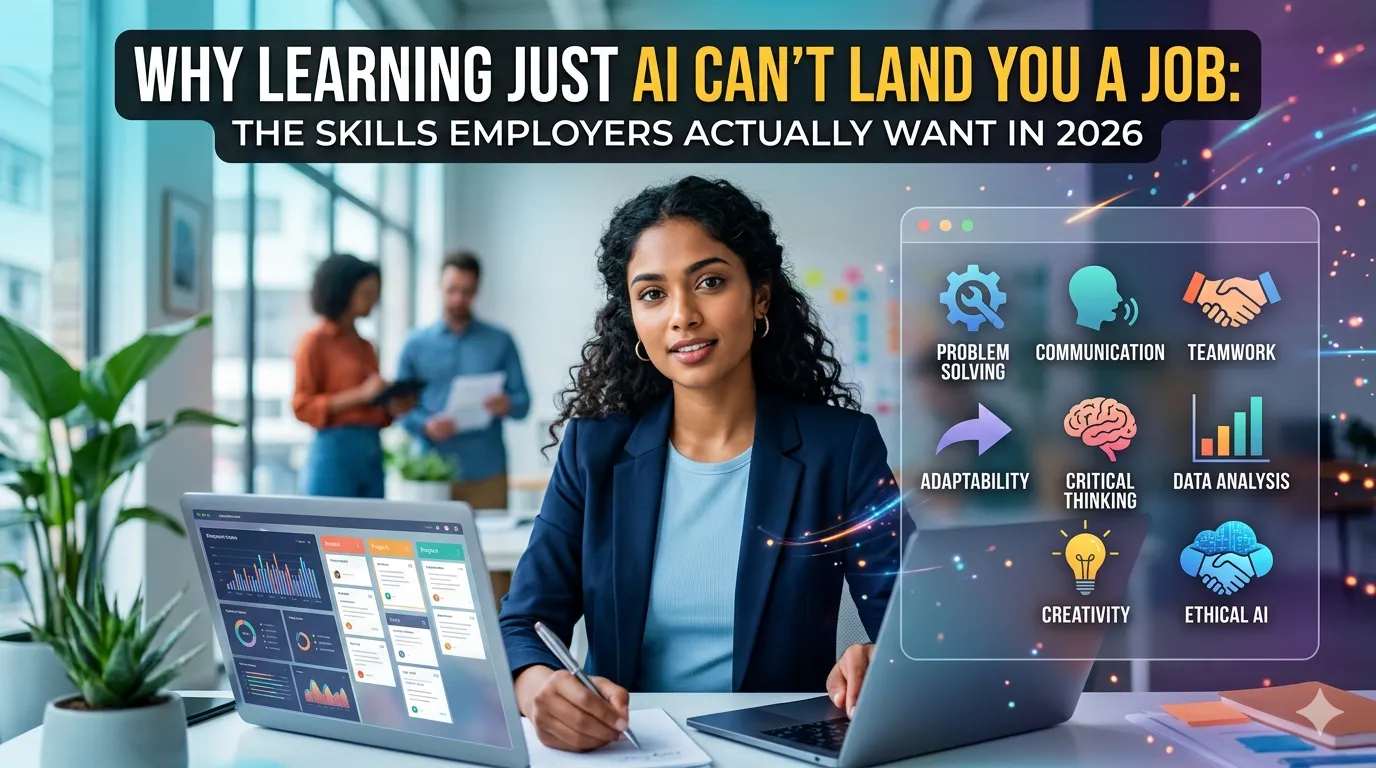
Despite the AI boom, core human skills remain in even higher demand. Here's what employers are actually looking for:
3.1 Communication, Collaboration & Teamwork (39%)
This is the most sought-after attribute across all industries. AI can write a report, but it can't persuade a stakeholder, negotiate a deal, or lead a team through a crisis. These are distinctly human capabilities.
3.2 Professionalism & Work Ethic (36%)
Reliability, accountability, and integrity still matter. Employers need people they can trust to show up, take ownership, and deliver—consistently.
3.3 Adaptability & Willingness to Learn (34%)
The pace of change is relentless. Employers value people who can pivot, learn new skills quickly, and embrace change without resistance .
3.4 Critical Thinking, Creativity, and Judgment
AI can generate ideas, but it can't determine which ideas are good. It can analyze data, but it can't interpret nuance. It can produce content, but it can't understand cultural context. The future belongs to those who combine AI with human insight .
4. The Rise of "Seniorised" Entry-Level Roles
This is perhaps the most surprising finding. AI-exposed entry-level roles are now seven times more likely to require traditionally senior-level skills like leadership, creativity, and face-to-face interaction .
4.1 What This Means for Job Seekers
These "seniorised" entry-level roles have grown 35% since 2019, while other entry-level roles have shrunk by 10%. What does this tell you? Employers are raising the bar. They're no longer interested in hiring someone who just knows how to use AI tools. They want junior professionals who can think like seniors.
5. The Certification Trap: Why Papers Aren't Enough
There's been a massive surge in AI certifications. But here's the reality: employers are paying significantly higher salary premiums for practical AI skills than for formal AI certifications .
5.1 The Value Gap
Twenty-three non-certified AI skills command salary bonuses ranging from 19% to 23% of base pay. In contrast, the ten highest-paying AI certifications average premiums of only 9% to 11%.
Why? Because certifications often fall short of providing the practical experience that employers increasingly demand. Companies want to see what you can do, not just what you know.
6. Why Practical Experience Trumps Everything
As one hiring manager put it, "I prefer candidates who have actively contributed to open-source projects or gained hands-on experience through internships" .
6.1 Building Your Competitive Edge
Want to stand out? Build a portfolio of real projects. Some practical examples:
- Use an NLP library and social media APIs to build a sentiment analysis tool .
- Create a predictive analytics model for forecasting revenue growth.
- Develop a chatbot using NLP techniques and language model APIs.
These experiences demonstrate your ability to apply AI concepts in practical settings—which is exactly what employers want.
7. The Framework: How to Become Valuable in the AI Era
So if learning AI alone isn't enough, what should you focus on? Here's the framework that works.
7.1 AI Fluency (The Baseline)
This is non-negotiable. You need to understand how to use AI tools effectively, verify outputs, and integrate AI into your workflow. But this is just the starting point.
7.2 Human Judgment (The Differentiator)
AI is powerful but imperfect. It produces false information, misunderstands context, and misses cultural nuances. Human oversight is becoming more important, not less . A marketer using AI must still verify strategies. A manager using AI must still apply ethical judgment.
7.3 Creativity and Problem-Solving (The Superpower)
As AI automates routine tasks, human value increasingly lies in identifying problems, connecting ideas, and designing solutions suited to real-world conditions. A farmer using AI weather tools must still decide when to plant. An entrepreneur building an AI-powered system must still understand human frustration, language, and trust.
The future belongs not simply to those who use AI, but to those who combine AI with human insight.
8. Real-World Implications for Digital Marketing Professionals
For marketers, this shift is already visible. AI tools are now handling content creation, ad optimization, and campaign management. But the most successful marketers aren't being replaced—they're becoming more valuable.
8.1 The AI-Powered Marketer
Instead of just knowing how to use ai tools like ChatGPT or Jasper, top marketers are developing:
- Strategic thinking: Understanding business goals, customer psychology, and brand positioning.
- Creative direction: Knowing which content works and why, beyond what AI generates.
- Ethical judgment: Navigating privacy, authenticity, and consumer trust in an AI-driven world.
This is why a comprehensive digital marketing course or SEO course goes beyond tool training. It teaches strategy, analytics, and human-centric marketing. Because that's what employers actually need.
9. Conclusion: The Moving Walkway of Career Relevance
LinkedIn's Career Expert sums it up perfectly: "Relevance has clearly emerged as the defining career lens". She describes today's job market as "less like a fork in the road and more like a moving walkway," where standing still still moves you forward.
But here's the catch: not moving forward is moving backward. Those who succeed now aren't the loudest or the fastest—they're the clearest. They understand that AI is a tool, not a career strategy. They combine technical fluency with human judgment, creativity, and adaptability.
So yes, learn AI. Master the tools. Stay updated on the latest ai tools and automation. But don't stop there. Develop your communication skills. Build practical projects. Apply critical thinking. That's how you land a job in 2026. That's how you stay relevant.
The question isn't whether you can use AI. The question is: what can you do with AI that nobody else can?
Frequently Asked Questions (5 Unique FAQs)
❓ 1. If AI skills are in such high demand, why are AI-certified people struggling to get hired?
There's a gap between credentials and competence. Certifications often focus on theoretical knowledge, while employers need practical, hands-on experience. Additionally, narrow tool expertise without business context or human skills isn't as valuable. Companies want professionals who can apply AI to solve real problems, not just use AI tools.
❓ 2. What are "human skills" and why do they matter more with AI?
Human skills include communication, collaboration, critical thinking, creativity, judgment, and adaptability. They matter more because AI handles routine tasks, so human value increasingly lies in areas AI struggles with—empathy, strategic thinking, ethical judgment, and creative problem-solving.
❓ 3. How can I demonstrate AI skills without certifications?
Build a portfolio of real projects. Contribute to open-source projects, complete internships, or develop prototypes solving real business problems. Practical examples like sentiment analysis tools, predictive models, or chatbots show employers you can apply AI in real-world settings.
❓ 4. Is a formal AI degree worth it compared to certifications?
Degrees provide breadth, depth, and recognized credentials that certifications can't fully match. However, the best path depends on your career stage. Early-career professionals benefit from degrees, while mid-career professionals may prefer certificates to add specific skills. But in all cases, practical experience is what employers value most.
❓ 5. What's the single most important thing I can do to future-proof my career?
Focus on becoming an "AI translator"—someone who bridges AI capabilities and business decisions. This means developing both technical fluency and strategic business thinking . Continuously learn, build practical projects, and develop your human skills. The most valuable professionals in 2026 are those who combine AI with human insight.


