Let's be honest. The traditional marketing funnel — awareness, interest, desire, action — has been the foundation of digital marketing for decades. It's simple. It's logical. And in 2026, it's completely broken.
Why? Because AI has fundamentally transformed how people discover, evaluate, and buy products. The linear journey from stranger to customer no longer exists. Today's buyers hop between channels, consult AI assistants, research on their own terms, and make decisions that don't fit into a neat little funnel.
In this guide, I'll show you exactly how AI changed the buyer's journey forever — and how to build a marketing funnel that actually works in 2026. Whether you're a digital marketing professional, a business owner, or a student taking a digital marketing course, this is your roadmap to the new reality.
Let's rebuild the funnel.
1. The Old Funnel: A Linear World That No Longer Exists
Let's start by understanding what we're replacing. The traditional marketing funnel looks like this:
- Awareness: The customer discovers your brand
- Interest: They show interest in your product
- Desire: They develop a preference for your solution
- Action: They make a purchase
This model assumes that buyers move in a straight line. They start at the top and eventually trickle down to the bottom. It's neat, predictable, and completely outdated.
Here's what actually happens in 2026:
- Buyers skip stages entirely
- They loop back to earlier stages
- They consult AI assistants before ever visiting your website
- They research on multiple channels simultaneously
- They make decisions based on AI-generated recommendations
2. How AI Transformed Each Stage of the Funnel

Let's look at each stage of the buyer's journey and see how AI has changed it forever.
2.1 Awareness: AI Now Controls Discovery
In the past, awareness was about being visible. You ran ads, optimized for SEO, and hoped people found you. Today, AI controls discovery.
What's changed:
- Search engines use AI to understand intent, not just keywords
- Social media algorithms decide what content people see
- AI assistants (like ChatGPT, Claude) recommend products and brands directly
- AI-powered discovery means your content needs to be optimized for algorithms, not just people
What this means for marketers: You need to create content that signals quality to AI algorithms. That means clear structure, relevant keywords, genuine value, and consistent engagement signals.
2.2 Interest: AI Is the New Researcher
In the past, buyers would visit your website, read about your product, and compare options. Today, AI does the research for them.
What's changed:
- Buyers ask AI assistants to summarize product information
- They use AI to compare features and prices
- They trust AI-generated recommendations over traditional advertising
- They expect personalized experiences based on their behavior
What this means for marketers: Your content needs to be AI-friendly. That means clear, structured information that AI can easily parse and summarize. If AI can't understand your offering, it won't recommend you.
2.3 Desire: AI Builds Trust
Desire used to be about persuasion. You'd use marketing copy, testimonials, and social proof to convince people. Today, AI helps build trust — or breaks it.
What's changed:
- Buyers use AI to analyze reviews and sentiment
- They trust AI-curated recommendations
- They expect transparency and authenticity
- AI identifies fake reviews and inauthentic content
What this means for marketers: Authenticity is more important than ever. You need genuine reviews, transparent communication, and content that builds trust. AI can detect inauthenticity, and so can your customers.
2.4 Action: AI Removes Friction
Action used to be about closing the sale. Today, AI removes friction from the purchasing process.
What's changed:
- AI-powered chatbots handle questions and objections
- Personalized recommendations increase conversion
- AI optimizes pricing and offers in real-time
- Automated follow-up sequences nurture leads
What this means for marketers: Your conversion process needs to be seamless. AI can handle objections, answer questions, and guide users to purchase. If your checkout process is friction-filled, you'll lose sales.
3. The New Marketing Funnel: AI-Powered and Non-Linear
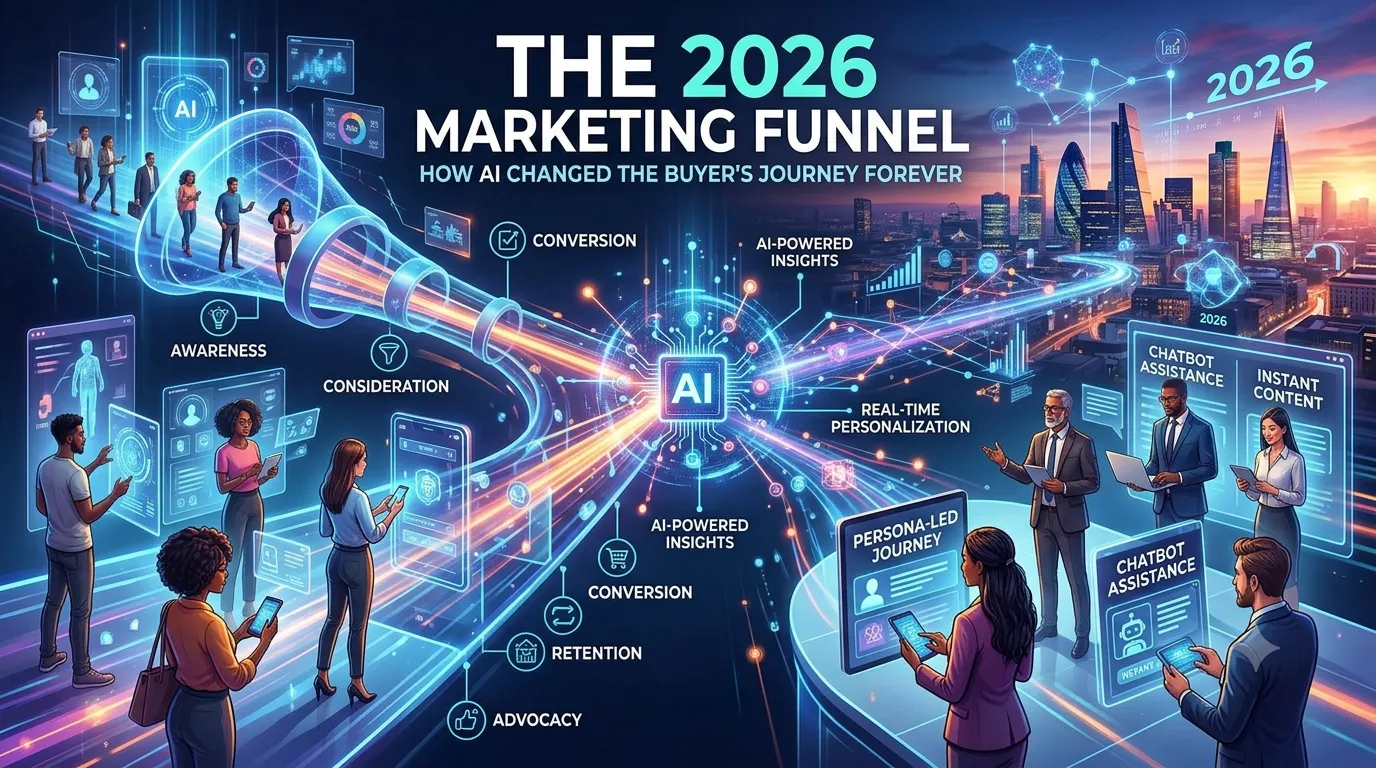
So what does the new marketing funnel look like? It's not a funnel at all. It's a continuous, non-linear loop that looks more like a figure-eight than a triangle.
3.1 Stage 1: Discovery (AI-Optimized)
Your goal is to be discovered by AI systems and algorithms. This means:
- Creating content that AI understands and ranks
- Optimizing for search and social algorithms
- Building a presence where AI assistants look for answers
- Ensuring your brand appears in AI-generated recommendations
3.2 Stage 2: Research (AI-Augmented)
Your goal is to provide information that AI can easily parse and present to buyers. This means:
- Clear, structured product information
- Comparison content that helps buyers choose
- Educational content that answers questions
- Data that AI can use to generate insights
3.3 Stage 3: Trust (AI-Verified)
Your goal is to build genuine trust that AI can verify. This means:
- Authentic reviews and testimonials
- Transparent communication
- Consistent brand messaging
- Social proof that AI can validate
3.4 Stage 4: Conversion (AI-Optimized)
Your goal is to remove all friction from the conversion process. This means:
- AI-powered chatbots for instant support
- Personalized recommendations
- Seamless checkout experience
- Automated follow-up sequences
3.5 Stage 5: Retention (AI-Enhanced)
Your goal is to keep customers coming back. This means:
- AI-powered personalization
- Automated loyalty and retention campaigns
- Continuous value delivery
- Building a community that AI can't replicate
3.6 Stage 6: Advocacy (AI-Amplified)
Your goal is to turn customers into advocates. This means:
- Encouraging reviews and testimonials
- Creating shareable content
- Building a referral program
- Leveraging user-generated content
4. How AI Tools Help at Each Stage
Here's how specific AI tools can help you optimize each stage of the new funnel.
4.1 Discovery Tools
- Surfer SEO: Optimize content for search algorithms
- AnswerThePublic: Find what people are searching for
- Google Trends: Identify trending topics
4.2 Research Tools
- ChatGPT/Claude: Generate educational content
- Grammarly: Ensure clarity and professionalism
- Canva AI: Create visual content that explains complex topics
4.3 Trust Tools
- Trustpilot: Collect and display reviews
- Reputation management tools: Monitor brand sentiment
- Content authenticity tools: Ensure transparent messaging
4.4 Conversion Tools
- Chatbots: Handle questions and objections
- Personalization tools: Deliver tailored experiences
- Checkout optimization: Remove friction
4.5 Retention Tools
- Email automation: Nurture relationships
- CRM systems: Track customer interactions
- Loyalty programs: Reward repeat customers
4.6 Advocacy Tools
- Referral programs: Encourage word-of-mouth
- User-generated content tools: Leverage customer content
- Social sharing tools: Make it easy to share
5. Real-World Example: An AI-Powered Marketing Funnel
Let's see what this looks like in practice for a digital marketing course provider.
Discovery Stage
What they did: Created SEO-optimized content around "best digital marketing course," "learn AI marketing," and "digital marketing certification." Used Surfer SEO to optimize content. The content ranked on Google and was picked up by AI assistants.
Research Stage
What they did: Created detailed comparison guides, course outlines, and FAQ pages. Used ChatGPT to generate comprehensive content. Structured information so AI could easily parse and summarize it.
Trust Stage
What they did: Collected and displayed authentic student testimonials. Created case studies showing real results. Shared behind-the-scenes content that built transparency and authenticity.
Conversion Stage
What they did: Implemented an AI chatbot to answer questions and address objections. Used personalized email sequences to nurture leads. Created a seamless checkout experience.
Retention Stage
What they did: Provided ongoing value through email newsletters, community access, and continuous updates. Used AI to personalize recommendations based on student progress.
Advocacy Stage
What they did: Encouraged students to share their success stories. Created a referral program that rewarded advocates. Leveraged user-generated content for marketing.
6. How to Build Your AI-Powered Funnel Today
Here's a step-by-step action plan to create a marketing funnel that works in 2026.
Step 1: Audit Your Current Funnel
Map out your current funnel. Where are you losing people? Where is AI already involved? Where are you missing opportunities?
Step 2: Optimize for AI Discovery
Create content that AI can understand and rank. Structure your information clearly. Use schema markup. Answer questions directly.
Step 3: Build AI-Friendly Content
Create content that AI can easily parse. Use headings, lists, and clear structure. Answer common questions. Provide comprehensive information.
Step 4: Implement AI Tools
Start using AI tools for content creation, optimization, and analysis. Choose tools that fit your workflow and budget.
Step 5: Measure and Iterate
Track your performance. What's working? What isn't? Use AI-powered analytics to gain insights. Iterate continuously.
7. The Bottom Line: AI Is Not Replacing the Funnel — It's Transforming It
The traditional marketing funnel isn't dead. It's been transformed. AI has changed how buyers discover, research, evaluate, and purchase. The funnel is no longer linear. It's dynamic, non-linear, and AI-powered.
The marketers who succeed in 2026 will be the ones who understand this new reality. They'll create content that AI can understand and recommend. They'll build trust through authenticity and transparency. They'll remove friction from the conversion process. And they'll use AI tools to optimize every stage of the funnel.
If you're serious about building a career in digital marketing or SEO, understanding the new marketing funnel is essential. A comprehensive digital marketing course can help you master these strategies and stay ahead of the curve.
The funnel has changed. Have you?
Conclusion: The Funnel Has Changed. Have You?
The traditional marketing funnel is dead. In 2026, AI has transformed how people discover, research, and buy. The journey is no longer linear — it's dynamic, AI-powered, and constantly evolving.
But here's the good news: AI isn't replacing marketers. It's making them more powerful. The combination of human strategy and AI efficiency is unstoppable. The marketers who embrace this change will thrive. Those who don't will be left behind.
The choice is yours. Keep doing what worked in 2025, or adapt to the new reality.
Join the best Digital Marketing Course to master the AI Funnel
Frequently Asked Questions (5 Unique FAQs)
❓ 1. Is the traditional marketing funnel completely obsolete?
Not completely. The principles — awareness, interest, desire, action — still apply. But the journey is no longer linear. Buyers skip stages, loop back, and consult AI assistants. The funnel needs to be reimagined as a non-linear, continuous loop.
❓ 2. How do I make my content "AI-friendly"?
Structure your content clearly with headings, lists, and logical flow. Answer questions directly. Use schema markup. Provide comprehensive information. The more structured and clear your content is, the easier it is for AI to parse and recommend.
❓ 3. What's the biggest mistake marketers make with AI in the funnel?
Assuming AI replaces strategy. AI is a tool to enhance your marketing, not a replacement for strategic thinking. The best marketers use AI to execute faster and smarter, but they still provide the direction, judgment, and creativity.
❓ 4. How can I tell if my funnel is working in 2026?
Track the same metrics but with new layers: AI-driven traffic, chatbot engagement, personalization effectiveness, and AI-assisted conversions. Also, monitor your brand's visibility in AI search results and recommendations.
❓ 5. Do I need to rebuild my entire funnel for AI?
Not from scratch, but you need to adapt. Start by auditing where AI already touches your funnel. Then optimize those touchpoints. Focus on discovery and research first, as these are where AI has the most impact. Then work your way down.