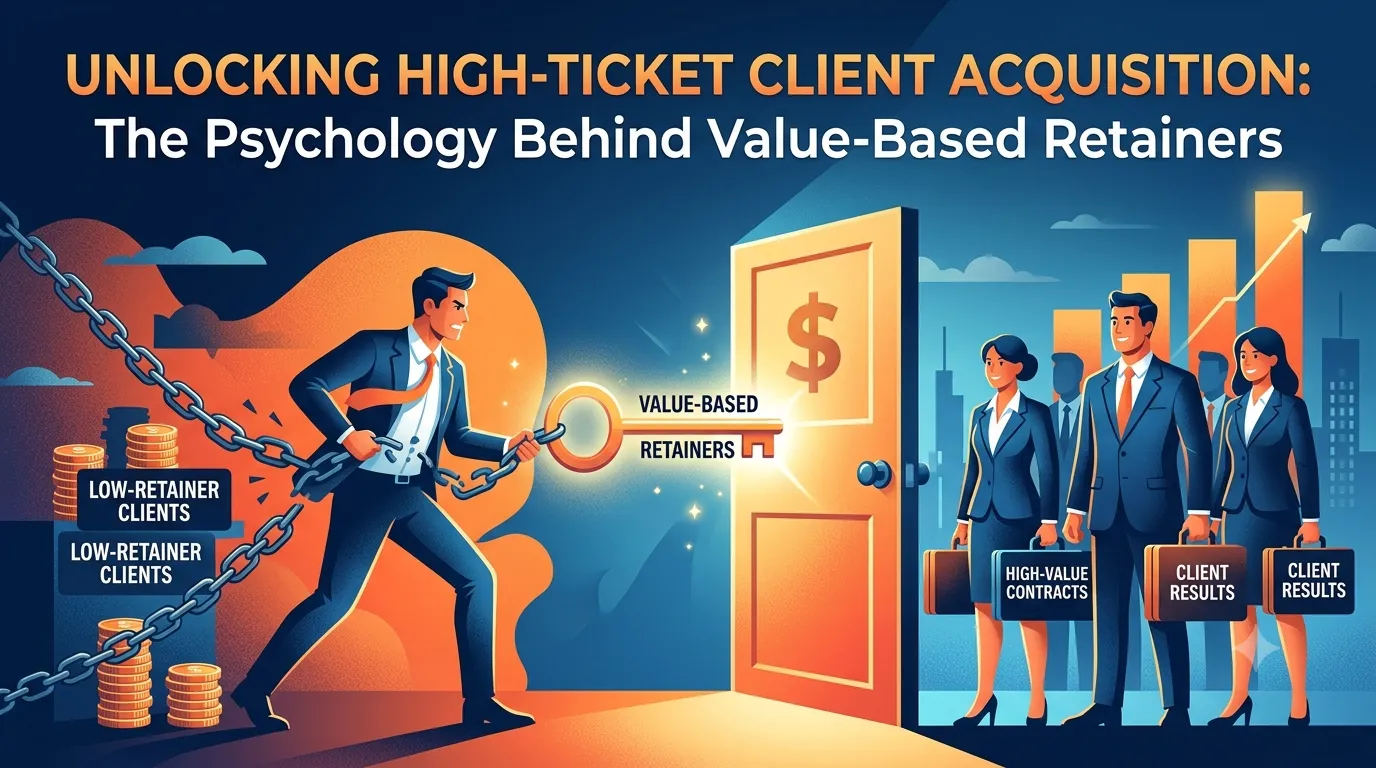
Unlocking High-Ticket Client Acquisition: The Psychology Behind Value-Based Retainers
Let me ask you something. How many clients are you currently serving? How many hours are you working each week? And most importantly — are you actually making the money you deserve?
If you're like most B2B agencies and freelancers, the answer is probably: "I'm working too hard for too little." You're trapped in a cycle of low-ticket clients, constant churn, and burnout. You're trading time for money, and it's keeping you broke.
Here's the hard truth: Your pricing model is the problem. Not your skills. Not your expertise. Not your ability to deliver results. Your pricing model.
In this guide, I'll show you how to unlock high-ticket client acquisition using the psychology behind value-based retainers. You'll learn why clients pay premium prices, how to position yourself as a high-value partner, and how to build a sustainable, profitable business.
Whether you're a digital marketing agency owner, a consultant, or a freelancer, this is your roadmap to escaping the low-ticket trap.
1. The Low-Ticket Trap: Why You're Keeping Yourself Broke
Here's the pattern I see everywhere. Agency owners and freelancers start out charging low prices to attract clients. They're afraid to charge more because they might lose business. So they keep prices low, work longer hours, and take on more clients just to make ends meet.
The result? You're working harder, not smarter. You're exhausted, frustrated, and wondering why your business isn't growing.
1.1 The Fear Factor
Most people underprice their services because of fear. Fear of losing clients. Fear of being rejected. Fear of not being "worth" more. But here's the thing: your fear is costing you money. When you price based on fear, you attract clients who are price-sensitive — not value-sensitive. And those clients are the hardest to work with.
1.2 The Burnout Cycle
When you're charging low prices, you need to take on more clients to survive. More clients mean more work, more stress, and less time for each client. The quality of your work suffers. Your clients aren't happy. You're exhausted. It's a cycle that's impossible to sustain.
2. The Psychology of Value-Based Pricing
Here's what the most successful agencies understand: Clients don't buy hours. They buy outcomes. They're not paying for your time — they're paying for the results you deliver.
2.1 The Perception of Value
Price is not just a number. It's a signal. When you charge $500/month, clients perceive your services as low-value. When you charge $5,000/month, clients perceive your services as high-value. Your price communicates your value before you even speak.
2.2 The Trust Premium
Clients pay premium prices to people they trust. Trust comes from authority, expertise, and a proven track record. When you position yourself as an expert — not just a service provider — clients are willing to pay more. They're paying for the confidence that you can deliver results.
2.3 The Psychology of Commitment
When clients pay more, they're more committed. They're more invested in the relationship, more likely to follow your advice, and more likely to stay long-term. Higher prices attract better clients. It's that simple.

3. Step 1: Shift Your Mindset
The first and most important step is to shift your mindset about your value.
3.1 You're Not Selling Time — You're Selling Results
Stop thinking of yourself as someone who sells hours. You're selling transformations. You're helping clients grow their revenue, save time, and achieve their goals. That's not a commodity — that's a high-value service.
3.2 Your Expertise Is an Asset
You've spent years building your skills and knowledge. That's an asset. And assets have value. When you discount your expertise, you're saying it's not valuable. Own your expertise. Price it accordingly.
3.3 Stop Competing on Price
There will always be someone cheaper. If you compete on price, you'll always lose. Instead, compete on value. Be the expert who delivers results — not the cheapest option. You don't want clients who choose you for your price. You want clients who choose you for your expertise.
4. Step 2: Communicate Your Unique Value
Your value doesn't matter if clients don't understand it. You need to communicate your value clearly and convincingly.
4.1 Use Client Feedback to Showcase Impact
There's nothing more powerful than a testimonial from a satisfied client. Collect and showcase feedback that highlights the results you've delivered. Let your past results sell your future services.
4.2 Quantify Your Results
Numbers speak louder than words. Instead of saying "I grew my client's social media following," say "I grew my client's social media following by 10,000 followers, generating 500+ leads and $50,000 in revenue." Specific numbers build credibility and trust.
4.3 Tell Stories
People remember stories, not statistics. Share case studies that tell the story of a client's transformation — the challenge they faced, the solution you provided, and the results they achieved. Storytelling builds emotional connection and trust.
5. Step 3: Offer Value-Based Retainers
This is the game-changer. Instead of charging by the hour, charge by the value you deliver.
5.1 What Is a Value-Based Retainer?
A value-based retainer is a fixed monthly fee based on the value you deliver to the client — not the hours you work. You're paid for outcomes, not time. This aligns your incentives with your client's goals. If they win, you win.
5.2 How to Price a Value-Based Retainer
Start by understanding the ROI you can deliver. If your services can generate an extra $100,000 in revenue for the client, charging $5,000/month is a no-brainer for them. Your price should be a fraction of the value you create.
5.3 How to Pitch a Value-Based Retainer
Instead of saying "I charge $5,000/month," say "I'll help you generate an additional $100,000 in revenue over the next 12 months. My fee is $5,000/month. That's a 60% ROI — and you only pay if I deliver results." Frame it as an investment, not an expense.
6. Step 4: Create Tiered Packages
Not all clients have the same needs. Tiered packages allow you to serve different segments while maintaining your value-based pricing.
6.1 Tier 1: The "Essential" Package
For clients with smaller budgets who still want to work with you. Keep this package streamlined — essential services only. Use it to build relationships and demonstrate value.
6.2 Tier 2: The "Growth" Package
For clients who are serious about growth. Includes additional services, more strategic support, and deeper analysis. This is your bread-and-butter package.
6.3 Tier 3: The "Premium" Package
For clients who want the full experience. Includes everything — strategy, execution, reporting, and a dedicated account manager. This is your high-ticket offer. This is where you make the most money with the least effort.
6.4 How to Position Tiered Packages
Always frame your packages from most expensive to least. Show what clients get at each level. And make the premium package look like the best deal. You want clients to choose the highest tier, not the lowest.
7. Common Objections and How to Overcome Them
When you raise your prices, you'll face objections. Here's how to handle them.
7.1 "You're too expensive."
Response: "I understand. But here's the thing — I'm not the cheapest option. I'm the option that delivers results. If you're looking for the cheapest solution, I'm not your best fit. If you're looking for results, I'm exactly what you need."
7.2 "I can find someone cheaper."
Response: "You absolutely can. But cheaper isn't always better. My clients choose me because they want results — not because they want cheap. I've helped businesses generate [specific results]. That's what you're paying for."
7.3 "I don't have the budget."
Response: "I understand. This is a significant investment. But let me ask you — what's the cost of not investing? How much revenue are you losing by not having the right strategy in place? This isn't an expense. It's an investment in growth."
8. Real-World Example: From Low-Ticket to High-Ticket
Let me share a real example of how this works.
8.1 The Agency That Was Drowning
A digital marketing agency was charging $500/month to manage social media for local businesses. They had 20 clients, were working 60+ hours per week, and barely making ends meet. They were exhausted, frustrated, and ready to quit.
8.2 The Transformation
They shifted to value-based retainers. They identified their ideal client — B2B companies with revenue of $1M+ who needed lead generation. They created a $5,000/month package that generated qualified leads for clients. They communicated the value: "We'll help you generate 10+ qualified leads per month, resulting in $50,000+ in new revenue."
8.3 The Results
They went from 20 clients at $500/month ($10,000/month revenue) to 5 clients at $5,000/month ($25,000/month revenue). They went from 60+ hours per week to 25 hours per week. They made more money working less.
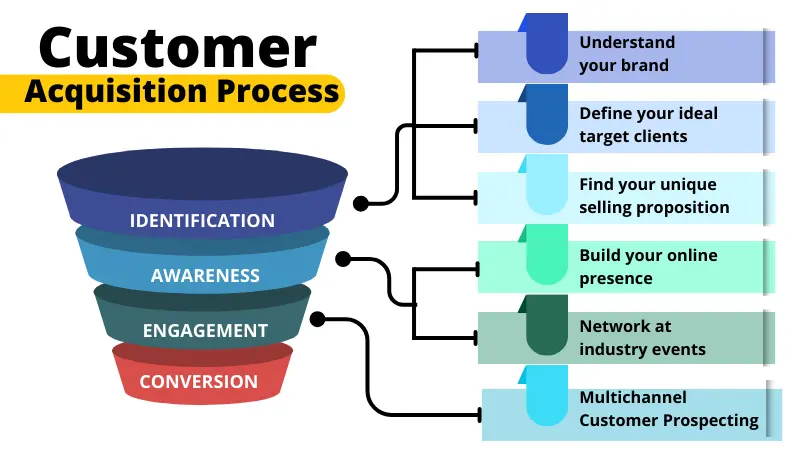
9. How to Find High-Ticket Clients
Now that you know how to price, let's talk about where to find clients who can afford premium prices.
9.1 LinkedIn — Your High-Ticket Goldmine
LinkedIn is where decision-makers hang out. Build your authority by posting valuable content. Engage with your ideal clients. Build relationships before pitching.
9.2 Referrals — Your Warmest Leads
Your existing clients are your best source of new clients. They trust you, and they know other business owners who need your services. Ask for referrals. Most people don't — and they're leaving money on the table.
9.3 Networking — Relationships Over Transactions
High-ticket clients come from relationships, not cold outreach. Attend industry events. Join mastermind groups. Connect with complementary service providers. Build a network that refers business to you.
10. The Bottom Line: Stop Charging by the Hour, Start Charging by the Result
Here's what this all means for you. Your pricing model is keeping you broke. Not your skills. Not your expertise. Your pricing model. The sooner you shift from hourly billing to value-based retainers, the sooner you'll escape the low-ticket trap.
Stop chasing low-retainer clients who undervalue your expertise. Start attracting clients who understand the value of results. Adjusting your pricing model isn't just about numbers — it's about recognizing your worth in the marketplace.
What's your next step?
Frequently Asked Questions (5 Unique FAQs)
❓ 1. How do I determine the right price for a value-based retainer?
Start by calculating the ROI you can deliver for a client. If you can generate $100,000 in revenue, charging $5,000/month is reasonable. The price should be a small fraction of the value you create. Research your competition, but don't use their prices as your ceiling — your value is unique to you.
❓ 2. What if a client insists on hourly billing?
Politely explain that you don't sell time — you sell results. Help them understand that a value-based retainer aligns your incentives with their success. If they still insist on hourly billing, they might not be your ideal client. It's okay to say no.
❓ 3. How do I handle clients who want to negotiate my price?
Be firm but friendly. Explain that your price reflects the value you deliver — not the hours you work. If they push back, ask them: "What would you be willing to invest to achieve [specific result]?" Sometimes clients have their own budget in mind, and you can find a middle ground that still works for you.
❓ 4. What if I lose clients when I raise my prices?
It happens. But here's the thing — the clients you lose are usually the ones who undervalue your services. The clients you attract with higher prices are more committed, easier to work with, and stay longer. In the long run, you'll be more profitable and less stressed.
❓ 5. How long does it take to transition to value-based retainers?
It varies. Some businesses make the shift in a few weeks. Others take a few months. Start by introducing value-based pricing to new clients first, while keeping existing clients on their current pricing. Over time, you can transition existing clients as their contracts renew.
Conclusion: It's Time to Recognize Your Worth
Your pricing model is keeping you broke. Not your skills, not your expertise — your pricing model. The sooner you shift from hourly billing to value-based retainers, the sooner you'll escape the low-ticket trap and build a sustainable, profitable business.
But here's the good news: You already have the expertise clients are looking for. You just need to price it correctly, communicate your value, and attract the right clients who are willing to invest in results.
The choice is yours. Keep chasing low-retainer clients, or start unlocking high-ticket client acquisition.
Join the best Digital Marketing Course to master high-ticket client acquisition and value-based pricing.


