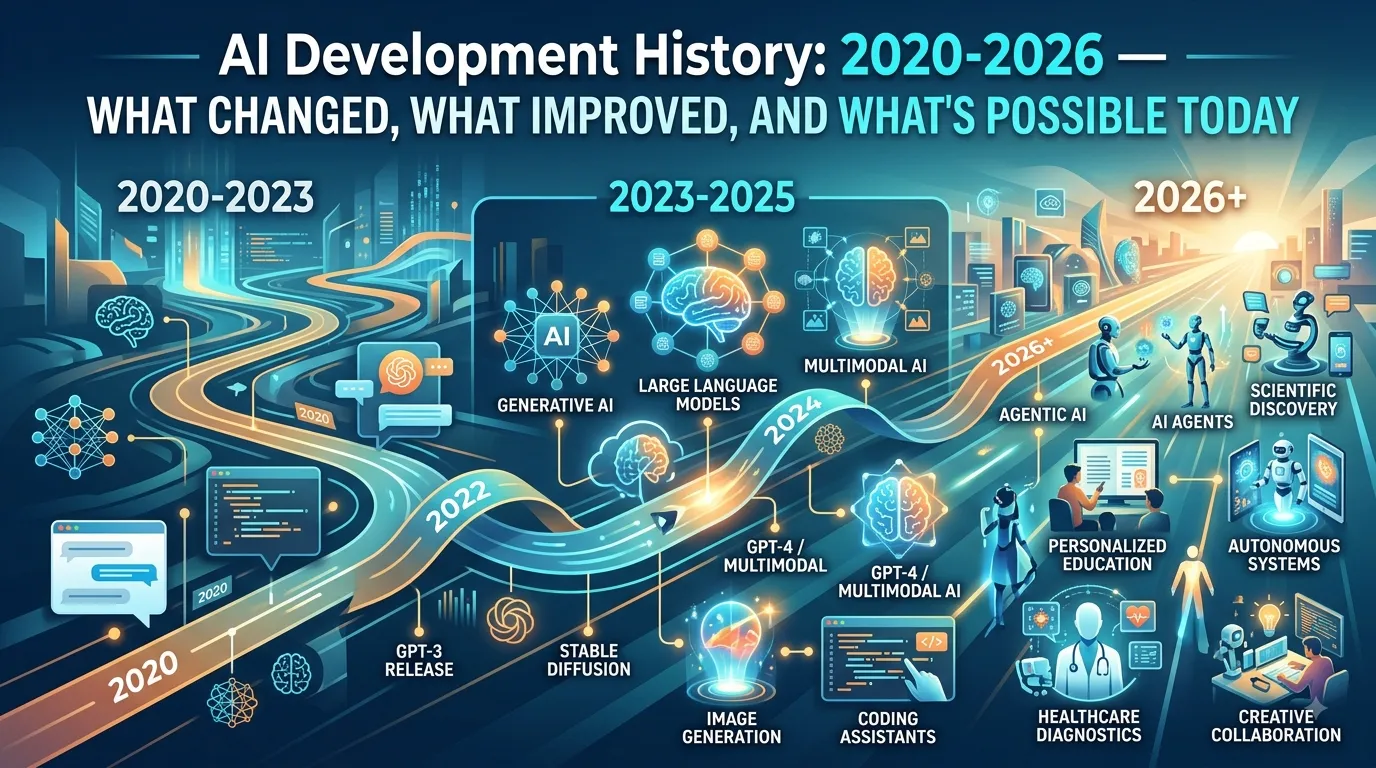
AI Development History: 2020-2026 — What Changed, What Improved, and What's Possible Today
Let me ask you something. Do you remember what AI was like in 2020? If you're like most people, the answer is: "It was... okay. Interesting, but not life-changing."
Fast forward to 2026, and AI is everywhere. It's writing content, generating videos, automating workflows, and powering decisions. The transformation from 2020 to 2026 is nothing short of extraordinary.
In this guide, I'll take you through the AI development history from 2020 to 2026. You'll see what changed, what improved, and what's possible today. Whether you're a digital marketing professional, a business owner, or a student taking a digital marketing course, this journey will show you how far we've come — and where we're going.
Let's dive in.
1. The AI Landscape in 2020: Where It All Started
In 2020, AI was exciting — but limited. It was good at specific tasks, but it wasn't the game-changer it is today.
1.1 The State of AI in 2020
- GPT-3 had just been released. It was impressive but not widely accessible.
- Image generation was basic. DALL-E was in its early stages.
- AI tools were niche. Mostly for developers and researchers.
- Access was limited. Few AI tools were available to the public.
- No-code AI didn't exist. You needed coding skills to use AI.
- AI felt like a novelty. It was good for experimentation — not yet for solving real business problems at scale.
In short: AI was promising but inaccessible.
2. 2021: The Year of Democratization
2021 marked the beginning of AI becoming accessible to everyone.
2.1 What Changed
- OpenAI's Codex was released. This was the foundation for GitHub Copilot, introducing AI-assisted coding to developers.
- DALL-E was introduced. The first major AI image generator that captured the public's imagination.
- More AI tools went public. Tools like Canva AI and Jasper became available.
- AI literacy grew. More people started understanding what AI could do.
- Businesses started experimenting. Companies began testing AI for real-world applications.
2.2 The Catalyst Moment
2021 was the year AI stopped being a developer-only tool and became something anyone could try. It was the spark that ignited the AI revolution.
3. 2022: The Year of Viral AI
2022 was the year AI went mainstream.
3.1 What Changed
- ChatGPT was launched in November 2022. It reached 1 million users in just 5 days.
- Midjourney and Stable Diffusion went public. AI image generation became widely available and user-friendly, unleashing a wave of creativity and experimentation.
- AI became a conversation starter. Everyone was talking about AI.
- Businesses took notice. Companies started investing in AI seriously.
3.2 What Improved
- AI accuracy improved. Both text and image generation became much more accurate and coherent.
- Speed increased. AI responses became faster.
- Access expanded. More free AI tools became available.
3.3 The AI Tipping Point
ChatGPT made AI real for millions of people. It was the moment AI became something people could use daily.
4. 2023: The Year of Explosive Growth
2023 was when AI went from curiosity to necessity.
4.1 What Changed
- GPT-4 was released. The leap in quality and reasoning was significant. It could handle complex tasks much better than its predecessors.
- Bard (now Gemini) was launched. Google entered the AI race.
- AI integration exploded. AI was integrated into hundreds of tools and platforms.
- No-code AI became mainstream. Tools like Make and Zapier integrated AI.
- Claude was released. Anthropic introduced a powerful new AI assistant.
- AI video generation emerged. Tools like Runway and Pika appeared.
- Businesses started adopting AI. AI became a standard part of many workflows.
4.2 What Improved
- Context windows grew. AI could remember and process more information, leading to more coherent and in-depth interactions.
- Multimodal capabilities expanded. AI could handle text, images, and audio together.
- Integration became seamless. AI tools worked better with existing tools.
5. 2024: The Year of AI Maturity
2024 was when AI became a mature, reliable tool.
5.1 What Changed
- AI agents emerged. AI could now take actions, not just generate content. This shift from reactive to proactive AI opened new possibilities for automation and productivity.
- Enterprise adoption surged. Major companies integrated AI into their operations, with 84% of marketers now using AI in their workflows.
- Video generation improved. Tools like Kling and Sora delivered stunning results. AI-generated videos became more realistic, and text-to-speech became indistinguishable from human voices.
- Regulation began. Governments started regulating AI.
5.2 What Improved
- Reliability increased. AI became more consistent and predictable.
- Cost decreased. AI became more affordable.
- Specialization expanded. AI tools for every niche emerged.
- Accuracy improved. RAG made AI more reliable, and reasoning became more logical.
6. 2025: The Year of Agentic AI
2025 was when AI started working autonomously.
6.1 What Changed
- Agentic AI became mainstream. AI could plan, execute, and learn. Companies like Appier and Salesforce integrated agentic AI across their platforms to automate complex workflows.
- Autonomous workflows emerged. AI could run entire workflows without human intervention.
- Multimodal AI improved. Handling text, images, video, and audio became seamless.
- GEO (Generative Engine Optimization) emerged. SEO evolved to focus on AI-optimized content that is referenced and cited by AI models, marking a major paradigm shift.
6.2 What Improved
- Reasoning improved. AI became better at logic.
- Autonomy increased. AI could operate with less human input.
- Integration deepened. AI was woven into every tool.
7. 2026: The Year of AI Ubiquity
Today, AI is everywhere.
7.1 What's Changed
- AI is in every tool. From email to spreadsheets to design tools, AI powers nearly every application.
- Agentic workflows are standard. AI handles entire processes, from lead generation to customer support.
- Multimodal AI is seamless. Models like Qwen and Gemini can understand and generate multiple forms of content.
- Zero-click search is dominant. AI answers questions directly, bypassing websites, leading to a fundamental change in how businesses approach visibility and authority.
- GEO is the new SEO. Optimizing for AI visibility is essential.
- AI is democratized. Powerful AI tools are free and accessible to everyone.
7.2 What's Possible Today
- Build AI agents without coding. Platforms like Voiceflow and Make let you create autonomous agents with no coding required.
- Generate professional videos from text. Tools like Kling, Google Flow, and Qwen let you create realistic video content from simple prompts.
- Automate entire workflows. AI agents can handle end-to-end processes, from lead capture to customer support, on autopilot.
- Personalize at scale. AI delivers tailored experiences to millions of customers simultaneously.
- Create content in minutes. AI can generate text, images, videos, and more — all from a single prompt.
- Analyze data instantly. AI can process vast amounts of data and deliver actionable insights.
8. Key Improvements from 2020 to 2026
Here's a summary of what improved over the past six years.
| Aspect | 2020 | 2026 |
|---|---|---|
| Access | Limited, mostly for developers | Universal, everyone can use AI |
| Cost | Expensive, only for large companies | Free or affordable for everyone |
| Capability | Basic text and limited image generation | Text, image, video, audio, reasoning, and autonomous action |
| Reliability | Often inaccurate or inconsistent | Highly accurate and reliable |
| Integration | Standalone tools | Integrated into every workflow |
| Autonomy | Reactive, needed constant human input | Agentic, can act and execute tasks independently |
9. What's Possible Today That Wasn't in 2020
Here's a list of what you can do today with AI that was impossible six years ago.
- ✅ Generate a professional video from a text prompt
- ✅ Build an AI agent that works autonomously
- ✅ Automate entire business workflows
- ✅ Personalize content for millions of customers
- ✅ Get answers from AI in seconds
- ✅ Translate languages in real-time
- ✅ Create professional designs without design skills
- ✅ Analyze massive datasets in minutes
- ✅ Write code without knowing how to code
- ✅ Create content in any format from a single prompt
10. Conclusion: From Curiosity to Necessity
The journey from 2020 to 2026 is extraordinary. In just six years, AI went from a curiosity to an essential tool. It's now integrated into everything we do — from digital marketing to content creation to business operations. The tools we have today were unimaginable in 2020.
But here's the good news: This is just the beginning. The pace of change is accelerating. The next six years will bring even more transformation. The best time to learn AI was yesterday. The second best time is now.
The choice is yours. Watch from the sidelines, or start mastering AI today.
Join the best Digital Marketing Course to master AI-powered marketing and stay ahead in 2026 and beyond.
Frequently Asked Questions (5 Unique FAQs)
❓ 1. What was the biggest breakthrough in AI between 2020 and 2026?
The biggest breakthrough was the shift from generative AI to agentic AI. In 2020, AI could generate text and images. In 2026, AI can plan, execute, and learn autonomously — it's no longer just a tool, but a capable teammate.
❓ 2. How has AI video generation improved since 2020?
In 2020, AI video generation was experimental and low-quality. Today, tools like Kling, Google Flow, and Qwen create photorealistic, cinematic videos from simple text prompts. It's now possible to generate professional video content in minutes.
❓ 3. Can AI really work autonomously in 2026?
Yes. Agentic AI can plan, execute, and learn without constant human intervention. It can handle entire workflows — from lead generation to customer support — on autopilot.
❓ 4. What skills do I need to use AI in 2026?
You don't need coding skills. AI literacy — understanding what AI can and can't do — is essential. Prompt engineering, strategic thinking, and human-AI collaboration are the skills that matter most. You can learn these through hands-on experience and structured learning.
❓ 5. What's next for AI beyond 2026?
We can expect even more autonomy, deeper integration into every aspect of life and work, and continued improvements in reasoning and creativity. AI will become even more accessible and powerful. The future is bright, and the pace of change is only accelerating.