Let me ask you something. How many leads are you generating right now? And more importantly—how many of those leads actually convert?
If you're like most businesses, the answer is: "Not enough, and not nearly enough." Lead generation is the lifeblood of any business. But traditional lead generation is slow, expensive, and inconsistent. You're spending too much time chasing leads that don't convert.
Here's the good news: AI changes everything. You can build a lead generation machine that works 24/7, automatically, without burning out your team. And you can do it in just 30 days.
In this guide, I'll show you exactly how to build a lead generation machine with AI in 30 days. Whether you're a digital marketing professional, a business owner, or a student taking a digital marketing course, this is your step-by-step blueprint for generating qualified leads on autopilot.
Let's dive in.
1. Why Traditional Lead Generation Is Broken
Before we get into the solution, let's understand the problem.
1.1 The Old Way
- Cold outreach with generic messages
- Manual lead research and data entry
- Inconsistent follow-ups
- No personalization at scale
- Relies on human effort and time
1.2 Why It Fails
- Inefficient: You spend hours on research and outreach with low ROI
- Inconsistent: Quality varies based on who's doing the work
- Not scalable: You can only do so much manually
- Expensive: Hiring a lead generation team is costly
The shift: AI automates the research, personalization, and follow-up—leaving you to focus on building relationships and closing deals.
2. The AI-Powered Lead Generation Framework
Here's the framework that will power your 30-day journey.
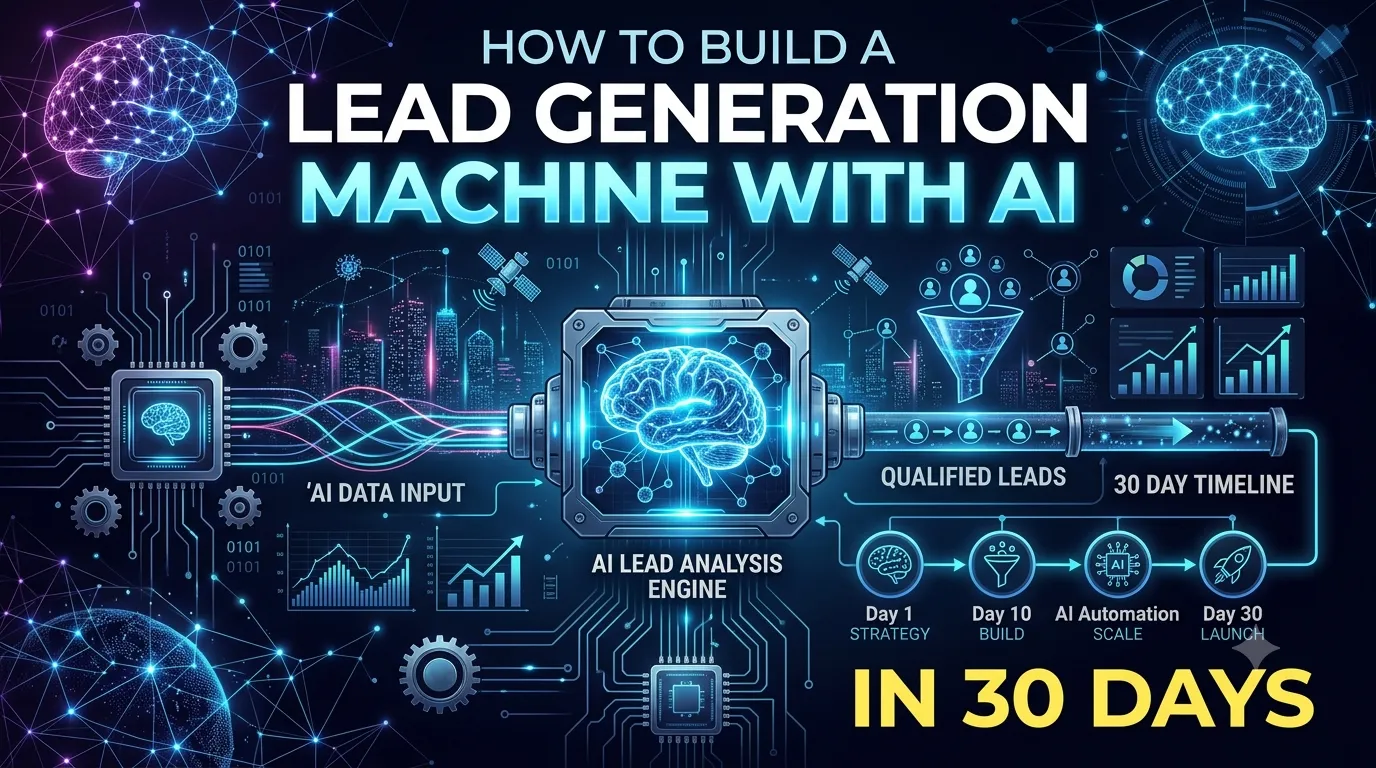
2.1 The 4-Stage Lead Generation Loop
- Stage 1: Identify — Find and qualify leads
- Stage 2: Engage — Personalize outreach at scale
- Stage 3: Nurture — Build trust and relationships
- Stage 4: Convert — Turn leads into customers
AI supercharges every stage—from finding leads to nurturing them to closing the deal.
3. The AI Tools You'll Need
Here are the essential AI tools for your lead generation machine.
- For lead research: ChatGPT, Claude (research and lead enrichment)
- For outreach: Reply.io, Instantly (AI-powered email sequences)
- For engagement: LinkedIn Sales Navigator (AI-powered prospecting)
- For nurturing: Mailchimp, Klaviyo (AI-powered email marketing)
- For CRM: HubSpot, Salesforce (AI-powered lead management)
- For personalization: ChatGPT, Claude (personalized messaging at scale)

4. Week 1: Build Your Foundation
In the first week, you'll set up the infrastructure for your lead generation machine.
Day 1-2: Define Your Ideal Customer Profile (ICP)
Before you generate leads, you need to know who you're targeting. Use AI to help you define your ICP.
AI Prompt: "Create a detailed ideal customer profile for [your business]. Include demographics, psychographics, pain points, and where they spend time online."
Day 3-4: Set Up Your Tech Stack
- Email outreach: Set up Reply.io or Instantly
- CRM: Set up HubSpot or Salesforce
- Lead research: Set up LinkedIn Sales Navigator
- Email marketing: Set up Mailchimp or Klaviyo
Day 5-7: Create Your Lead Generation Templates
- Outreach templates: Use AI to generate email sequences, LinkedIn messages, and scripts
- Nurturing sequences: Create email sequences for different lead segments
- Follow-up sequences: Automated follow-ups for leads who don't respond
AI Prompt: "Generate 5 email templates for cold outreach to [target audience]. Include subject lines, body copy, and calls to action. Make them personalized, conversational, and value-driven."
Week 1 Checkpoint: You have your ICP defined, tech stack set up, and templates ready. You're ready to start lead generation.
5. Week 2: Build Your Lead List
In the second week, you'll build a list of qualified leads to target.
Day 8-10: Identify Leads Using AI Tools
- Use LinkedIn Sales Navigator to find leads
- Use AI to enrich lead data and research
- Build a targeted list of 500-1,000 leads
Day 11-14: Segment and Score Leads
- Segment leads by industry, job title, pain point
- Use AI to score leads based on fit and engagement
- Prioritize high-quality leads
AI Prompt: "Analyze this lead list and score each lead from 1-10 based on fit for my ideal customer profile."
Week 2 Checkpoint: You have 500+ qualified leads ready for outreach.
6. Week 3: Launch Your Outreach
In the third week, you'll start engaging leads with personalized outreach.
Day 15-18: Launch Your First Campaign
- Launch your email sequence with Reply.io or Instantly
- Send personalized LinkedIn messages
- Track open rates, reply rates, and engagement
AI Prompt: "Personalize this outreach message for [lead name] at [company]. Reference their role, recent activity, and why my solution can help them."
Day 19-21: Monitor and Optimize
- Monitor performance metrics
- Use AI to generate follow-up variations
- Optimize based on what's working
AI Prompt: "My email sequence has a 20% open rate and 5% reply rate. Suggest improvements to increase open rates."
Week 3 Checkpoint: You have active campaigns running and are getting real replies.
7. Week 4: Nurture and Convert
In the final week, you'll nurture leads and convert them into customers.
Day 22-25: Nurture Warm Leads
- Set up automated nurturing sequences in Mailchimp or Klaviyo
- Use AI to personalize follow-up content
- Track lead engagement and interest
Day 26-28: Convert Leads
- Identify leads ready to convert
- Use AI to generate closing messages
- Offer consultations, demos, or special offers
AI Prompt: "Generate a closing message for a lead who has engaged with our content and expressed interest in [solution]."
Day 29-30: Review and Plan
- Review your lead generation machine's performance
- Identify what worked and what didn't
- Plan how to scale
Week 4 Checkpoint: Your lead generation machine is operational and generating leads. You've built a system that works.
8. Real-World Example: The Lead Generation Transformation
Here's how a digital marketing agency used this framework to build a lead generation machine:
- Before: Generating 5-10 leads per month, manually, with inconsistent quality
- After 30 days: Generating 50-100 qualified leads per month, automatically, with consistent quality
- Result: 10x more leads, less team effort, higher conversion rates
9. Conclusion: Build Your Lead Generation Machine Today
Lead generation doesn't have to be slow, expensive, or inconsistent. With AI, you can build a machine that generates qualified leads automatically—24/7. The 30-day plan I've shared gives you everything you need to get started.
But here's the good news: You can start today. Week 1, Day 1. Define your ICP. Set up your tech stack. Start building. The sooner you start, the sooner you'll have a lead generation machine that works for you.
The choice is yours. Keep doing lead generation the old way, or start building your AI-powered lead generation machine.
Join the best Digital Marketing Course to master AI-powered lead generation and digital marketing in 2026.
Frequently Asked Questions (5 Unique FAQs)
❓ 1. Can AI really generate qualified leads?
Yes. AI can research, identify, and qualify leads faster and more accurately than humans. It analyzes data to find the best-fit prospects and personalizes outreach at scale.
❓ 2. How much does it cost to build an AI-powered lead generation machine?
It depends on the tools you choose. Some tools are free (ChatGPT, Mailchimp free tier). Paid tools range from $20-$200/month. Total cost can be as low as $50/month or as high as $500/month for enterprise solutions.
❓ 3. Can I do this without a large team?
Yes. The whole point of building an AI-powered lead generation machine is to reduce the need for a large team. One person can manage the entire process with the right AI tools.
❓ 4. How do I know if my lead generation machine is working?
Track key metrics: number of leads, lead quality, reply rate, conversion rate, and cost per lead. If these metrics are improving, your machine is working. AI can help you track and optimize all of these metrics.
❓ 5. Can I build a lead generation machine for any industry?
Yes. AI-powered lead generation works across industries—B2B, B2C, SaaS, services, ecommerce, and more. The framework is the same: define your ICP, find leads, engage, nurture, and convert.