Let me ask you something. Have you ever had an idea for a software product but stopped because you thought: "I can't code, so I can't build it"?
If you're like most entrepreneurs, creators, and digital marketing professionals, the answer is: "Yes. All the time." The belief that you need to be a developer to build software is one of the biggest myths holding people back. Here's the truth: You don't need to code to build a profitable software product.
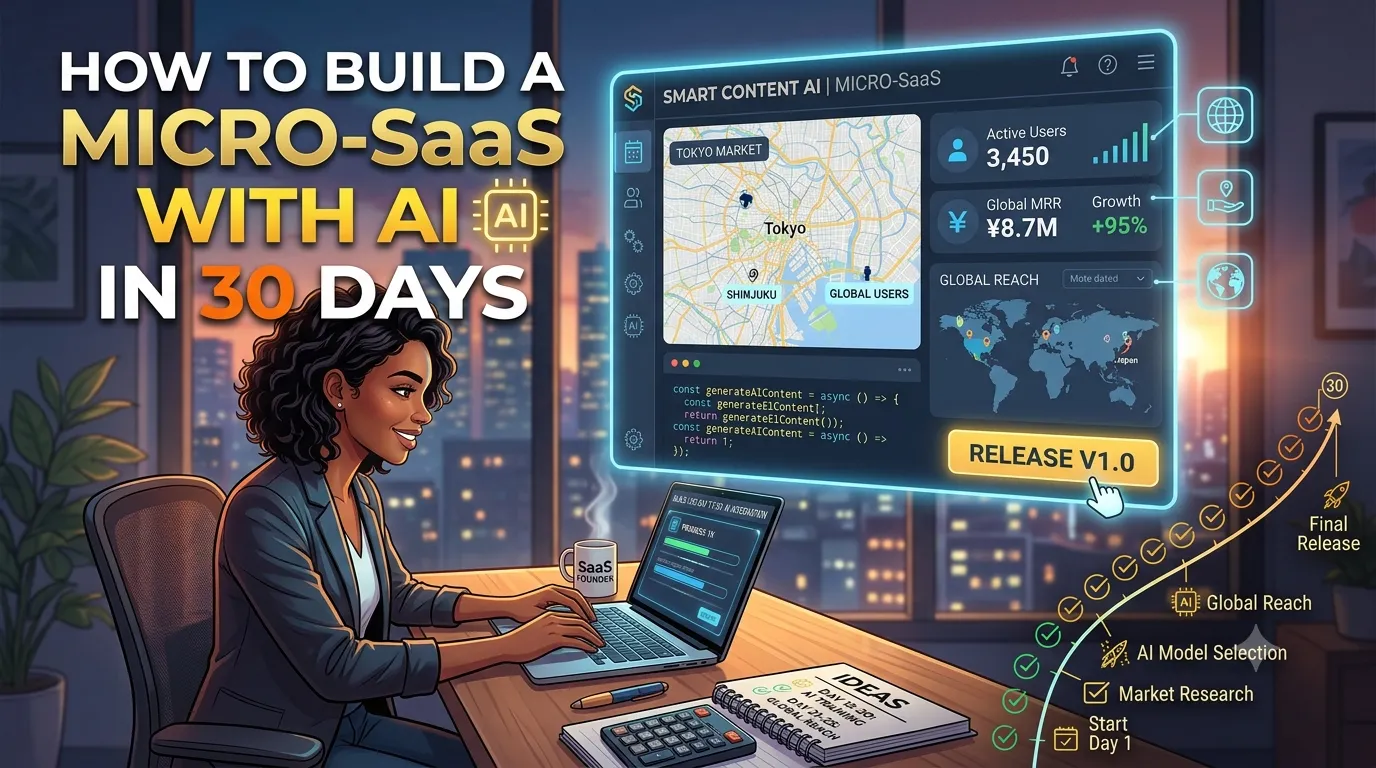
In 2026, AI and no-code tools have made it possible for anyone to build a Micro-SaaS—a small, focused software product that solves a specific problem—in just 30 days. In this guide, I'll show you exactly how to build a Micro-SaaS with AI in 30 days.
Whether you're a digital marketing professional, a business owner, or a student taking a digital marketing course, this is your blueprint for building a software business—without writing a single line of code.
Let's dive in.
1. What Is Micro-SaaS?
Before we get into the how, let's define what Micro-SaaS actually is.
1.1 The Definition
Micro-SaaS is a small, focused software-as-a-service product. Unlike traditional SaaS, which tries to solve many problems for many people, Micro-SaaS solves one problem for a specific audience.
1.2 Why Micro-SaaS Is Booming
- Low barrier to entry: No coding required with AI and no-code tools
- Fast to build: You can launch in weeks, not months
- Low cost: Minimal investment to get started
- Scalable: Software scales without hiring more people
- Profitable: Recurring revenue from subscriptions
1.3 Examples of Micro-SaaS
- A tool that generates social media captions for a specific industry
- A tool that creates invoices for freelancers in a specific niche
- A tool that analyzes SEO for local businesses
- A tool that generates product descriptions for ecommerce stores
2. The 30-Day Micro-SaaS Roadmap
Here's your week-by-week plan for building a Micro-SaaS in 30 days.
Week 1: Ideation and Validation
- Day 1-2: Identify a problem you can solve
- Day 3-4: Validate demand with research
- Day 5-6: Define your target audience
- Day 7: Finalize your idea and value proposition
Week 2: Design and Build
- Day 8-10: Design the user experience
- Day 11-13: Build the core functionality
- Day 14: Test and refine
Week 3: Launch Preparation
- Day 15-17: Create your landing page
- Day 18-20: Set up pricing and payment
- Day 21: Prepare marketing materials
Week 4: Launch and Grow
- Day 22-24: Launch your product
- Day 25-27: Promote and get your first users
- Day 28-30: Gather feedback and iterate
3. Week 1: Ideation and Validation
The first week is about finding the right idea and validating it.
3.1 Find a Problem Worth Solving
Great Micro-SaaS products solve a specific, painful problem. Use AI to identify problems in your niche.
AI Prompt: "What are the biggest pain points for [target audience] in [industry]? List 10 problems they face daily."
3.2 Validate Demand
Before you build, validate that people will pay for your solution. Use AI to research competitors and demand.
AI Prompt: "Analyze the market for [product idea]. Who are the competitors? What are they charging? Is there demand?"
3.3 Define Your Target Audience
Get crystal clear on who you're building for. The more specific, the better.
AI Prompt: "Create a detailed customer profile for [product idea]. Include demographics, pain points, goals, and where they spend time online."
3.4 Craft Your Value Proposition
Your value proposition is the one-sentence reason someone should use your product.
AI Prompt: "Write a compelling value proposition for [product idea]. Focus on the specific benefit and target audience."
4. Week 2: Design and Build
The second week is about bringing your idea to life.
4.1 Design the User Experience
Keep it simple. Focus on the core functionality. Use AI to generate design ideas and user flows.
AI Prompt: "Design a simple user flow for [product idea]. Include the main steps a user takes to get value from the product."
4.2 Build the Core Functionality
Use AI and no-code tools to build your product. Don't try to build everything at once—focus on the core functionality that delivers value.
4.3 The Best No-Code AI Tools for Building Micro-SaaS
- Bubble: Build web apps without coding
- Glide: Build apps from spreadsheets
- Softr: Build web apps and portals
- Airtable: Database and workflow automation
- Make (Integromat): Automation and integration
- Zapier: Connect apps and automate workflows
- ChatGPT/Claude: Generate content and code snippets
4.4 Test and Refine
Test your product with real users. Gather feedback and iterate. Don't wait for perfection—launch and improve.
5. Week 3: Launch Preparation
The third week is about getting ready to launch.
5.1 Create Your Landing Page
Your landing page is where you'll convert visitors into users. Use AI to write compelling copy.
AI Prompt: "Write a landing page for [product idea]. Include a headline, problem, solution, benefits, testimonials, and call to action."
5.2 Set Up Pricing and Payments
Decide on your pricing model (subscription, one-time, freemium). Set up payments with Stripe or PayPal.
AI Prompt: "Suggest a pricing strategy for [product idea]. Include tiers, price points, and what each tier offers."
5.3 Prepare Marketing Materials
Create your launch assets: social media posts, emails, and outreach messages.
AI Prompt: "Create a 30-day launch plan for [product idea]. Include social media posts, emails, and outreach messages."
6. Week 4: Launch and Grow
The final week is about launching and getting your first users.
6.1 Launch Your Product
- Announce on social media
- Email your network
- Post on relevant communities (Reddit, Indie Hackers, Product Hunt)
- Reach out to potential users directly
6.2 Get Your First Users
- Offer a free trial or discount for early adopters
- Ask for feedback and testimonials
- Iterate based on user input
- Focus on delivering value
6.3 Gather Feedback and Iterate
Your first version won't be perfect. Talk to users, understand their needs, and improve your product.
AI Prompt: "Analyze this user feedback. What are the common themes? What should I prioritize improving?"
6.4 Plan for Growth
- Identify your most successful acquisition channels
- Double down on what's working
- Add new features based on user requests
- Scale your marketing
7. Real-World Example: The 30-Day Micro-SaaS Launch
Here's how a digital marketing professional built a Micro-SaaS in 30 days:
- Idea: A tool that generates SEO-optimized product descriptions for ecommerce stores.
- Week 1: Validated demand by talking to ecommerce store owners. Found they struggled with writing unique descriptions.
- Week 2: Built the tool using Bubble and ChatGPT API. Users could input product details and get SEO-optimized descriptions.
- Week 3: Created a landing page and set up Stripe payments. Prepared launch materials.
- Week 4: Launched on Product Hunt and social media. Got first 50 users and $1,000 MRR in the first month.
8. Conclusion: Build Your Micro-SaaS in 30 Days
You don't need to code to build a profitable software product. AI and no-code tools have made it possible for anyone to build a Micro-SaaS in 30 days. You can validate an idea, build a product, launch it, and get your first users—all without writing a single line of code.
But here's the good news: You can start today. Identify one problem. Validate demand. Build a simple solution. Launch. Small steps lead to big results.
The choice is yours. Keep thinking you can't build software, or start building your Micro-SaaS with AI.
Join the best Digital Marketing Course to master AI-powered entrepreneurship and digital marketing in 2026.
Frequently Asked Questions (5 Unique FAQs)
❓ 1. Do I really need no coding to build a Micro-SaaS?
No. Platforms like Bubble, Glide, and Softr allow you to build functional web apps without coding. AI tools like ChatGPT can help you generate content, code snippets, and even entire features.
❓ 2. How much does it cost to build a Micro-SaaS?
You can start for free using free tiers of no-code tools. Paid plans start at around $20-$50/month. Your main investment is time and effort, not money.
❓ 3. How do I find a good Micro-SaaS idea?
Look for problems you've experienced or observed. Use AI to research pain points in your niche. Validate demand by talking to potential users before building.
❓ 4. How do I get my first users?
Launch on Product Hunt, Indie Hackers, and Reddit. Share on social media. Reach out to potential users directly. Offer a free trial or discount for early adopters. Ask for feedback and iterate.
❓ 5. Can I really build a profitable business with Micro-SaaS?
Yes. Many Micro-SaaS founders build profitable, sustainable businesses. The key is solving a specific problem for a specific audience and delivering value consistently.