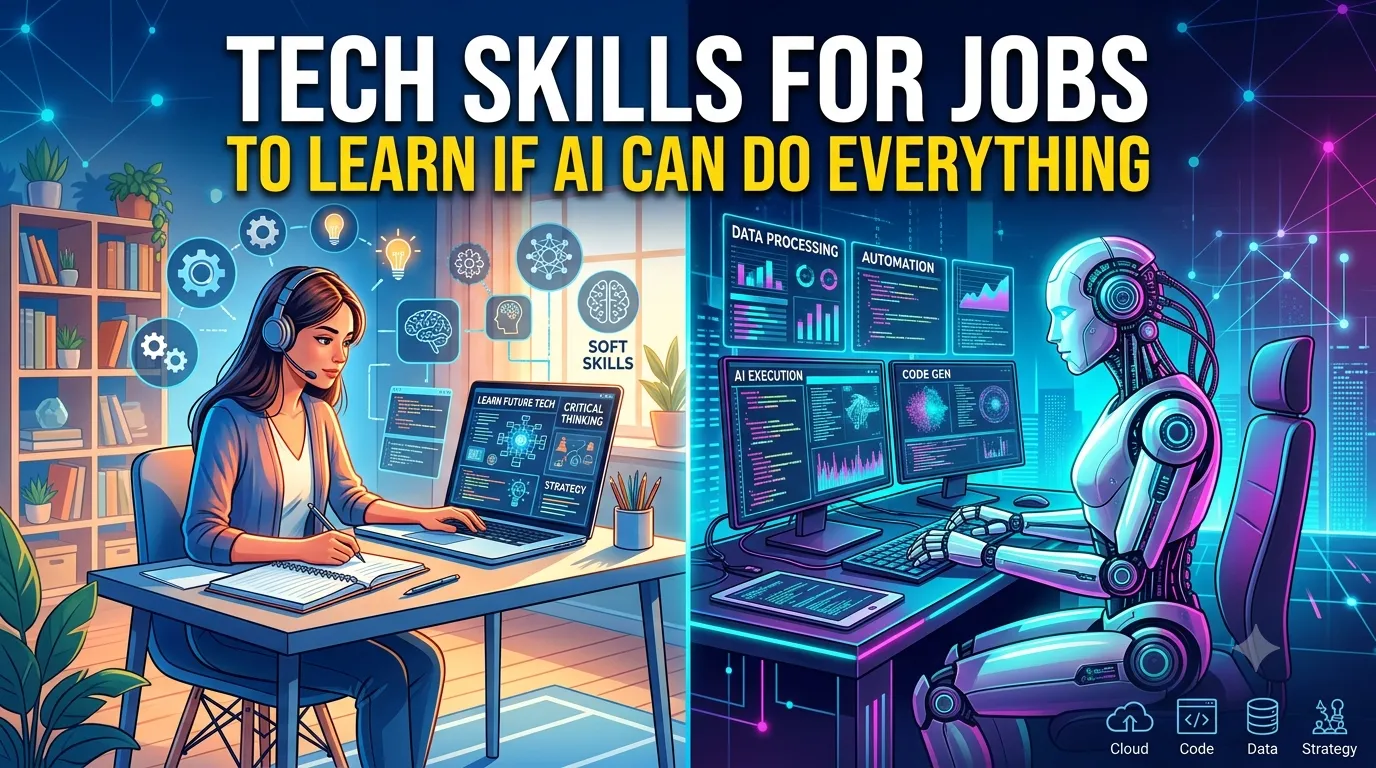
Let me ask you something. Have you ever looked at an AI tool and thought: "Why should I learn to code when AI can just do it for me?"
You're not alone. This is the biggest question in 2026. AI can write code, design graphics, generate content, and even analyze data. So what skills are actually worth learning?
Here's the truth: The skills worth learning are the ones AI cannot replicate. Not the syntax, not the execution — the thinking. The strategic thinking. The systems thinking. The ability to ask the right questions, design the right architectures, and solve problems that don't have clear answers.
In this guide, I'll show you exactly what tech skills for jobs to learn if AI can do everything. These are the skills that will make you irreplaceable, not outdated. Whether you're a digital marketing professional, a career-changer, or a student taking a digital marketing course, this is your roadmap to the future of work.
Let's dive in.
1. The AI Paradox: More Tools = More Human Value
Here's the irony. As AI gets better at doing things, the value of human thinking increases. Not decreases. When everyone can execute, the differentiator becomes who can think better — who can see the bigger picture, who can connect the dots, who can ask the right questions.
The most valuable people in 2026 aren't the best coders or the fastest designers. They're the people who can:
- Identify the right problems to solve
- Design systems that combine human + AI strengths
- Translate business needs into technical solutions
- Make judgment calls when there's no clear right answer
2. The Skills AI Cannot Replicate
2.1 Systems Thinking
AI is good at executing within a defined system. It's bad at designing systems. Systems thinking is the ability to understand how different parts of a system interact, identify leverage points, and design solutions that work holistically.
This skill is essential for architects, engineers, product managers, and anyone who builds complex solutions.
Why AI can't replace it: AI doesn't understand context, relationships, or trade-offs at a systems level. It can analyze individual components but can't optimize the whole.
2.2 Strategic Problem Definition
The most important skill in the AI era is knowing what problem to solve. AI is excellent at solving problems you give it. But it can't determine which problems are worth solving.
This skill involves:
- Identifying root causes, not just symptoms
- Prioritizing problems based on business impact
- Framing problems in a way that leads to good solutions
Why AI can't replace it: Problem definition requires business context, stakeholder understanding, and strategic thinking that AI simply doesn't possess.
2.3 Human-AI Collaboration
In 2026, work is about collaboration between humans and AI. The ability to orchestrate this collaboration is a highly valuable skill.
This includes:
- Knowing which tasks to delegate to AI and which to keep for yourself
- Designing workflows that combine human and AI strengths
- Evaluating and critiquing AI output
Why AI can't replace it: AI can't orchestrate its own collaboration with humans. It needs humans to guide, direct, and evaluate.
2.4 Creative Problem-Solving
AI is excellent at generating variations on existing ideas. It's terrible at generating genuinely novel ideas that break paradigms.
Creative problem-solving involves:
- Connecting seemingly unrelated domains
- Generating solutions that don't exist yet
- Thinking outside existing mental models
Why AI can't replace it: AI works with patterns in existing data. It can't create something truly new that doesn't have precedent.
2.5 Ethical Judgment
AI has no ethical compass. It doesn't understand fairness, accountability, or the impact of its outputs on real people.
This skill involves:
- Evaluating the ethical implications of technology
- Ensuring AI systems are fair and unbiased
- Making decisions that balance competing values
Why AI can't replace it: Ethics requires human values, context, and judgment. AI can be programmed with rules, but it can't understand or navigate moral complexity.
3. Tech Skills That Are Still Worth Learning
Here are the technical skills that remain valuable — but with a twist. You're not learning them to execute; you're learning them to understand, evaluate, and collaborate.
3.1 Prompt Engineering and AI Orchestration
This is the skill of designing effective prompts and orchestrating multiple AI tools to achieve complex goals. It's not about "writing better prompts" — it's about designing workflows that combine AI capabilities.
Why it matters: AI is powerful, but it needs direction. The person who can orchestrate multiple AI tools into a coherent workflow is invaluable.
What to learn: Chain-of-thought prompting, multi-step workflows, combining different AI tools, evaluation and iteration.
3.2 Data Literacy and Interpretation
AI can generate insights, but it can't tell you what they mean or how to act on them. Data literacy is the ability to understand, interpret, and make decisions based on data.
Why it matters: Data is the fuel for AI. But raw data is useless without interpretation. The person who can understand and act on data insights is essential.
What to learn: Basic statistics, data visualization, understanding metrics and KPIs, avoiding common analytical traps.
3.3 Architecture and Integration
AI can generate code, but it can't design scalable, secure, maintainable systems. This skill is about understanding how different components fit together and designing solutions that work at scale.
Why it matters: Building a small prototype is easy. Building something that works for thousands of users, integrates with existing systems, and is secure and maintainable — that's hard. AI can't do it alone.
What to learn: System design, API design, database architecture, security fundamentals, cloud architecture, microservices, scalability, and performance optimization.
3.4 Security and Privacy Fundamentals
AI can code, but it can't think like a security analyst. It doesn't understand attack vectors, threat modeling, or privacy compliance. Every AI-generated system needs human oversight to be secure.
Why it matters: Security breaches are expensive and damaging. The person who ensures systems are secure and compliant is essential.
What to learn: Secure coding practices, authentication and authorization, data protection, privacy regulations (GDPR, CCPA), and threat modeling.
3.5 Project Management and Agile Methodologies
AI can't manage projects. It can't coordinate teams, track progress, manage stakeholders, or adapt to changing requirements. Project management is a distinctly human skill that remains essential.
Why it matters: Software projects still need leadership, coordination, and adaptability.
What to learn: Agile, Scrum, Kanban, stakeholder management, project planning, and risk management.
4. The "Human AI Stack" Framework
Here's a framework to think about your skills in the AI era. I call it the "Human AI Stack."
- Layer 1: AI Execution — AI does the work
- Layer 2: AI Orchestration — Humans design workflows that combine AI tools
- Layer 3: Problem Definition — Humans identify what problems to solve
- Layer 4: Strategy and Vision — Humans set direction and goals
- Layer 5: Ethics and Values — Humans ensure technology serves people
The higher up the stack you operate, the more valuable you are. And the harder it is for AI to replace you.
5. Real-World Example: The AI-Ready Digital Marketer
Let's see what this looks like in practice. A digital marketing professional in 2026 doesn't just create content — they orchestrate a system that combines AI tools to create, distribute, and optimize content.
- AI does: Generate draft content, create visuals, optimize headlines, schedule posts
- Human does: Set strategy, define audience segments, review and edit content, interpret data, make judgment calls, and provide emotional connection
This marketer is more valuable than someone who just uses AI tools. They're designing the system, not just executing within it.
6. How to Learn These Skills
Here's how to develop the skills that AI can't replicate.
6.1 Learn by Building
Build projects that combine AI and human effort. Create a chatbot, build a workflow automation, develop a research assistant. The process of building and orchestrating is the best teacher.
6.2 Study Systems, Not Just Tools
Read about system architecture, design patterns, and integration strategies. Understand how different components fit together. This is where AI is weakest.
6.3 Practice Problem Definition
Start with a problem, not a tool. Ask: "What's the real problem here?" before thinking about solutions. This is the skill that AI can't replicate.
6.4 Develop Your Human Skills
Communication, empathy, collaboration, and leadership are more valuable than ever. These are the skills that make you irreplaceable.
7. Conclusion: Stop Learning Syntax, Start Learning Systems
The days of learning syntax for syntax's sake are over. If you're learning to code just to code, you're competing with AI. And you will lose.
But here's the good news: You don't need to compete with AI. You need to complement it. Focus on what AI cannot do: systems thinking, problem definition, human-AI collaboration, creative problem-solving, and ethical judgment.
The choice is yours. Keep learning skills that AI can replicate, or start developing skills that make you irreplaceable.
Join the best Digital Marketing Course to master AI-powered digital marketing and future-proof your career.
Frequently Asked Questions (5 Unique FAQs)
❓ 1. Is learning to code still worth it if AI can code?
Yes — but not to code. Learn to code so you can understand, evaluate, and collaborate with AI-generated code. The value is in understanding what's happening, not in typing syntax.
❓ 2. What's the most valuable technical skill in the AI era?
Prompt engineering and AI orchestration. The ability to design workflows that combine multiple AI tools to achieve complex goals is a highly valuable skill that AI cannot replicate.
❓ 3. Should I still learn data science and analytics?
Yes — but focus on interpretation and decision-making, not just analysis. AI can analyze data; it can't tell you what it means in your specific context.
❓ 4. What non-technical skills matter most now?
Problem definition, strategic thinking, communication, empathy, and ethical judgment. These are the skills that make you irreplaceable.
❓ 5. How do I stay relevant as AI capabilities grow?
Focus on the high-level skills — systems thinking, problem definition, strategy. Move up the "Human AI Stack." The higher you operate, the harder you are to replace.